







HR Technology
The room of requirement for HR: AI as the tool we didn't know we needed





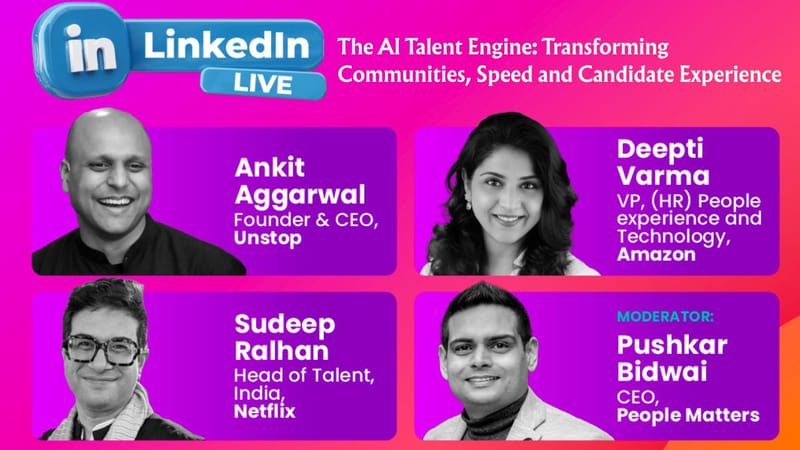
Explore how AI is transforming HR into a high-speed, human-centric talent engine, with insights from Netflix, Unstop, and TechHR 2025.
What happens when HR stops doing AI and starts thinking in AI?
The hands of HR are reaching for patterns, tracing the pulse of a growing AI Talent Engine. As AI embeds itself deeper into the organisational fabric, talent leaders are no longer asking if it will change the game, but how fast, how deeply, and how humanely. However, with legacy systems, fragmented experiences, and rising candidate expectations, how can organisations truly harness the full potential of intelligent talent systems?
This very question anchored the recent People Matters LinkedIn LIVE conversation, The AI-Talent Engine: Transforming Communities, Speed & Experience. The session brought together Sudeep Ralhan, Head of Talent, India, at Netflix, and Ankit Aggarwal, Founder & CEO of Unstop, in a conversation moderated by Pushkar Bidwai, CEO of People Matters. Offering a compelling preview of the themes that will shape People Matters TechHR India 2025, the discussion explored how organisations can decode the next frontier of AI-powered, human-first work design.
Where we are now: Automation with awareness
Pushkar Bidwai kicked off the session by posing the question:
"What does the AI Talent Engine look like today, and what could it become across community, velocity, and experience?"
Sudeep Ralhan responded by identifying a clear trend among forward-looking companies: the use of HR maturity models to assess their AI readiness. Most organisations today, he noted, are at stage 2 or 3, where AI is primarily used for process automation and efficiency, automating resume screening, standardising workflows, and creating consistency in high-volume tasks. But the real transformation lies ahead.
“Most organisations have developed their own HR maturity models. We’re seeing a clear shift with HR no longer just being efficient and process-driven; it’s becoming increasingly proactive. Many teams are now progressing toward stages 4 and 5, where strategic impact and agility take centre stage," says Sudeep Ralhan, Head of Talent, India, Netflix.
To put it another way, intelligent workforce design driven by AI engines that can think, learn, and adapt is the next frontier, not just improved HR processes.
The infrastructure challenge: Legacy systems & data gaps
Venturing deeper into panel insight, Pushkar posed a key question:
“What challenges do you see in introducing AI to past models? Do we need a completely new drawing board?”
Ankit Aggarwal weighed in with a candidate-first perspective. He highlighted the realities of legacy systems, deeply embedded and often resistant to fast change. Yet, it’s exactly those systems that contribute to broken feedback loops and ghosting in recruitment. A candidate might go weeks without hearing back, not because of intent, but because the system doesn’t allow for it. AI, if implemented with empathy, could change that.
“Legacy systems are situational. We can’t overturn all of them overnight, but we can start by solving for real pain points. Every candidate complains about ghosting and a lack of feedback after rejection. Our current systems simply don’t support solving that.”
He shared how candidate engagement in the pre-joining phase can act as a predictive signal. If there’s no interaction in the months after the offer rollout, the chance of the candidate actually joining can be less than 10%. With AI reading the signals in behaviour patterns, organisations can intervene early, personalise outreach, and adjust expectations.
“Feedback systems are a work in progress, but this is where AI can truly change the game.”
Predictive insights: From intent to action
Sudeep offered a candid assessment drawn from his experience at Netflix, where AI is already reshaping the entertainment space, from generative visuals in shows to real-time recommendation interfaces. But he warned that many organisations risk falling behind by treating AI as a standalone IT project rather than a core business transformation.
“AI needs to be integrated into processes. Data is the biggest risk. The quality, accuracy, historical biases, and mislabeling are major hurdles. And our legacy systems, layered over decades, often aren’t equipped to handle that.”
A major theme that emerged was this: most AI tools in talent acquisition are optimised for process efficiency, while internal systems focus on employee experience. The gap? They rarely talk to each other.
Sudeep summed it up:
“We’re missing the magic that happens when process intelligence and experience design converge. If we can integrate both, we unlock a more seamless, human-centred talent journey. In HR, we’ve gotten wrapped up in systems stacked on top of systems. I don’t think there’s a single right answer, but ignoring it isn’t one.”
With global hiring pools expanding, AI also plays a role in inclusivity if designed intentionally. Ankit spoke about how AI could eventually signal to candidates why they may not be hearing back, helping avoid psychological fatigue. Meanwhile, Sudeep noted how smaller organisations often assume AI is out of reach, but that today’s tools are increasingly modular and accessible. Still, diversity can’t be left to automation alone. The AI we build will only be as inclusive as the data and values we train it on.
The AI Talent Engine is here, but it needs fuel
As the session approached its final bite, one thing became clear: the road to a high-functioning AI Talent Engine isn’t paved with technology alone. It runs on clarity of intent, quality data, and human empathy. As Ankit put it, we’re not just imagining a world where offer letters go out in 30 minutes; we’re engineering toward it.
At People Matters TechHR India 2025, this future will take centre stage, where AI doesn’t just streamline HR but redefines how we think about people, performance, and potential.
Topics
Author
Loading...