







HR Technology
When AI makes the recommendation, who owns the decision? Leaders respond at TechHR India 2026



 ||
||

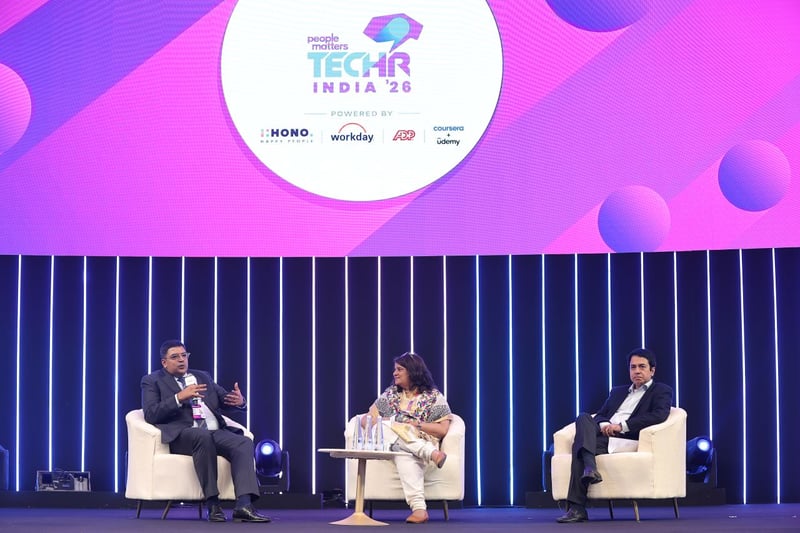
As AI assumes more analytical and decision-support work, Rohit Thakur and Mahalakshmi R outlined why judgement, learning agility and accountability will define the next generation of leaders.
At People Matters TechHR India 2026, Rohit Thakur, Group CHRO, Mahindra Group, and Mahalakshmi R, Global CHRO, Apollo Tyres, discussed that AI is not reducing the importance of leadership. It is changing where leadership value lies.
In a conversation moderated by Vikrant Khanna, Vice President and Lead – Strategic Pursuits, APMEA, Darwinbox, the two leaders shared the capabilities, succession models and organisational responsibilities required for AI-native work.
Their thought was clear: AI can improve the quality and speed of a recommendation, but leaders must still provide the context, exercise judgement and remain accountable for the consequences.
Context is what turns information into a decision
For Thakur, the human contribution begins with context. “The most important thing is context, which is a part of the human stack,” he said.
AI may process large volumes of information, but it does not automatically understand the culture, strategy and leadership priorities that make a recommendation appropriate, or potentially damaging, for a particular organisation.
“The context of culture for Mahindra could be very different from the context for Apollo, Microsoft or GE,” Thakur explained.
Mahalakshmi placed judgement at the centre of this human stack, saying, “The human stack is in judgement, on which data to act and on which data to step back and say, ‘The programme is giving me this data, but how am I validating it?”
This becomes especially important when AI is used to inform hiring, performance, workforce planning or restructuring. Leaders cannot treat a technology-generated recommendation as a transfer of accountability.
Their responsibility is to interrogate the output, understand what may be missing and decide whether acting on it is consistent with the organisation’s values and purpose.
Leadership potential is shifting from knowing to learning
The capabilities used to identify future leaders must also change.
“Gone are the days when knowledge was the currency, because now that is easily available,” Mahalakshmi said.
Experience still matters, but it can become a constraint when leaders apply an old solution to a fundamentally different problem. As markets, technology and roles change more rapidly, past success offers less certainty about future readiness.
“Can you stop saying what you’ve done and actually show your ability to unlearn and relearn?” she asked.
For Mahalakshmi, resilience, learning agility and humility will become stronger indicators of leadership potential. Leaders must be able to absorb disruption without becoming paralysed by it and be willing to say, “I don’t know, but we are going to figure this out together.”
This has direct implications for leadership development. Organisations need to move beyond preparing leaders for a predetermined next role and build their capacity to navigate situations for which no established playbook exists.
Succession needs to account for trust, talent and technology
Thakur proposed three lenses for assessing who is ready to take on greater responsibility: trust, talent and technology.
The first test is whether leaders can attract, nurture and elevate strong talent. This also requires them to be secure enough to surround themselves with capable people.
“Leaders who are insecure about themselves will build teams and organisations that are insecure themselves,” he said.
The second is whether they can earn trust beyond the authority conferred by their title. The third is their willingness to engage with technology, not necessarily as technical experts, but as leaders capable of understanding how it could reshape their business or function.
Under this model, succession readiness is not defined only by current performance or previous experience. It depends on whether a leader can build capability in others, create confidence through change and use technology without surrendering judgement to it.
Transformation must protect employability, not every existing job
AI will change roles, reduce the need for some tasks and create demand for others. The panel’s direction for HR leaders was to focus on employability rather than assume every job can remain unchanged.
“Roles will change, jobs will change and the construct of jobs will change,” Thakur said.
He added that Mahindra has stated that employees will not lose jobs because of technology, with reskilling and redeployment offered to those willing to develop new capabilities.
This moves reskilling from a learning initiative to a workforce strategy. Organisations must identify which work is changing early, establish the capabilities employees will need next and create credible pathways into emerging roles.
“More so now than earlier, careers become more important than a job. It is about employability and reskilling rather than saying, ‘I have employment because I do this particular task,” Thakur said.
Mahalakshmi added that as the half-life of skills shortens, succession plans will need to become more fluid. The capabilities required tomorrow may differ substantially from those used to identify successors today.
The priority is therefore not merely to prepare someone for an existing position, but to develop leaders who can remain valuable as roles and organisational structures evolve.
Empathy is how difficult decisions are executed
A more fluid workforce does not remove the need for difficult decisions. It increases the responsibility to handle them well.
“One of the large gaps is: how do you transform with empathy and trust?” Thakur said.
Mahalakshmi reduced empathy to a practical question leaders can use when restructuring work or roles:
“If this was happening to me, how would I like to be treated?”
That means explaining the rationale behind the decision, communicating early enough for people to plan and treating affected employees with the dignity leaders would expect themselves.
“Tell me the why so that I know I am not being victimised,” she said. “Tell me as early as you can so I can plan my life. That’s empathy.”
Empathy, therefore, does not mean avoiding necessary business decisions. It means remaining accountable for how those decisions are communicated and experienced.
The CHRO must help design the AI-native organisation
For Mahalakshmi, this moment gives the CHRO a more concrete role in business transformation.
She pointed to an emerging partnership between the CFO, who influences investment; the digital or technology leader, who understands technological possibilities; and the CHRO, who brings the organisation and talent perspective.
Together, they must examine the work to be done, determine what can be digitised, anticipate which roles will emerge and build the skills the future organisation will require.
“The CHRO has a very tangible role to play,” she said. “It has a hard element and a soft element, and now is a very interesting time for us to play both.”
This requires HR to engage before technology decisions are finalised. Its responsibility is not limited to managing communication or employee sentiment after implementation. The function must influence job redesign, workforce investment, capability building and the governance of AI-led people decisions.
Thakur described the CHRO as a “leader of leaders”, someone who connects business priorities, culture and leadership across different parts of the enterprise.
The function will also face greater pressure to demonstrate how its decisions affect productivity, organisational capability and financial performance.
Human and machine, not human or machine
The panel ultimately reframed the leadership debate around partnership rather than replacement.
“It is about human plus machine, not human or machine,” Thakur said.
AI will increasingly contribute analysis, foresight and speed. Leaders will be responsible for testing its reliability, applying organisational context and owning what happens next.
That creates a sharper leadership contract for the AI era: technology can inform the choice, but it cannot absorb the responsibility.
The leaders who remain in control will not be those who compete with AI for answers. They will be those who know when to trust its recommendation, when to challenge it and why the final decision must still be theirs.
Author
Loading...