







Leadership
‘40–80K hours of work at risk’: CEO Pushkaraj Bidwai calls for HR overhaul



 ||
||

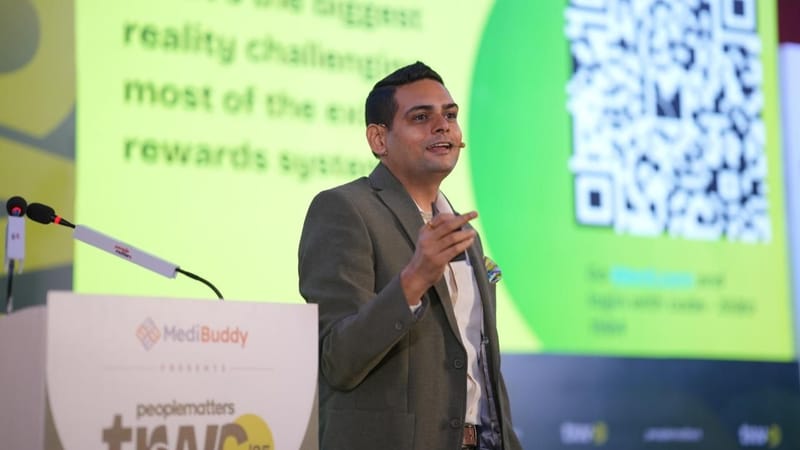
At People Matters TRWC'25, SHRPA CEO Pushkaraj Bidwai warned HR leaders that AI, ageing and health risks demand an urgent overhaul of career and rewards models.
For decades careers were in a predictable pattern, starting in 20s, career peaking in 40s or 50s, and retiring at 60. “But life expectancy has gone up, health spans are shrinking, work patterns have changed, and those assumptions no longer match the world we live in. Despite this, most organisations are still designing policies and rewards based on the old model,” said CEO Pushkaraj Bidwai at People Matters TRWC 2025.
“Reality today is different” with pace of change, technology, AI, new skills, disrupting traditional career paths, signaling how careers and rewards need to be redesigned for this new world. “The old career formula is outdated and no longer reflects how people actually work, grow, or retire,” he added.
The new realities we see today
Explaining the shift towards the new reality, Pushkar said, “People are switching roles every 2–4 years, which is far more frequent than before. Even though people are living longer, they’re not staying healthy for as long, and mid-career instability is becoming a real, measurable problem, not just a theory.
On top of that, AI is drastically reducing the amount of human work, even if it’s not eliminating entire jobs.
By 2030, almost 40% of all work tasks could be automated, which equals 40,000–80,000 hours of human labour disappearing, the same as wiping out 4–8 years of a person’s career.”
‘AI is not just replacing jobs, it’s taking away the most productive years of people’s careers,” he remarked.
The mid-career cliff
Pushkar deep-dived into how the disruptions caused by technology and AI are hitting the middle layer of the workforce the hardest. He noted three key points:
Mid-level coordination roles are disappearing: Tools, dashboards, and AI “super agents” are taking over coordination and administrative work that humans used to do.
Some roles are becoming completely obsolete: Tech is eliminating job categories altogether.
Roles that do survive lose their value: Even when mid-level roles remain, the premium, the extra value or higher pay they once commanded, drops sharply because technology can do much of the work faster and cheaper.
Further outlining that:
GCCs are hiring fewer mid-level workers.
Companies are using AI to eliminate thousands of IT and consulting roles.
Lateral hiring drops sharply after age 40.
Employees feel this shift, even though organisations don’t openly acknowledge it.
“HR and rewards leaders must help employees prepare for this new, more volatile reality,” he urged.
The wellbeing equation in the new realities
Pushkar warned HR leaders that India is heading into a perfect storm of longer lives, shorter careers, and skyrocketing health risks and medical costs, and that reward systems must urgently adapt.
“This shift is colliding with a massive rise in chronic illnesses and healthcare costs. India’s 60+ population is set to double, diseases like diabetes and cardiac issues are hitting earlier, and environmental stressors are accelerating health decline, while healthcare inflation is climbing at 14% a year.
A procedure that costs ₹3–4 lakh today could touch ₹30 lakh within a decade, yet salaries aren’t growing at anywhere near that pace,”
He said this means the biggest threat to Indian employees isn’t just job volatility, it’s illness. And that rewards and benefits systems are still built for an older world and must now be redesigned to reflect these new financial and health realities, with AI placed at the center.
HR leaders, he says, have the power to shape the second half of employees’ lives by creating rewards strategies that provide stability, well-being, financial resilience, and support through unpredictable career transitions.
Insights from SHRPA Research
Pushkar also shared SHRPA 2025 Global Total Rewards Insights about the massive shift happening in HR and total rewards, driven by AI, changing labour markets, and new career realities, and why HR leaders urgently need to rethink how they design compensation, benefits, careers, and well-being.
“Three major disruptors stand out: AI and emerging tech, labour market shifts, and borderless talent,” he said. And they are:
AI and emerging technologies
Labour market shifts
Borderless talent
At the same time, HR is struggling most with leadership development and talent excellence, areas where total rewards leaders can have a huge impact.
He highlights that executive compensation is a major gap between CEOs and HR, and that performance-based, AI-enabled talent systems are becoming essential as career paths shift.
Investments in AI and HR tech are rising fast, yet many organisations still underuse the technology, face integration issues, or believe, incorrectly, that there are “no challenges.”
Pushkar warns that the old, linear career model is breaking, reward systems built for stability no longer fit a volatile world, and leaders must now rethink compensation, benefits, careers, and well-being through an AI-driven lens.
His core message to HR leaders: the baseline of work has shifted, transformation is unavoidable, and HR must step up, with data, technology, and new reward structures, to match the realities shaping modern careers.
Topics
Author

Loading...