







Leadership
The New Mandate for Leaders: Ethics, curiosity, and self-leadership in the age of AI



|
Updated on


For Bryant, the most effective leaders practise “confident humility.” They are neither arrogantly certain nor crippled by self-doubt. Self-leadership, he argues, is about taking ownership: “We need people to turn up as adults, taking ownership of themselves.
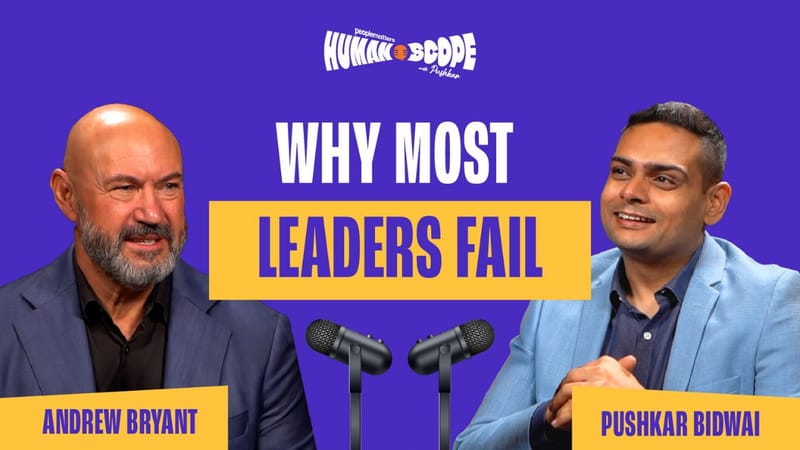
In a world where technology is evolving at breakneck speed and the very definition of leadership is being rewritten, Andrew Bryant stands out as a voice of wisdom, nuance, and deep humanity. As the Founder of Self Leadership International and a globally renowned keynote speaker, coach, and mentor, Bryant's recent conversation with Pushkar Bidwai, CEO of People Matters, for the Humanscope Podcast, offered a masterclass in leadership for the modern era. This compelling interview traversed the landscapes of sport, business, psychology, and the very essence of being human.
From Physiotherapist to Global Leadership Guru: The power of curiosity
Bryant’s journey to becoming a leading authority on self-leadership is anything but conventional. Trained as a physiotherapist, with forays into traditional Chinese medicine and psychology, his career began not in the boardroom but in the clinic and on the sports field. This diverse background, he explains, honed two critical traits: curiosity and observation.
“As a physiotherapist, you could watch somebody walk across a room and be able to analyse whether their limp was because of a big toe, an ankle, knee, hip or lower back,” he recalls. This relentless focus on understanding the ‘why’ behind human behaviour laid the foundation for his later work with elite athletes and, eventually, business leaders.
Transitioning from medicine to coaching world-class athletes, Bryant quickly realised that success depended as much on mindset as on physical ability. “Natural talent is actually quite rare,” he notes. “The great athlete can let go of mistakes and move on to the next challenge, rather than carrying emotional baggage.” This insight—drawn from the likes of tennis legend John McEnroe’s on-court tantrums and the fictional positivity of Ted Lasso—would become central to Bryant’s philosophy of self-leadership.
The Sporting Arena and the Boardroom: Lessons in peak performance
Bryant’s foray into the business world was serendipitous. After helping a sports team achieve victory, the managing director of a sponsoring company asked him to replicate this success with his management team. Initially beset by imposter syndrome, Bryant leaned on his core skills of observation and curiosity. What he found was striking: “They had many of the same issues (as athletes)—pre-game nerves before presentations, the need to perform under pressure. But unlike athletes, business leaders rarely get time to recover or debrief.”
Drawing on the practices of elite sports and even military debriefings, Bryant advocates regular reflection—not just after failures, but also after successes. “We should also be debriefing a great sales call. What did we do well? What can we learn from that?” This shift from blame to learning, he argues, is crucial for building high-performing teams.
Leadership Across Cultures: Context is king
With experience coaching leaders in more than 40 countries, Bryant’s approach is profoundly shaped by cultural sensitivity. “Nationality is an accident of birth,” he muses, “yet people are fiercely proud of it. My work is to understand the frame of mind people are operating from—and the frame of mind of those they’re trying to lead.”
Leadership, for Bryant, is not a solitary attribute but a dynamic between leader and followers. “If there is no followership, there is no leadership. The dynamic is: Have you created a delta? Have you moved people from point A to point B?” This nuanced understanding allows him to adapt his coaching to hierarchical cultures, creative environments, and everything in between.
Bryant shares a revealing anecdote about coaching Indian business leaders in Singapore. When one expressed doubt that someone from a small Indian village could lead a global company, Bryant challenged this self-limiting belief. “It’s not about nationality or privilege; it’s about mindset. Isn’t it interesting how we sabotage ourselves by saying, ‘It can’t happen for me’?
The heart of self-leadership
For Bryant, the most effective leaders practise “confident humility.” They are neither arrogantly certain nor crippled by self-doubt. Self-leadership, he argues, is about taking ownership: “We need people to turn up as adults, taking ownership of themselves. I break down ownership into responsibility for and accountability to. You’re responsible for yourself, but accountable to your commitments and the culture.”
This self-awareness isn’t just a personal virtue—it’s an organisational imperative. Bryant recounts a moment of personal stress in Mumbai traffic, when his ingrained fear of being late clashed with circumstances beyond his control. “I caught it in the moment, took a breath, and chose to be present rather than frustrated,” he recalls. Leaders, he insists, must cultivate this awareness to avoid projecting stress onto their teams and to model resilience under pressure.
From top leadership to the front lines
Much of Bryant’s work focuses on the often-overlooked middle layers of organisations. “Top management is typically the worst performing team—they’re not a team at all, just heads of department who rarely interact as a cohesive unit.” He stresses the importance of cascading values and role modelling from the executive leadership team down to frontline managers. “Culture is the collective beliefs and behaviours of a group. If the executive team isn’t role modelling those values, the message won’t reach the rest of the organisation.”
Bryant introduces the evocative metaphor of ‘putting the fish on the table’—an Italian expression for bringing problems into the open. “If the fish is under the table, it rots and stinks. But if we put it on the table, we can eat it—solve the problem together.” This approach, he found, transformed conversations in a Silicon Valley software company, making conflict resolution more open and less threatening.
The perils of technical promotions and the power of vulnerability
A recurring challenge in organisations, Bryant observes, is the tendency to promote technical experts into leadership roles without regard for people skills. “Not everyone wants to be a great leader. Often, people get promoted because they’re good at their job—not because they’re good at leading others.”
He advocates early identification of people with people skills and validation of behaviours such as learning and vulnerability. “What gets acknowledged gets done. When someone opens up about what they’ve learned or where they’ve struggled, acknowledge that. It changes the team dynamic.”
Potentializing: A framework for the age of AI
Bryant’s latest book, “Potentialize,” emerges from his lifelong fascination with human potential—now more relevant than ever as artificial intelligence reshapes the world of work. The concept of ‘potentializing’ is, for Bryant, an active process: “It’s the process of being your best self while constantly redefining what ‘best’ is.”
Asked by Bidwai how organisations can unlock true potential, Bryant unveils his “IGNITE” framework.
- Inspire
- Guide
- Nurture
- Integrate
- Transform
- Evaluate
He emphasises the importance of not just inspiring and guiding, but also integrating technology, transforming behaviours, and—crucially—evaluating progress through regular debriefs. “Have we added extra processes without removing anything? Are we freeing people up, or bogging them down?”
Efficiency vs Effectiveness
Bryant is unequivocal about the challenges—and opportunities—posed by AI. “The wave of AI is stressful because we can’t control it. Leaders and managers want to control everything; that’s problematic. The important thing is to step back and ask: What can I control? I can control myself.”
AI, he argues, excels at efficiency—doing things quickly and repeatedly—but often misses effectiveness —the human touch that makes interactions meaningful. “If you’ve lost a loved one and are trying to sort out bank accounts, you don’t want efficiency. You want empathy and understanding.”
He warns against over-reliance on technology for tasks where human nuance matters, sharing stories of companies that implemented AI customer service bots only to roll them back after losing the crucial element of humanity.
The wisdom of listening
The emergence of Gen Z in the workplace, with their digital fluency and desire for meaning, presents both a challenge and an opportunity. Bryant relates a personal anecdote about learning new workout methods from his 18-year-old son, who, despite teasing his father’s “old” ways, also values Bryant’s critical thinking. “It’s that marriage between experience and the speed of the new generation. Stop trying to know everything—surround yourself with people who can teach you.”
Bryant urges leaders to practise reverse mentoring, to learn from younger colleagues even as they provide direction and context. “What gets validated is learning and vulnerability, not just technical expertise.”
Ethics, meaning, curiosity and observation in a data-driven world
As leadership responsibilities broaden to include the ethical use of technology, Bryant calls for a new kind of leader: the philosopher-innovator. “We need leaders to make value judgements, to think about the ethics of their decisions, not just efficiency,” he insists. Recalling an MBA professor who once predicted that the job of the future would be that of a librarian—curating information wisely amid a flood of data—Bryant argues that leaders must now act as both ethicists and meaning-makers.
But ethics and meaning alone are insufficient without the engines of progress: curiosity and observation. Throughout his career, Bryant has championed these qualities as the bedrock of genuine innovation. He cautions against hiring practices and organisational cultures that stifle curiosity in favour of box-ticking and rigid conformity. “Curiosity and observation are the two things that really have set me up for my entire career,” he reflects. “Prescription without diagnosis is malpractice.”
The most future-ready organisations, Bryant maintains, are those that encourage open-ended questions, validate creative thinking, and give voice to all levels of staff—sometimes by allowing the most junior voices to speak first, as in the Japanese practice of ‘Nemawashi’. Such approaches foster a culture of inquiry and continuous improvement, ensuring that innovation is not a top-down directive, but a collaborative, organisation-wide endeavour.
Self-leadership as the ultimate competitive advantage
As the conversation draws to a close, Bryant leaves leaders with a challenge and an invitation. The journey to unlocking human potential—both individual and organisational—requires self-awareness, adaptability, and the courage to ask better questions. In an era defined by rapid change, the true differentiator is not just technical prowess, but the capacity for self-leadership and the ability to potentialize—again and again.
Watch the complete Humanscope Podcast, here.
Loading...