







Leadership
The boardroom you need before the boardroom you want



 ||
||


Every senior woman leader needs a personal board of directors. Most do not have one.
By Anand Shankar
Nisha had fourteen years at the bank. She ran the retail lending division through two recessions, grew the book by forty percent, and built a team that never missed a target. When the Group CFO role opened, she was not shortlisted. The feedback: the board did not feel they knew her well enough.
Not unqualified. Not under-performing. Simply unknown — to the people who mattered, at the moment that mattered.
"You are already being branded — by your boss, your peers, the committee that overlooked you. The only question is: are you the author of that story, or are you the subject?" |
Nisha's story repeats itself across industries and functions. Brilliant women arrive at the threshold of the C-suite and find that competence, on its own, is not a passport. The conversations that determine who ascends happen in rooms they have never been invited into, between people who know not just what you have done, but who is prepared to vouch for you.
Research by Ibarra, Carter, and Silva in the Harvard Business Review (2010) established the core problem: high-potential women are over-mentored and under-sponsored.1 Sylvia Ann Hewlett's data from the Center for Talent Innovation quantified the cost: employees with a sponsor are 23 percent more likely — women specifically, 19 percent more likely — to receive their next promotion than those without.2 The gap is not talent. It is advocacy.
The solution is structural. It is a personal board of directors.
Seven Seats. Each Irreplaceable.
Think of it as governance for your career. Every serious organisation has a board — people with different expertise, different networks, different kinds of power — whose collective purpose is to ensure the organisation reaches its potential. Your career deserves the same architecture.
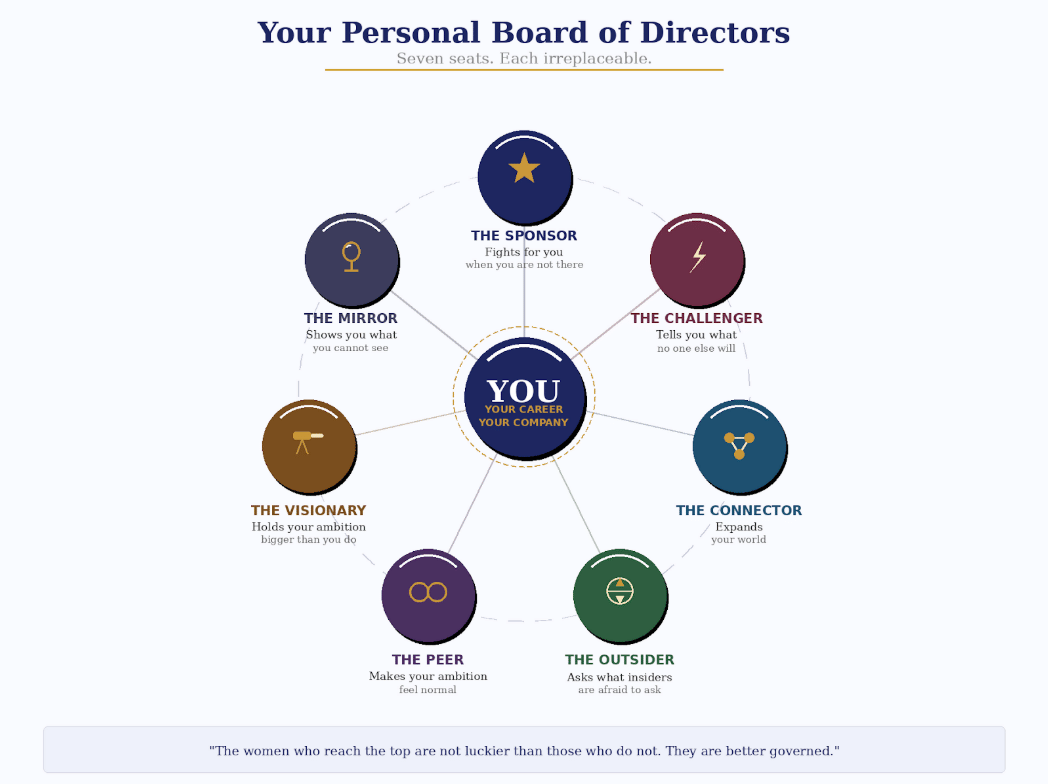
Figure 1: The Seven-Seat Personal Board of Directors — an original framework
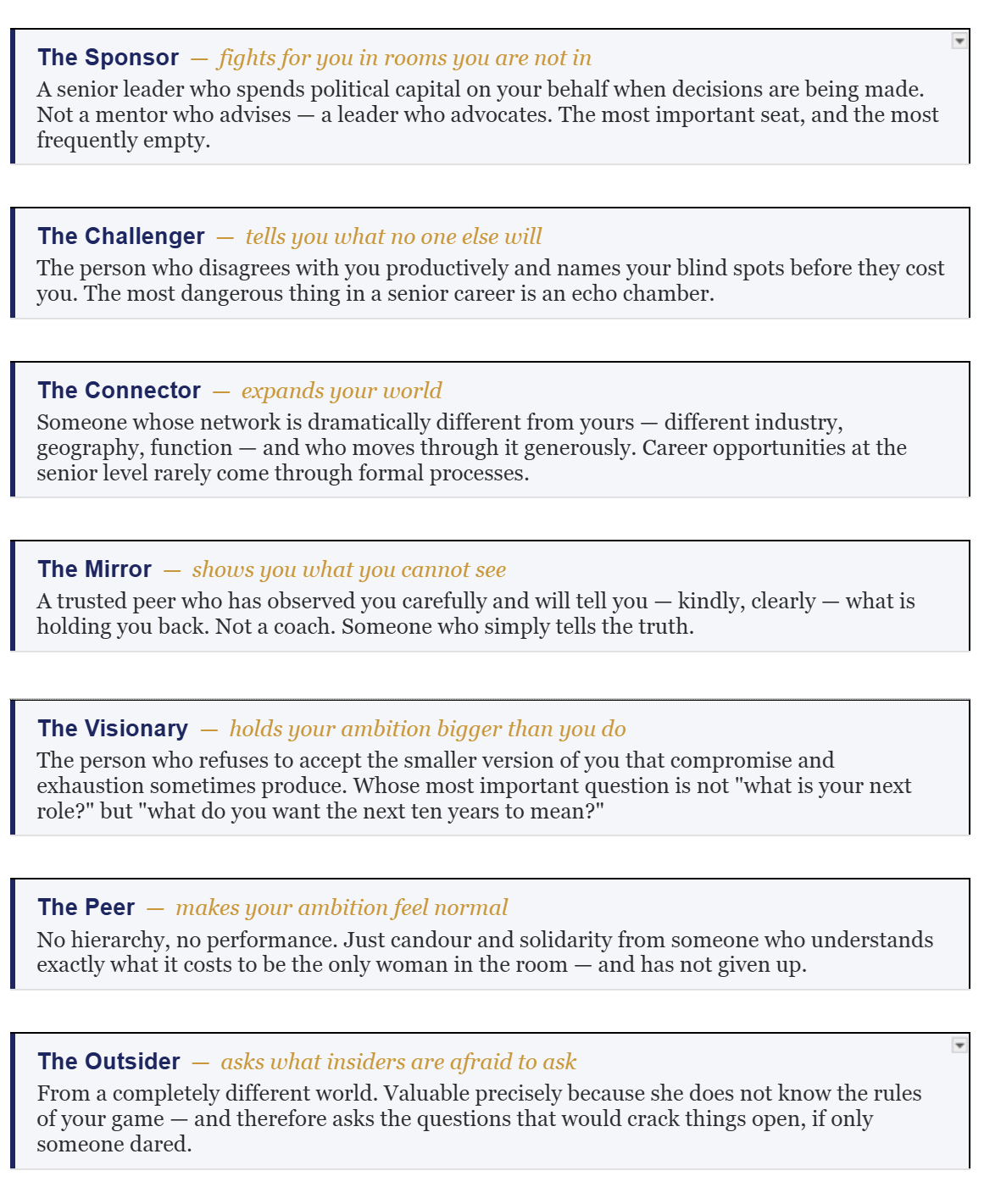
Building a personal board requires time, intentionality, and a willingness to be strategic about relationships most of us prefer to think of as purely organic. For women, it carries an additional layer: many senior women were raised to believe that asking for help was weakness, and talking about ambition was arrogance. These are not personal failings. They are the residue of conditioning that rewarded modesty and penalised assertion.
The reframe that matters: visibility is not vanity. It is a professional responsibility. If the right people do not know what you are capable of, the opportunities that should reach you will go elsewhere.
Four women. Four different outcomes
Nisha (Finance): Three years after being passed over, she was appointed Group CFO at a competitor — because a former colleague had mentioned her name at the critical moment. Her Sponsor. She had not thought of him that way. But when it mattered, he spent his influence. The lesson: visibility gives your Sponsor something to point to.
Ananya (Technology): Three mentors. Outstanding 360 feedback. Passed over for regional CEO. When she mapped her relationships honestly, every name was internal, similar to her, and operating below the level of the people who made that decision. Mentors, no Sponsor. Agreement, no Challenger. It took eighteen months to rebuild. The next opportunity, she was ready.
Rekha (Sales): Most effective sales leader in her company's history. Entirely unknown outside it. Her Outsider named it: "You are the best-kept secret in your industry. That is not a compliment." Rekha began writing a short industry column. Within a year: three conference invitations, two search firm approaches. Twelve months of external visibility opened what a decade of internal excellence had not.
Meena (General Management): Fifty-three, a General Manager, and by her own admission she had stopped dreaming. Her Visionary — a former boss of twenty years — refused to allow it. "You are not being realistic. You are being small." Meena was appointed to her first board directorship at fifty-five. She now sits on three.
"The women who reach the top are not luckier than those who do not. They are better governed." |
Where to start
Write down the names of the people you actually turn to for career guidance. Not who you think you should list — who you actually call. Now ask: Are they all internal? All similar to you? All mentors, with no sponsors? Do they all agree with you? Who on this list would walk into a room where a decision was being made and spend their own political capital on your behalf?
Most people find significant gaps. That is not a failure. It is a starting point. The board is not built in a day. It is built by making yourself worth knowing, and by investing in relationships with generosity before you need them.
Your career is the company. It deserves a board. The seats are vacant. Who fills them is entirely up to you.
Anand Shankar is the Chief Transformation Officer for Deloitte South Asia. He specialises in leadership development. All views expressed here are his own and not that of Deloitte or its affiliate firms. All named individuals are composite fictional characters. The seven-seat personal board is an original model by the author.
Author
Loading...