







Leadership
As AI transformation takes time, Accenture recalibrates its workforce strategy






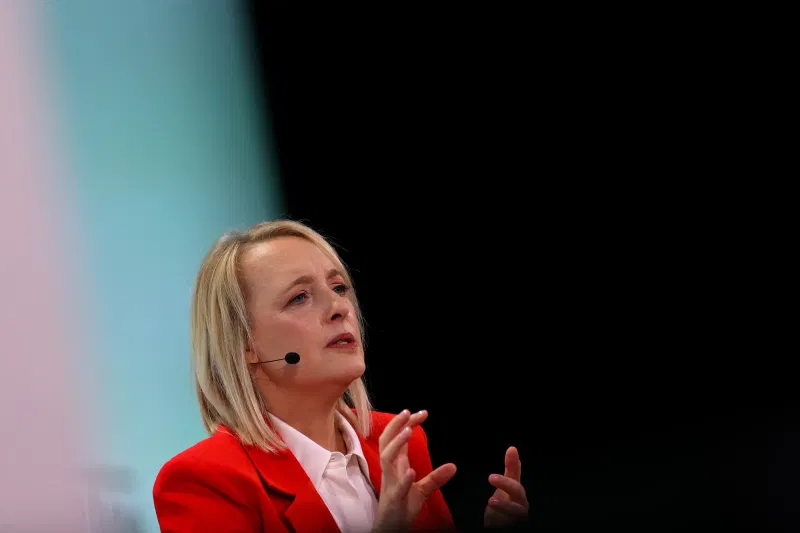
As AI moves from experimentation to enterprise scale, Accenture CEO Julie Sweet says transformation will take time—highlighting the growing need to balance business reinvention, workforce trust and long-term leadership.
Accenture CEO Julie Sweet has delivered a reality check to businesses racing towards AI adoption: enterprise-wide transformation will not happen overnight.
Her remarks come at a critical juncture for the consulting giant, whose shares plunged nearly 20% following weaker-than-expected guidance and a decline in new bookings, despite reporting $18.7 billion in quarterly revenue. Sweet, however, urged investors to look beyond short-term market reactions and focus on the longer arc of AI-led reinvention, according to a Business Insider report.
But the story extends beyond stock market volatility.
As organisations grapple with scaling AI, Accenture is simultaneously rethinking how it rewards, retains and prepares its workforce for the next phase of transformation.
AI's biggest challenge isn't technology—it's organisational change
"We are still early in this journey," was the underlying message from Sweet, who emphasised that many enterprises are only now moving beyond AI experimentation into production environments. The company has increasingly positioned itself around "reinvention" rather than incremental digital transformation, even restructuring its business into a unified Reinvention Services model to accelerate client outcomes.
The message reflects a growing reality confronting organisations globally: deploying AI tools is relatively straightforward; embedding AI into the operating model, workflows and culture of an enterprise is significantly harder.
For leaders, the challenge has shifted from asking "How do we adopt AI?" to "How do we redesign work itself?"
Workforce economics are evolving alongside AI investments
The timing is particularly notable given Accenture's recent changes to employee compensation.
The company has introduced a revised salary structure for its June 2026 compensation cycle, under which employees will receive 50% of their approved increments as an immediate lump-sum payout, while the remaining 50% will be incorporated into base pay. The move affects its global workforce of over 780,000 employees, including a substantial employee base in India.
Accenture said the change aims to provide employees with faster access to cash while helping the organisation manage costs amid ongoing economic uncertainty and sustained investments in AI. Promotion-related salary increases, however, will continue to be fully added to base pay, as reported by The Times of India.
The compensation redesign underscores a broader trend emerging across industries: organisations are simultaneously investing billions into AI capabilities while reassessing traditional workforce cost structures.
The leadership balancing act has begun
The dual challenge facing leaders today is becoming increasingly apparent.
On one side are investors seeking immediate returns from AI investments. On the other are employees navigating evolving roles, changing skill expectations and new compensation models.
As per the The Guardian, Accenture itself has been vocal about making AI proficiency a core workplace capability, having trained hundreds of thousands of employees while integrating AI adoption into leadership expectations.
For CHROs and business leaders, this signals a significant shift:
AI transformation will unfold over years, not quarters.
Workforce strategies will increasingly prioritise adaptability over static roles.
Compensation and career frameworks may evolve to balance business resilience with employee expectations.
Leadership success will depend on managing both technological disruption and human uncertainty.
The Accenture story is emblematic of a larger transition underway across global enterprises. AI is no longer an innovation project; it is becoming an organisational redesign exercise.
And while the technology may be advancing at unprecedented speed, the harder work lies elsewhere: reshaping operating models, rebuilding workforce confidence, and helping employees navigate a future where transformation is continuous rather than episodic.
The organisations that succeed may not be the ones that deploy AI the fastest, but those that can sustain both business performance and workforce trust while doing so.
Topics
Author
Loading...