







Leadership
At TRWC 25, Madhav Keswani challenges leaders to rethink recognition





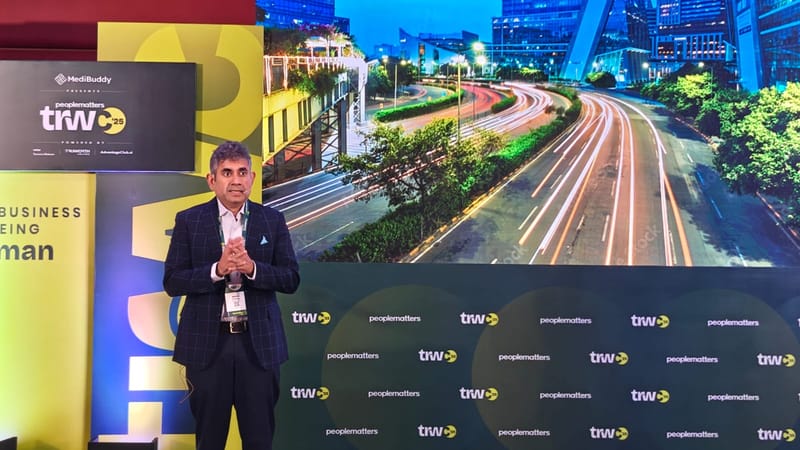
For Keswani, the true challenge lies in creating rewards that go beyond chasing short-term results. They must deliver stability and anchor for success.
At the People Matters TRWC 25 conference, the atmosphere was charged with anticipation as Madhav Keswani, President, Group HR of Aditya Birla Group, took to the stage. His address, woven with personal stories and far-reaching insights, placed the spotlight squarely on a topic often relegated to the background—rewards and recognition. But Keswani’s message was clear: these systems are not mere formalities, but the very levers that shape the destiny of organisations and the people within them.
The unseen power of incentives
Keswani began by reflecting on a lesson gleaned from decades at the intersection of business and human resources: incentives possess a power that is at once subtle and profound. “Rewards and recognition,” he remarked, “are not afterthoughts—they are the levers that shape behaviour, drive ambition, and, when misaligned, can even imperil entire industries.”
He recalled the tumult of the global financial crisis, when poorly designed incentives triggered a chain reaction of risk that ultimately destabilised the world economy. In that moment, the responsibility of those who design these systems became starkly apparent.
For Keswani, the true challenge lies in creating rewards that go beyond chasing short-term results.
They must deliver stability, inspire trust, and anchor organisations for long-term success. “To those who design these systems, recognise your responsibility,” he urged. “These frameworks possess the power to influence outcomes at scale.”
The five force power equation—and the sixth
Drawing on the Aditya Birla Group’s storied legacy, Keswani illustrated the anatomy of transformation through the story of Birla Opus, the conglomerate’s audacious foray into the paints industry. The group eschewed incrementalism, doubling down on investment and building six world-class plants in record time. What enabled such speed and impact?
Keswani attributed this feat to what he described as the ‘five force power equation’: strategy, operating model, organisation design, performance, and rewards. These forces, he explained, must be finely tuned and aligned, much like instruments in an orchestra. “Their combined rhythm,” he said, “is what powers transformation.”
Crucially, the group’s rewards and recognition systems evolved in lockstep with the business. At the venture’s inception, incentives were milestone-driven—designed to reward progress in manufacturing and research. As the business matured, the metrics shifted to market share and revenue, ensuring that recognition remained relevant and motivating. Half of the long-term incentive plan was tied to the parent company’s performance, while the other half tracked the new business’s results, giving managers an unclouded view of the impact of their efforts. “This is how rewards should work,” Keswani asserted, “dynamic, relevant, and always in step with the business’s journey.”
Yet Keswani was quick to add that even perfectly aligned systems are not enough. There is a sixth force, often invisible but utterly indispensable: culture.
“Culture is the oxygen of an organisation,” he said. “When pure, it breathes life into every system; when thin, progress falters.” Without a nurturing culture, even the best-designed rewards can fail to ignite performance or loyalty.
Three mindsets for the future
The world, Keswani noted, is transforming at an unprecedented pace. In this environment, competitive advantage is fleeting, and yesterday’s solutions are often obsolete. To thrive, he urged leaders to adopt three core mindsets: digital, collaborative, and learner.
A digital mindset means embracing technology at every turn, viewing disruption not as a threat but as a catalyst for reinvention. Collaboration, he insisted, is non-negotiable—no function, HR included, can afford to operate in isolation. Breakthroughs come from partnerships across disciplines and hierarchies. Finally, the learner’s mindset is about unlearning as much as it is about learning: questioning whether old models still serve, and having the courage to abandon those that do not.
“It is this combination,” he said, “that offers speed, scale, and depth.”
A Rallying Cry: I am ready
As his address drew to a close, Keswani invited the audience to pause and envision the future they wished to create. With an exercise both symbolic and stirring, he asked everyone to sit up straight, plant their feet, and declare in unison: “I am ready.”
In a world swirling with uncertainty, it is this spirit of readiness—anchored in purpose, powered by aligned systems, and fuelled by the right mindsets—that will define tomorrow’s leaders. Keswani’s rallying cry left the audience not only inspired but equipped to meet the future head-on, together.
Topics
Author
Loading...