







Leadership
Be the Catalyst for Organisational Transformation: Pradeep Gulipalli advises CHROs


|
Updated on


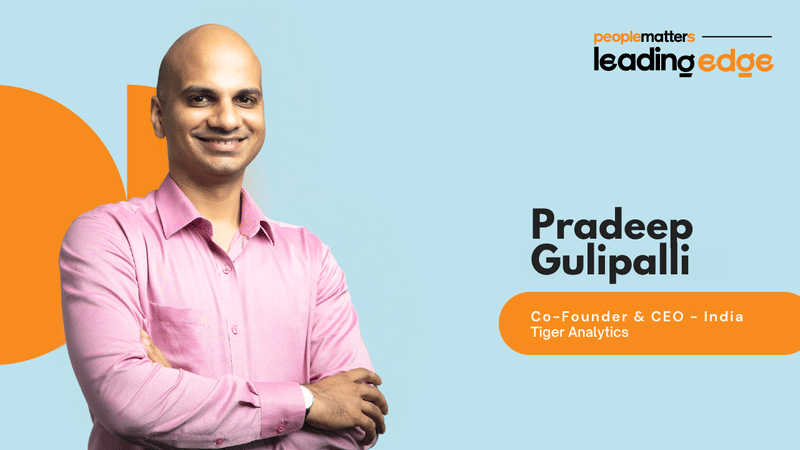
The people function must stay in sync with how the business evolves, always having a stake in business outcomes, especially in grooming future leaders, believes Gulipalli.
In a world where business landscapes are in constant flux—driven by technology, shifting generational values, and global uncertainty—leadership itself must continuously evolve. Nowhere is this more evident than in the story of Pradeep Gulipalli, Co-founder and Chief Executive Officer-India at Tiger Analytics, whose 14-year journey building a company from scratch provides a compelling lens into modern leadership and the rapidly changing relationship between CEOs and CHROs.
Building from the Ground Up: A leadership shaped by growth
Gulipalli’s leadership philosophy hasn’t been forged in the boardrooms of established conglomerates, but on the ground, building Tiger Analytics from a handful of people operating in co-working spaces to a thriving international organization with over 6,000 employees. “The biggest company I’ve ever worked at is Tiger,” he admits. “Before that, I was part of a startup with about 40 people. So my perspective is deeply shaped by building this organization from the ground up.”
This hands-on experience has made adaptability not just a preference but a necessity. Early on, he wore every conceivable hat—sales, marketing, HR, technical leadership, customer service—gaining a visceral understanding of each function’s challenges. As Tiger Analytics grew, the demands on his leadership style changed dramatically.
When you’re a five-person company, everyone is doing everything. As you scale, you have to start creating specialized functions. But you can’t hire a CHRO with the expectation they’re ready for a 5,000-person company when you’re only at 100. Instead, you hire the right level and invest in coaching and enabling your leaders.
For Gulipalli, the throughline in his leadership journey is the relentless focus on people—especially on hiring and enabling the right leaders at every stage of growth. “If you get the people part right, smart people will take care of the rest. My job is to make sure their expectations are aligned with what’s happening on the ground, and to set them up for success.”
Hiring in a World of Uncertainty: Skills, attitude, and respect
One of the major challenges facing organisations today is the rapid obsolescence of skills. Technology changes so quickly that what is relevant today may be outdated tomorrow. Gulipalli recognises there’s no one-size-fits-all answer when it comes to hiring.
For technical roles, he prioritises “learnability”—the ability to continuously adapt and engage with new challenges. For other functions, collaboration and attitude become paramount, especially in roles that may not be fully defined at the time of hiring.
Yet, across all roles, one trait stands out: respect. “No matter how senior a candidate is, we have them do a surprise interview with one of the most junior people. Sometimes, senior candidates get offended—if so, they’re not the right fit. Those who engage, listen, and show respect for everyone, regardless of role, are the ones we want.”
Evolving Hiring Strategies: From homogeneity to diversity of talent
Tiger Analytics’ exponential growth—scaling from just a few people to thousands—required a fundamental shift in hiring strategy. “In the beginning, the average person needed to be entrepreneurial, comfortable wearing multiple hats. As we grew, specialisation became more important.”
The company’s workforce, once relatively homogeneous, is now a tapestry of diverse skills, expertise, and experience.
There’s much more flexibility today in making people successful in their roles. The organisation has adapted to accommodate a broader variety of people,” Gulipalli says.
Interestingly, the much-discussed “AI wave” didn’t fundamentally alter Tiger Analytics’ hiring approach, as the company was already working in that space. Instead, the real challenge has been tuning the organisation to the right mix of entrepreneurial and specialised talent at each growth stage.
Managing a Multi-Generational Workforce: Empowerment over policy
With four generations now working side by side in many organisations, each with distinct expectations, how does a leader ensure alignment with business goals? Gulipalli acknowledges the complexity: “It’s hard—impossible, really—to design one policy that fits everyone. Even I couldn’t tell you exactly what every segment wants.”
Instead, Tiger’s answer is to decentralise decision-making and empower leaders at every level to create micro-cultures within their teams. “A team lead with five or six years’ experience will connect with Gen Z employees far better than I can. We give leaders the autonomy to make the right calls for their teams, within the framework of our business objectives. Flexibility is key—some teams start at 8 a.m., others at 11. What matters is accountability for outcomes, not rigid adherence to centralised policy.”
Decisions That Shape Culture: Balancing power and voice
Throughout the company’s journey, Gulipalli has made pivotal decisions to ensure a balanced, healthy organisational culture. As companies grow, it’s easy for certain functions—sales, tech, marketing—to accumulate disproportionate influence.
We had to consciously establish policies that give every function a seat at the table and an equal voice,” he explains. “If not, the organisation’s DNA can drift in a direction where only the loudest voices are heard.
This deliberate balancing act has yielded dividends: “Leaders now emerge from multiple functions, not just one. It’s created a more well-rounded, democratic decision-making process that’s better for the company.”
Learning from Setbacks: The value of empowerment and agility
No leadership journey is without its missteps.
Gulipalli is candid about the times when decisions haven’t worked out. “There are dozens of examples. We take bets, and a year later realise something’s not working. The key is that our empowered, democratic culture allows anyone to call out what’s not working, and we’re quick to course-correct. Wrong decisions don’t last long enough to do real damage. We pivot and move forward.”
Growth and Efficiency: People still at the core
Tiger Analytics has enjoyed robust growth, expanding by 35 percent in the last year alone, with ambitious plans to double in size and reach the $1 billion revenue mark within four years. Yet, Gulipalli is acutely aware of the industry trend toward efficiency—doing more with less. “Five or six years ago, 25 percent growth meant 25 percent more people. Today, it might only mean 5 percent more people, thanks to innovation and efficiency gains—especially from automation and AI. But the reality is, people are still at the core. Too much is made of AI replacing jobs. On the ground, we still need a lot of people to build solutions, given where the tech is today.”
The Evolving Role of the CHRO: From Transactional to Strategic Partner
A central theme in Gulipalli's leadership philosophy is the evolving role of the CHRO (Chief Human Resources Officer). At Tiger, the CHRO’s focus has shifted dramatically over time.
Early on, it was about identifying and hiring the right people. Then it became about providing growth paths and mentoring. Now, it’s about succession planning and leadership development. We can’t just keep hiring leaders from outside. At this scale, we need to groom people internally.
This shift requires the CHRO and the entire people function to continuously evolve, much like the organisation itself. “Policies can’t be set in stone—they’ll be irrelevant in a couple of years. The people function must stay in sync with how the business evolves, always having a stake in business outcomes, especially in grooming future leaders.”
The CEO-CHRO Relationship: True partnership for business impact
Gulipalli sees the relationship between the CEO and CHRO as central to the organisation's health and growth.
Every business leader needs a people partner. The CHRO function isn’t just about hiring anymore—it’s about working alongside business leaders, understanding industry evolution, steering the workforce, and supporting reskilling and reinvention.
He’s clear that while CHROs may not be the primary decision-makers on revenue or business strategy, their deep involvement in business realities is critical. “Business leaders focus on customers and growth, but they can’t handle everything alone. The CHRO as a strategic partner is essential—pairing up people leaders with business leaders ensures both sides are fully informed and aligned.”
Can CHROs become business leaders?
Looking beyond his own organisation, Gulipalli reflects on whether the talent function can become a primary driver of business success—perhaps even producing future CEOs. “When that happens, you no longer label them just as people leaders. They become business leaders. I know a couple of CHROs who have become CEOs. But it’s rare.”
He sees a gap in many organisations: “Too often, people box themselves in, focusing only on HR metrics and not engaging deeply with the business. To be a true business partner—or to become CEO—CHROs must understand the commercial side: the business model, margins, challenges. There’s an opportunity for much more involvement and impact.”
What makes a CHRO a business leader?
For CHROs aspiring to greater influence, Gulipalli highlights two essential qualities: openness to spending time in core business functions (such as sales or customer delivery) and the willingness to “take hits” and learn from real business challenges.
You don’t need to be a sales leader, but you need to understand the challenges firsthand. The HR function often designs rotations for others—they should design them for themselves too.
Ultimately, he says, “Don’t box yourself in. Think big, and link everything you do to commercial outcomes. The entrepreneurial mindset that’s required in a 6,000-person company is the same as in a 60,000-person company.”
Leadership as a continuous journey of adaptation
Gulipalli’s story is one of continuous adaptation, rooted in a deep understanding that people—and the relationships between business and talent—are the true engines of growth. His approach to leadership and his vision for the CEO-CHRO partnership offer a roadmap for organisations seeking to thrive in an era of relentless change: hire and enable the right people, empower leaders at every level, balance voices and power, and ensure the people function is always evolving as a strategic business partner.
In the end, as Gulipalli himself says, “Every year, it feels like we’re running a new company. What matters is staying flexible, keeping people at the core, and never losing sight of the business mission.”
In this season of LeadingEdge, we are delving deeper into the leadership styles of C-Suite leaders with a significant focus on their ability to empathise with their people, understand the challenges of their workforce, and initiatives to build a people-friendly organisation. We are also decoding the evolving relationships between the C-Suites and the CHROs to drive the company towards a growth trajectory.
Topics
Author
Loading...