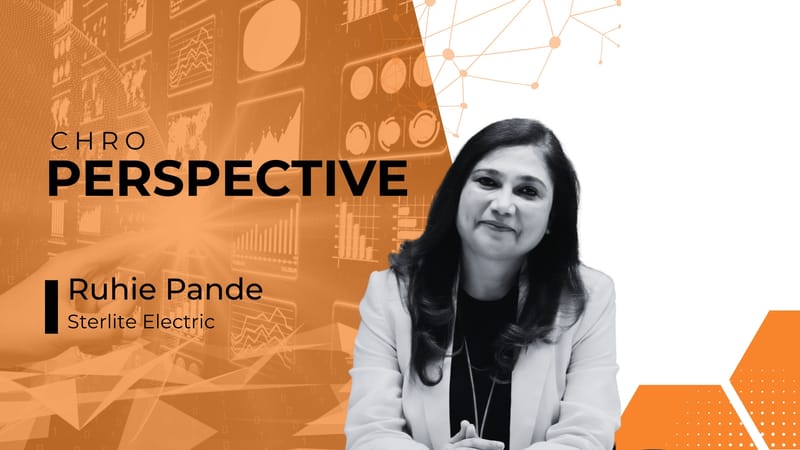
In the high-voltage world of the power sector, a silent revolution is underway, with the modern Chief Human Resources Officer (CHRO) at its helm. In an exclusive interview with People Matters, Ruhie Pande, Group CHRO and Chief Marketing Officer (CMO) at Sterlite, offers a powerful perspective on how the HR function has evolved from a transactional "personnel" role to a strategic business powerhouse.
Pande, leveraging decades of experience, delves into the HR leader's unique ability to connect the bottom line with human capital, a shift that was rapidly accelerated by the pandemic. The conversation explores the pressing talent challenges within the power sector, including a critical skills gap and a lack of diversity. Pande shares groundbreaking strategies, from hiring for skills over experience to building a purpose-driven workforce. This interview is a masterclass in how HR is reinventing itself to create a resilient, future-ready workforce and a competitive advantage. Edited excerpts
Q. You have been in the industry for over two decades. How have you observed the transformation of the HR function, particularly over the last four or five years?
The pace of change has been incredible. Just 10 to 15 years ago, HR was a back-end "personnel" function. It then evolved into a group focused on employee happiness and engagement. However, the real acceleration occurred with the onset of the COVID-19 pandemic. The HR community rose to the occasion with very little information, ensuring both business continuity and employee wellness.
Now, the expectation is that an HR leader isn't just an HR professional—they are a business leader. We create impactful talent strategies and serve as strategic advisors and change agents, leading initiatives that span from organisational structure design to ESG efforts. We have a seat at the table, and we are seen as trusted partners.
Q. Many CEOs acknowledge the expanded role of the CHRO but suggest there's still a lot of ground to cover before a CHRO can lead a multi-billion-dollar conglomerate as a CEO. What are your thoughts on that observation?
While the pace of change has been high, HR leaders have a unique vantage point to understand P&L, competitive advantage, and differentiation because they view the organisation and its people as a whole. They are in a position to connect the balance sheet with the human capital that delivers it. I don't doubt that many of them can lead multi-billion dollar businesses. However, I also believe that what an HR leader can do, no one else in the organisation can.
Take our business, for example. We build transmission lines across states, which is a core capability and a key competitive advantage. My work has been to build the people capability and stakeholder management skills in our on-ground teams, which is a strategic piece of work that directly impacts project success. When HR leaders can showcase these skills and let go of pure HR metrics, focusing on business outcomes, they can absolutely rise to the top.
Q. In the power sector, what are the most significant emerging talent trends and challenges that keep you up at night?
The power sector is still maturing, which creates a genuine shortage of good talent. The power sector, still in its maturing phase, is facing a significant talent shortage. This is primarily due to a paucity of good talent, as there are not enough mature academic courses to supply entry-level professionals, and a large portion of the current workforce is approaching retirement.
Additionally, the industry is grappling with a technology gap, making it challenging to find professionals with expertise in automation and AI, which are essential for this rapidly evolving, trillion-dollar sector. A persistent lack of diversity, as the industry remains predominantly male-dominated, further compounds these challenges.
To combat this, we have shifted our strategy from hiring purely within the industry to hiring for skills and culture. For instance, we hire people with land acquisition skills from the cement manufacturing industry and then train them on the nuances of our business. We also aim to partner with academia to develop co-branded courses that will provide a steady supply of entry-level talent.
The HR function must think long-term and create a talent forecast for the future, not just for today's needs.
Q. While industries like manufacturing and insurance struggle to attract young talent, how does the power sector, perceived as a traditional industry, compete for the same talent? What is your strategy for making the industry's purpose and career paths compelling to the next generation of employees?
I have not seen a significant challenge. Today's youth connect with a purpose that is larger than just a job. The purpose of our organisation—empowering humanity with clean energy—is a resounding one. If you can show them a clear career path, a larger purpose, and a psychologically safe environment, they will thrive.
We are also actively building diversity, not just at our head office, but also at our sites and on the shop floor. For example, we have hired a cohort of 150 bright young women for apprenticeship courses at our factories. We also look at unconventional talent pools, such as ex-army personnel, who are exceptional at stakeholder management —a key skill in our industry.
Q. Instead of just impacting your business, how is technology, specifically AI, fundamentally redefining the way your business operates and the very nature of work for your employees?
We are still scratching the surface with AI. AI is not an IT imperative, but a business imperative, and business leaders should lead its deployment. We have used AI in our operations and maintenance to identify faults in the field, which saves time and effort. We are also utilising mechanisation to reduce the need for manual labour on-site, a critical step given the labour shortage. While AI will make people more productive, it will not eliminate jobs at the same pace as the industry is growing.
Q. In a world where skills have a shrinking shelf life, how is your organisation strategically reskilling and upskilling your workforce to stay ahead of the curve, and what is your approach to embedding a culture of continuous learning at every level?
Continuous learning is a top priority. We focus on reskilling across multiple areas. We are dedicated to improving technology skills and promoting the greater adoption of digitisation, automation, and mechanisation by bringing in experts to conduct specialised workshops. Our leadership training is also evolving to meet the demands of a hybrid and diverse workforce, with a continued emphasis on developing emotional intelligence and creating psychologically safe environments for teams. Additionally, we enhance functional skills through role-specific programs and global field trips, ensuring our people are exposed to the best technologies and practices worldwide.
Q. Can you share some of the HR initiatives at Sterlite that have had a massive impact on the workforce?
Our diversity programs have been highly successful. We are on track to double our gender diversity in two years, mainly by hiring women for the shop floor and project sites from local catchment areas. We also have a program called 'Pehl' to hire people with disabilities. These initiatives provide our leaders with invaluable experience working with diverse teams, which a training program cannot replicate.
We have also focused on:
Hiring for Skills: This has brought in fresh perspectives and innovative ideas from outside the industry.
Futuristic Workforce Planning: We develop long-term workforce models to forecast our talent needs two to three years down the line.
Leadership Development: We focus on group coaching to help teams work better together, and we promote from within to ensure a culturally aligned talent pipeline.
Q. You mentioned that the power sector lacks female role models. What do you think the industry can do to make the sector more attractive to women?
The industry needs to create role models for women to aspire to actively. Organisations must have policies that support women through different life phases, such as flexible work during menstruation and maternity. Ensuring safety is paramount, especially at far-flung sites, which require the proper infrastructure and people. We have also started programs to sensitise our male and female colleagues on how to work together, addressing unconscious biases and fostering a culture of inclusion. It's an ongoing effort that the entire sector needs to embrace.
Q. What essential qualities will separate the leaders of tomorrow from those of the past, and how are you cultivating these in your organisation today?
To succeed in the future, leaders must possess a blend of digital and human skills. They must be digitally savvy, using technology and AI personally as a game-changer for both themselves and their teams. At the same time, emotional intelligence is crucial for managing a high-pressure, multi-generational, and hybrid workforce with empathy and self-awareness. Leaders must also be highly influential, capable of persuading people, stakeholders, and even government bodies.
Finally, humility and resilience will be essential for navigating the constant change and uncertainty that defines today's business environment.
Q. How has your own role as an HR leader evolved in the last few years?
Frankly, I don't see myself as an HR leader; I see myself as a business leader who happens to lead the HR function.
Frankly, I don't see myself as an HR leader; I see myself as a business leader who happens to lead the HR function. My role has evolved to create a significant impact on the P&L through people. My journey across industries, from FMCG to financial services and now power, has taught me to curate HR strategies that align with the business's unique challenges, whether it's a startup, a scale-up, or a turnaround. Today's CEOs want HR to move beyond jargon and provide hard facts on how we're improving productivity and creating new talent pools. The CHRO's role is now about reinvention at scale.
Q.
The power sector is undergoing a generational and technological transformation. As the old guard retires, what strategic imperatives must leaders embrace to build a workforce for the future?
Over the next five years, I anticipate a significantly younger and more gender-diverse workforce in the power sector. I believe a lot more talent from other industries will move in, bringing fresh perspectives. The workforce will also be highly tech-savvy, moving away from brick-and-mortar solutions to innovative, tech-driven ones. I also envision a global talent pool, with people moving across borders as we move towards a single energy grid. Leaders must be prepared to manage a workforce that is global, diverse, tech-savvy, and focused on a purpose larger than themselves.
This story is part of CHRO Perspective. A People Matters series featuring bold ideas and real-world insights from India’s top CHROs. Stay with us for more perspectives that power the future of work.