







Leadership
Chatterjee on Allcargo's Strategic Pivot: Why HR's 5-yr plan is now a 2-yr race



|
Updated on


Given how fast things are moving, it has led to an emphasis on making fast decisions, thinking proactively, and utilising predictive analytics.
In today's fast-paced business world, human resources leaders are at the heart of organisational change. The post-pandemic era has accelerated the need for HR to become a strategic partner, capable of navigating a complex talent landscape defined by dispersed workforces, shifting employee expectations, and the rapid rise of AI.
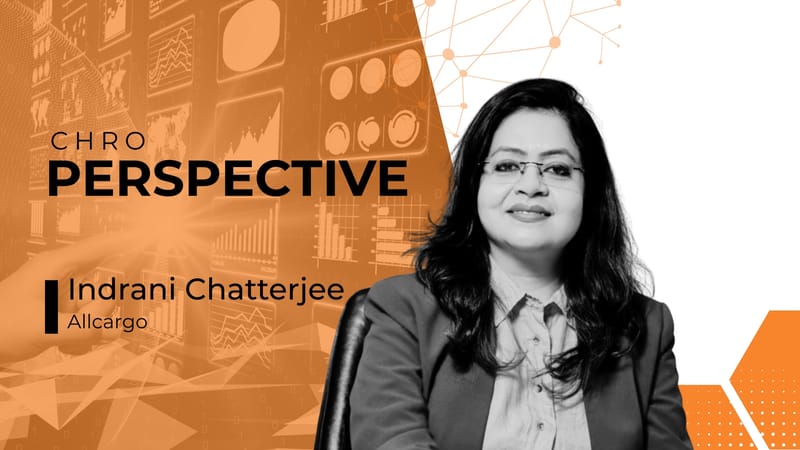
In an exclusive conversation, we sat down with Indrani Chatterjee, Group Chief Human Resources Officer at Allcargo, to explore this strategic transformation. She shares her insights on leading through constant change, the importance of predictive analytics, and how she is preparing Allcargo for a future where technology and a people-first philosophy are inextricably linked. The discussion explores how HR can bridge the gap between human capabilities and technological ambitions, thereby reshaping the talent landscape of an entire industry. Edited excerpts
Q. Having spent over two and a half decades in the industry, you have witnessed HR's transformation firsthand. Could you describe how the strategic demands on the HR function have intensified in the post-pandemic era, particularly with the rise of a dispersed workforce?
Over the last two and a half decades, I have witnessed changes in tranches of five years, not just in recent years. The shift from hard-copy CVs to emails and then to job portals was a major transformation. However, the last five years, accelerated by the pandemic, have been different. Things have become much faster, and a five-year plan is now a luxury. It has shrunk to three years and will soon be two. This has led to an emphasis on making fast decisions, thinking proactively, and utilising predictive analytics. Our people must also be prepared for constant change and have a Plan B or C in place.
I think the biggest learning is to be prepared and not be complacent. We need to stay updated on potential changes, anticipating what could go wrong and how to navigate those challenges. It is about combining an inward look at our own gaps with an outward view of the industry.
Q. What are the most significant talent challenges and hiring trends you are seeing in the logistics industry?
I will break that down. The biggest challenge is the paucity of seasoned logistics professionals at the mid- and senior levels. The industry, up until recently, was not a preferred choice for many, and it remains largely unstructured with small players. This creates a talent pool that isn't as robust as it could be.
Regarding the new workforce, particularly Gen Z, the challenge is universal, not just in logistics. This generation is not used to taking orders and is very focused on their purpose. They are transparent and won't hesitate to leave if they see a disconnect between their purpose and their work. This is leading to higher attrition. However, they are also bringing a lot of great qualities to the workforce.
Q. So you are saying that the logistics industry is struggling to get young talent?
It is a mixed bag. Segments like e-commerce and tech logistics are attracting a significant amount of young talent from premier campuses because they are perceived as more modern and aligned with technological advancements. The traditional side of the business continues to struggle to attract this talent. The industry as a whole needs to be promoted as a preferred employer, and the infrastructure needs to be more adaptable to all genders and work styles.
Q. Companies today comprise a multi-generational workforce. How do you ensure clear and consistent communication across different employee segments while taking into account their unique preferences for receiving information?
We have a multi-generational workforce with baby boomers, millennials, and Gen Zs. There is no one-size-fits-all solution, but one thing that works for every generation is crisp and clear communication. We believe in over-communication because even if you send ten emails, people might only read two. If you send two, they might not read any. It's better to over-communicate and ensure the message is absorbed rather than assume it has been. This is a common strategy among global CHROs today.
Q. How have you adapted your talent acquisition strategy to combat the accelerated decay of skills in today's market?
The need to upgrade is constant, much like the annual release of a new iPhone. There are core "old-school" skills that I always look for, such as resilience, ambiguity management, a positive attitude, and transparency. These are non-negotiable and are harder to teach.
In terms of new skills, tech savviness is a must. Five years ago, I wouldn't have looked for this in every role; however, I do now. It is not just for the IT team; I need to know what HR professionals, finance professionals, and business professionals know about technology in their respective functions. We also seek individuals who have successfully led change and transformation.
Q. Given that AI is set to automate a significant portion of transactional tasks, how do you see the roles of middle and senior management evolving? What new responsibilities or skills will be most critical for them to remain relevant in an AI-driven environment?
AI will take jobs, but primarily repetitive, low-level tasks. It will provide a wealth of data and insights for middle and senior management to design more effective strategies and make informed decisions. From what I have seen, AI is an aggregator of existing data. It is not thinking on its own. The base level of every function will be impacted, but middle and top management will still be needed to manage and be more intelligent than AI. We are the ones who need to direct the machine, not the other way around.
Q. With AI emerging as a core driver of efficiency, what specific initiatives is Allcargo undertaking to lead the transformation of the logistics sector?
AI is impacting logistics in a similar way to how it's affecting every other industry. It is not an IT imperative, but a business imperative, and we are using it to drive positive change. We are using AI in our digital teams to improve efficiency and enhance customer experience. For example, we utilise chatbots to address employee queries and automate repetitive logistical tasks. AI is a tool to make us smarter, faster, and more effective. We have even created new departments focused on AI and data science to analyse and leverage our data.
Q. As an HR leader in an industry with a significant carbon footprint, how do you align your talent and people strategies with the organisation's broader sustainability and ESG goals?
We are committed to achieving carbon neutrality by 2040. As a logistics company, we move goods via rail, road, and ocean, all of which have a carbon footprint. While the ESG team drives the overall strategy, our role is to ensure that our people are aligned with this commitment. We foster a culture that prioritises our ESG goals.
Q. You prefer the word "inclusivity" over "diversity." Is that correct?
I find the word "diversity" to be discriminatory. It implies that I am identifying you as different from me. I prefer "inclusivity" because it means that as long as you have the right competencies and skills, you are included, regardless of your gender, nationality, or age.
Q. As an industry traditionally seen as male-dominated, what specific barriers are you working to dismantle to attract and retain female talent in logistics?
As a group, we are performing well, with nearly a 50 percent representation of women globally. However, in India, that number is around 17-18 percent. This is because the industry was long perceived as male-dominated due to infrastructure issues, such as a lack of proper restrooms, and the nature of the work, which sometimes requires long hours.
To increase women's participation, we have launched several initiatives aimed at promoting their involvement. Our policies are very inclusive, and we give equal opportunities during hiring and promotions. We also introduced an all-women shift in our Express division and a 'Restart' program to help women who have taken a career break. We need society to step up and support women in getting back to work.
Q. What is the single biggest legacy mindset that CHROs in the logistics industry must overcome to be more of a strategic partner?
The biggest mindset to overcome is the idea that HR is a support function for the CEO. We are not. We should be business leaders. CHROs need to understand the bottom line and the P&L. There should be only one metric in an organisation: business metrics. All other metrics, including those for HR, should be integral to the business metric. Attrition, for example, is not an HR problem; it's an organisational problem. CHROs must stop focusing on HR jargon and become fluent in business outcomes.
Q. In an industry on the cusp of a technological revolution, what is your five-year vision for the logistics workforce, and how are you building the talent required to make that a reality?
I think the logistics segment will merge completely with technology. Everything we do is about moving goods from point A to point B, and technology is making that more efficient. Logistics will follow the path of the airline industry, which is now almost entirely tech-driven. The workforce will be more agile and tech-savvy. The future of logistics is heavily influenced by technology, and our workforce will need to adapt accordingly.
This story is part of CHRO Perspective. A People Matters series featuring bold ideas and real-world insights from India’s top CHROs. Stay with us for more perspectives that power the future of work.
Topics
Author
Loading...