







Leadership
Coforge's Khanna on why leaders must still get their hands dirty and execute




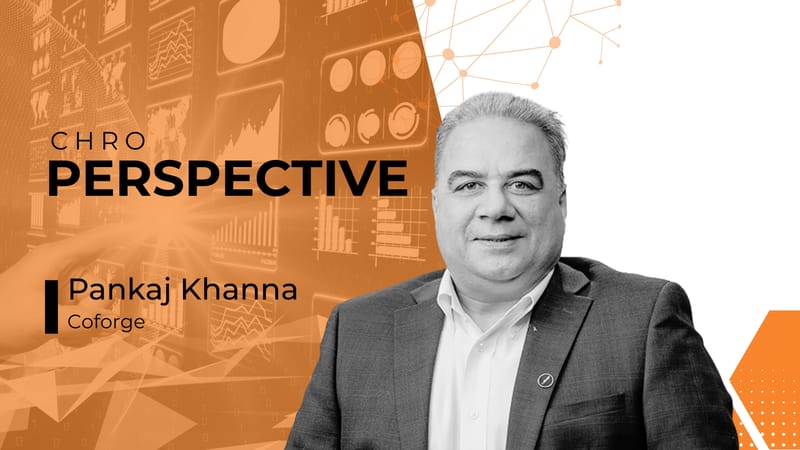
As leaders become more senior, there is a natural tendency to delegate everything. In this high-growth environment, we can't afford that, says Khanna.
In an era where technology firms are grappling with the twin forces of hyper-growth and systemic disruption, the role of the Chief People Officer has never been more pivotal. Pankaj Khanna, Chief People Officer at Coforge, leads a company that not only navigates this volatility but thrives in it, boasting an industry-leading low attrition rate.
In this candid interview, Khanna dissects the strategic blueprint behind Coforge's success, beginning with his fundamental leadership philosophy, which is built on clarity and transparency. He explains that the CPO's new mandate is to push leaders to "get their hands dirty" in the pursuit of aggressive growth. Edited excerpts
Q. As a seasoned talent leader, what fundamental philosophy guides your approach to managing people, and how have you had to adapt that style in response to the immense volatility and growth challenges of the last four to five years?
My core philosophy, which has remained the constant foundation, centres entirely on clarity and transparency. Whenever I bring people onto the team or review our existing workforce, I need them to understand three non-negotiables: what the role entails, the exact success parameters, and how that role fits into the organisation's unique culture.
I have not felt the need for a radical shift in that fundamental style, but the application of my leadership has been intensely refined due to Coforge's aggressive growth journey. The biggest tweak has been aligning our leaders with the sheer scope and pace of that growth.
You see, as leaders become more senior, there is a natural tendency to delegate everything and manage from a distance. In this high-growth environment, we can't afford that. My adaptation has been to insist on a leadership style where people are not only comfortable with the strategic vision but are absolutely willing to get their hands dirty and lead by example. We need leaders who understand the bigness of the growth but are ready to jump into the execution with their teams. That focus on aggressive, hands-on growth has become the primary challenge and adaptation point.
Q. The last few years have introduced a multi-generational, hybrid workforce, alongside the rise of AI, which fuels job insecurity. As a talent leader, how do you address these evolving expectations, particularly around flexibility and job security, while ensuring that the workforce views technology as a support, not a threat?
You know, regardless of the generation, one constant remains: everybody wants to know, 'What is in it for me?' While we can talk about purpose and well-being, let's be honest—compensation is still the most critical factor. Unless those dollars are hitting the account, very little else matters.
However, we are definitely seeing shifts. The current generation is focused on the present; they have a very limited concept of long-term future savings. For them, life is about today, their mental well-being, and they are inflexible about their personal time; they are going to take all 20 days of leave, for example. This means their attention spans for engagement programs have naturally decreased, so we have to adapt by creating much crisper, shorter-duration programs that provide them with immediate value.
The other major factor is AI. We don't see AI as a replacement; we see it as AI with humans. The core change is that AI tools now provide not just data, but also analysis and the most plausible options, which is a significant leap. The bigger challenge, though, lies in the talent pipeline itself: our universities are still producing graduates with a pedantic, theoretical focus. We have to invest in training them explicitly, telling them: we want you to communicate, have a point of view, and introduce conflict when you disagree. We are prioritising quality over quantity to ensure we are preparing people for the actual demands of the job, not just the exam hall.
Q. You have highlighted a critical mismatch between the talent coming out of our universities and the actual needs of the industry. As a talent leader in a major corporation, what is the best way to narrow this gap, and who should take the lead in aligning academia's curriculum with today's requirements?
That's an interesting and, frankly, vital question. Look, both industry and academia are honestly trying their best. We have seen many attempts at curating curricula over the years, which is why you see so many big corporate names getting involved in the university and education space—because they want to offer a better chance of preparing students.
However, the real, underlying problem is philosophical and societal. It's the laziness of the input population—the student generation itself. Everything is now available at the touch of a button. An entire PhD is available online, instantly. We have become so accustomed to ease, whether it's ordering food or shopping, that we have lost the art of going outside and engaging with the world. We have replaced social interactions with individual, at-home convenience.
I don't know who or where the solution will ultimately evolve, but I know this: as long as the student population doesn't fundamentally believe there is a personal need to shake off that laziness and push beyond what's immediately available, we will continue to struggle. Both academia and industry can offer inputs and partnerships. Still, the ultimate power to narrow that gap rests with the individual student recognising that they must take ownership of their preparedness.
Q. I understand that Coforge has one of the lowest attrition rates in the IT industry. Could you explain how you manage to sustain it, especially when the industry is fighting this intense 'war for talent' and seeing high turnover among newly trained professionals?
The war for talent will likely persist as long as the industry continues to grow. Today it's AI, yesterday it was full-stack development, tomorrow it will be something else; it's just the flavour of the day. Of course, that creates a short supply, and companies end up competing and throwing money at people. However, we have maintained an attrition rate of less than 12 percent over the past two to three years, which is indeed the lowest in the industry. We sustain this through a three-pronged approach.
First, we have a powerful lineage in training. We understand what it takes to create a fully trained, risk-ready professional. We invest in providing customised training programs and learning platforms without rigid time constraints. Second, our growth creates internal opportunities. At Coforge, we are clear that seven out of ten times, we will try to offer people internal mobility, even if they are only 50 percent ready for the role. We acknowledge that three out of ten might fail, but that doesn't stop us from pushing them into client-facing, decision-making, or leadership roles earlier than the outside world would expect. This empowerment makes people feel valued. Third, we have a unique culture of execution and decisiveness. We don't like to dither or waste time "dancing around" a decision. We believe in taking a call, even if it might be a bad one—we'll live with it, but we won't delay. This approach empowers management and leadership at all necessary levels to act, and people find that comfort and autonomy—that sense of control—to be a powerful reason to stay with us.
Q. I have spoken to many leaders who say their hiring strategy is shifting dramatically—the average age of candidates is dropping, and the shelf life of technical skills is collapsing rapidly. They now prioritise attitude and the willingness to learn new skills. Are you seeing similar strategic shifts at Coforge, particularly in how you balance specialised skills against a candidate's aptitude?
In terms of overall strategy—where and how we hire, whether from campuses, outside, or specific locations—that's always dictated by our business plan. If the business wants to grow in a certain area, that is what we do. But the methodology and criteria for assessment are indeed undergoing a profound shift.
The biggest realisation we have had is that the world is moving toward the fact that I don't need one skill; I need three skills in one person. We have to balance that out: I could hire one person for one skill and train them, or I could pay more and delay hiring someone who already has all three. We employ a mix-and-match approach, but the days of picking up people from outside and training them from scratch are largely behind us, especially since we're already paying competitive rates.
The biggest change, though, is in the expectations coming from our clients. They are demanding talent that is more articulate, communicative, and conflict-oriented. They need people who are smarter, younger, and willing to challenge established patterns. This was once an expectation reserved for only a few senior leaders; now, clients expect it from virtually everyone, as they face the pressure of shorter cycles and massive digitalisation—just look at the speed with which industries reacted to the recent GST cuts. This requires a sense of preparedness and readiness from our talent to manage that rapid change, and for our clients, quality, not just cost saving, is now the most crucial driving factor.
Q. Do you see entirely new roles and functions emerging within Coforge as a natural result of your growth? Can you provide an example of a job that didn't exist in your repository two or three years ago?
Absolutely. When you are consistently growing at 16 to 24 percent year-over-year, as we are, new roles are continuously cropping up. They often come either "creepily" or unannounced, meaning we sometimes have to find one or two gems and then start building the entire function around them.
The best way to illustrate this is by looking at what we call "combo jobs." It is no longer enough to hire just a "Data" specialist or an "AI" expert. Today, we need to understand how this data and AI will specifically work within a client's retail domain to impact their customer behaviour. That is a combination of four distinct things collapsed into one new job.
Another example is driven by the industry's need for Legacy Modernisation. Mainframe technology is often considered outdated; however, clients need to migrate those older platforms to new ones. Therefore, we need to find someone who understands the old mainframe, possesses the necessary technical expertise to handle the new platform, and can effectively manage the modernisation journey. It is essentially a combination of very old and very new skills collapsing into one strategic role.
Q. Looking ahead to 2030 or 2035, how do you envision the future of the IT talent workforce in India? What kind of shifts will we see in talent evaluation and the overall workplace?
I believe the IT workforce will absolutely continue to increase. In my mind, there is really no debate that the number of jobs will shrink. I keep reminding everyone that machine learning and automation have been around for 15 to 18 years, and they have not led to a reduction in roles; instead, they have simply increased the complexity of the available roles. We saw it with manual testing moving to automation testing—the job didn't disappear, it evolved.
The same dynamic will unfold with AI. It will become more about "human plus AI," not AI replacing humans entirely. Yes, some basic, repetitive tasks—such as answering simple queries on a bot—will likely be impacted and may disappear because there is truly no value beyond answering a basic fact. But the complex roles will continue to work.
Ultimately, the number of jobs will go up, but the roles themselves will be different. The core shift will be at the bottom of the pyramid. Universities and engineering institutions will realise they can't just offer generic courses; they'll need to offer specialised programs and add necessary elements everywhere to ensure people are job-ready. The fact that data with language has now come in as an interpretation tool will lead us to some truly interesting and exciting places.
This story is part of CHRO Perspective. A People Matters series featuring bold ideas and real-world insights from India’s top CHROs. Stay with us for more perspectives that power the future of work.
Author
Loading...