







Leadership
Complementary chaos: Deciphering the Darwinbox decade





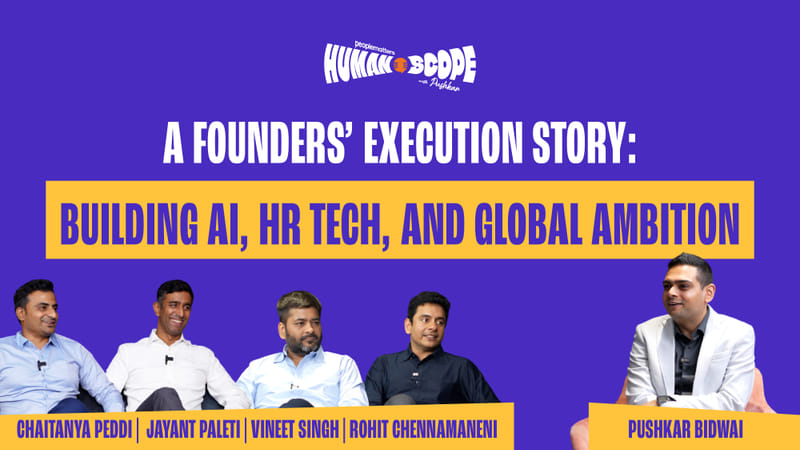
Darwinbox founders share their journey, AI vision, and ambition to build a global HR tech franchise on the Humanscope podcast.
Every meaningful creation begins beneath the threshold of visibility. A millimetre of conviction creates a spark. An inch of progress finds the rhythm. A mile of persistence weathers the friction. And if sustained long enough, those inches turn into the architecture of decades.
People Matters CEO Pushkar Bidwai finally gathered the founding quartet of Darwinbox—Jayant Paleti, Chaitanya Peddi, Rohit Chennamaneni, and Vineet Singh—in a special and long-awaited episode of the HumanScope podcast to delve into their decade-long journey.
The banker, the consultant, and the "people angle"
Before Darwinbox was a Unicorn, it was an observation made in the high-pressure corridors of investment banking and global consulting. Jayant Paleti, a former banker, noticed a recurring glitch in the matrix of corporate success. As a banker, you realise that the success or failure of a deal often hinges on the people involved. However, Jayant reflected, "We don't often discuss the process of getting a deal done."
That insight lingered. If people determined the fate of businesses, why were the systems designed to manage them so fragmented, rigid, and uninspired?
This observation led to a pivotal conversation with Rohit Chennamaneni and Chaitanya Peddi. For Rohit, having worked with global systems, the limitations were evident firsthand. Drawing from his experience at Google, he felt the stark contrast between cutting-edge consumer tech and the archaic systems used by enterprises, which often hinder innovation and efficiency in business operations. "I hated what I was using," Rohit admitted. "All my customers were also using terrible systems. So that was definitely one thing I thought: Why are there such bad HR systems?"
Chaitanya met the idea with scepticism—a sign of his seasoned HR experience. He knew the incumbents had balance sheets "bigger than the GDPs of some African companies". He recalled his initial reaction to the pitch: "My first reaction was to laugh very, very loudly for five minutes." Yet, he couldn't ignore the data. The gap was real. The opportunity was immense.
Building an enterprise-grade reality
To turn this vision into a structural reality, they needed a master Chief Technology Officer (CTO) who could handle the complexity of enterprise architecture, which refers to the high-level structure of an organisation's IT assets and how they align with its business goals. Ideas remain abstract until someone writes the first line of code. For Darwinbox, that responsibility fell to Vineet.
After a series of LinkedIn cold calls and missed connections, Jayant finally caught up with Vineet on his birthday. “He was calling me continuously,” Vineet recalled. “I thought, let’s talk to him.”
Jayant's bold proposal called for creating an enterprise-level product in six months. Looking back, Jayant remarked, “We were never short of ambition."
Vineet, who had spent years as an engineer, saw both the scale of the challenge and the clarity of the opportunity, recognising that the success of Jayant's bold proposal would require not only technical expertise but also effective collaboration among the founders. Together, the four founders formed a complementary architecture of ambition.
The digital town square
The founders didn't just want to build another HR tool; they wanted to redefine how work is managed. Jayant describes the Human Capital Management (HCM) platform as the "digital town square." This is the core metaphor of the Darwinbox philosophy. While a CRM touches sales and an ERP touches finance, the HCM is the only system that reaches every single person in the hierarchy, from the CEO to the delivery driver.
"A delivery person or a person on the shop floor will never log into a CRM or an ERP," Jayant explained. "But he has to log into an HRMS to see his payslip, mark his attendance, or look at his leaves." By owning this "town square", Darwinbox became the primary interface through which employees experienced their professional lives.
The four cornerstones
One of the most compelling segments of the podcast explored the internal chemistry of the four founders. They are a study in complementary personalities, providing a blueprint for how a multi-founder team can scale without fracturing.
-
The Optimist: Jayant Paleti. As Rohit puts it, "If you could pick up the phone and call both of us and say, let's start an HRMS in 2015... You don't need to know who the optimist is."
-
The Scientist: Chaitanya Peddi. The "detail-oriented person" who thinks of a product with scientific precision.
-
The Balancer: Rohit Chennamaneni. The logical realist who brings "good balance to the equation" and manages the group's objective judgment.
-
The Builder: Vineet Singh. The quiet engine ensured the architecture could scale.
Chaitanya emphasised that this diversity was their secret weapon: "Execution is everything. You can take the simplest, plainest idea, even if it is full of competitors, and still execute it quite well."
From HRS to the system of work
The arrival of AI marked a new inflexion point.
While many companies treated AI as a feature, Darwinbox saw it as a structural shift.
Chaitanya calls AI a “foundational shift.” But rather than rushing to wrap language models into features, Darwinbox invested in infrastructure — self-hosted models, governance guardrails, and orchestration engines. This evolution extended Darwinbox’s role beyond HR. It was no longer simply about managing employees. It was managing work itself.
Vineet reframed the AI narrative sharply. “Everyone is focusing on laziness: write me this, generate me that,” he said. “There are things that can improve accuracy. Some things can improve efficiency.” That distinction matters. Laziness is table stakes. Efficiency and accuracy create real enterprise value.
Darwinbox’s laboratory
As Darwinbox enters its second decade, the founders are looking beyond traditional HR boundaries. The goal is to evolve from an HR system to a "system for work, where work happens". Ideas, the founders insisted, were only the beginning. What mattered was persistence and execution. “The ambition which we started in 2015,” Jayant reflected, “remains unwavering.”
What has evolved is the scale, the reach, and the responsibility that comes with it. What hasn’t changed is the belief that enduring companies are not built on ideas alone, but on the willingness to stay the course long after the excitement of the beginning fades. The founders spoke not of arrival, but of continuation.
And even as the world sees the product, somewhere behind the interface, the next experiment is already cooking in the lab.
Watch the full episode here.
Topics
Author
Loading...