







Leadership
Courage and Curiosity: Novo Nordisk GBS' Dawber on CHRO's core skills


|
Updated on


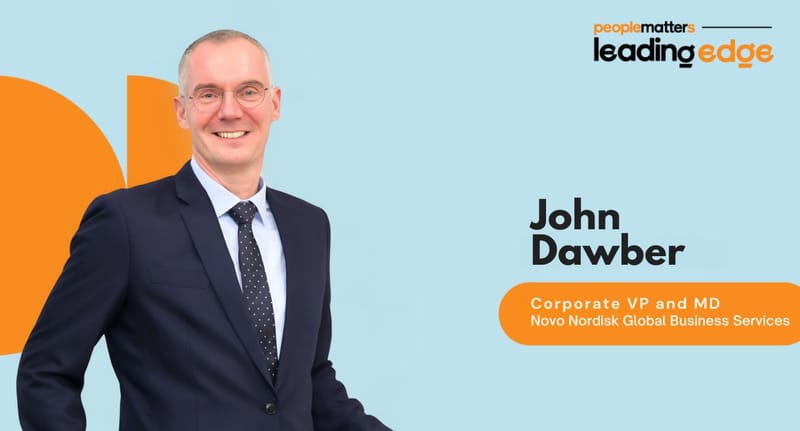
Dawber actively hires HR leaders based on their curiosity about the business, including its strategy, direction, and financial and human resource challenges.
In the modern corporate landscape, the role of a Chief Human Resources Officer has evolved beyond traditional functions, becoming a critical strategic partner with the CEO. This transformation is not merely theoretical; it is being meticulously put into practice by leaders like John Dawber, Corporate Vice President and Managing Director at Novo Nordisk Global Business Services.
In this candid LeadingEdge interview, Dawber, a veteran leader with over two decades of global experience, shared how a people-first philosophy, shaped by diverse cultural experiences and a pivotal moment of crisis, has become the cornerstone of his leadership and the driving force behind Novo Nordisk's remarkable growth story in India.
The heart of Dawber's leadership philosophy is a belief forged across continents: that "nobody gets up in the morning and comes to work with the intent of causing trouble or doing a bad job." This simple yet profound idea informs his core mission as a leader: to create an environment where the "best can come through." This is a journey he embarked on over the course of a career that spans the UK, Denmark, Japan, Thailand, and now, India.
Lessons from a global leader
Dawber's international career provided a masterclass in adapting leadership to diverse cultures. His time in Japan, a highly hierarchical society, revealed the need to challenge ingrained mindsets directly. He was confronted with a culture where career progression was slow and employees placed their faith entirely in their superiors to guide their professional journey.
Dawber saw this as a significant barrier to growth, famously quipping that at that rate, it would take "130 years" to develop a Japanese CEO. This experience lit a fire within him, fueling a passion to "put a rocket underneath the level of ambition," especially for female colleagues.
Dawber recalled the best piece of advice he received as a foreigner leading in Japan. "First, the best piece of advice somebody gave me was also relevant in Thailand: don't confuse English language ability with ability; it's often inversely correlated. A foreigner can come into an organisation and think, 'I just trust all the people who can speak English fluently,' and as a leader, that's pretty dangerous.
He remembers a moment of immense satisfaction when, for the first time, the leadership team welcomed a female vice president, breaking a long-standing male-dominated, grey-haired Japanese mold.
"Now it is much more diverse, so that sort of fueled a passion for diversity and also encouraged people to really progress their careers."
However, it was his tenure in Thailand during the COVID-19 pandemic that truly reshaped his leadership style. The global crisis, with its anxieties and personal fears, tore up the traditional rulebook of management. Dawber's core fear was not about business metrics, but about his people.
"So, it was a complete level up in realising that you had to lead an organisation with your heart and understand that the fears, insecurities, family connections, and all the things that are going on outside of work affect what people can do in work."
Dawber told his leadership team, "If we lose somebody because of a lack of engagement, we failed."
This moment of profound empathy forged a deeper commitment to employee experience and engagement, a philosophy he has since brought to the forefront of his work in India.
This human-centric approach is not a transactional choice but a core value, one that he says has been consistently reinforced by "great HR partners" throughout his career.
He openly admits that modern leadership is not about power and control, but about dealing with the "self-esteem, the insecurities, the worries, the concerns" of the workforce to create an environment where people can flourish.
The Evolved CHRO: C-suite partner, not a transactional leader
The most compelling insight from the conversation is Dawber's perspective on the evolution of the CHRO role. He views his HR director not as a functional head, but as a "critical partner" and a "complete partnership" in every sense of the word. He consults with her on nearly every major decision and actively seeks her feedback on his own leadership style.
He makes it a point to involve his CHRO in leadership meetings, not just to observe team dynamics, but to gain insights that help him improve his leadership. This level of trust and collaboration, he insists, is non-negotiable for running a modern organisation.
Dawber firmly agrees with the assertion that HR leaders must go beyond their own metrics and understand the business's profit and loss (P&L) statement and strategic goals. He actively hires HR leaders based on their curiosity about the business, including its strategy, direction, and financial and human resource challenges.
To aspiring HR leaders, he offers a powerful piece of advice: courage and curiosity. You cannot demand a seat at the C-suite table; you have to earn it. His counsel is to "jump out of your HR metrics bond" and ask questions of everything—the finance situation, the business strategy, and the "why" behind every decision.
He advocates for seeking to understand the business first before seeking to be understood, a philosophy he views as vital for propelling a leader to the top.
People-first strategy with measurable results
This partnership between a people-centric MD and a strategic HR function has led to remarkable results at Novo Nordisk. Three years ago, the company faced a dual problem: an annual attrition rate of 18 percent and a struggle to attract top talent. Dawber and his HR partners went beyond surveys, conducting in-depth conversations to understand the root causes of employee discontent.
The resulting initiatives were a testament to their human-centric approach:
A Focus on Employee Experience: They meticulously improved day-to-day work life, from upgrading food and transportation services to ensuring comfortable office environments.
Investing in Development: They launched programs like "blind date mentoring," which matched employees with mentors based on skill needs, and dedicated leadership programs for women.
The Flamingo Program: A program to support new mothers, providing pre- and post-maternity benefits that were, in some cases, unheard of in the industry. This initiative alone reduced the significantly high number of new mothers not returning to work to almost none.
The results speak for themselves. The annual attrition rate plummeted from 18 percent to a mere 6 percent. Employee experience scores soared, earning the company "Best Place to Work" awards. The company's Net Promoter Score, as measured by exit interviews—a key metric for determining how likely a departing employee is to recommend the company—consistently sits in the high 60s, a testament to the positive impact it has made on people's lives.
The Future of Work: A blend of AI and core human skills
Looking ahead, Dawber is optimistic about the future of the Indian workforce, which he calls "unparalleled." With an abundance of medical doctors, business graduates, and a new generation of talent that is "digital-first," he believes India is the obvious place for a company like Novo Nordisk to find the skills and scale it needs.
On the topic of AI and its impact on jobs, Dawber is pragmatic. While acknowledging that some transactional work will be automated, he says the company has been preparing by upskilling its existing workforce through "citizen developer" programs and consciously hiring for higher-level, "thinking roles" that are less vulnerable to automation.
He cites a specific example where they partnered with a startup to automate the quality checking of clinical reports, reducing a 40-hour task to less than an hour, freeing up medical doctors to focus on more complex, value-added work.
Novo Nordisk in India is also actively trying to inspire graduates to join the workforce by highlighting that the new generation workforce has grown up with AI and automation, so they don't have to be forced to adopt it. They already understand these tools. This mindset allows them to bring their curiosity and operate at a higher level from day one.
"The next five to ten years will be an exciting time for recent graduates, as they can leapfrog their careers and progress much faster than previous generations simply because they are already familiar with the tools that many organisations are still trying to grasp," believes Dawber.
In a decade, while AI skills will be essential, Dawber believes that what we used to call "soft skills" will become the new core skills. The ability to collaborate, critically challenge, speak up, and exercise curiosity will be non-negotiable. It is the "human in the loop" who will always be a critical component of leadership and innovation.
Dawber's leadership at Novo Nordisk is a powerful example of how a modern C-suite partnership, with HR at its core, can drive not only business success but a truly meaningful and sustainable organisational culture. It is a testament to the idea that in an age of unprecedented technological change, the most effective path forward is one paved with empathy, courage, and a relentless focus on people.
In this season of LeadingEdge, we are delving deeper into the leadership styles of C-Suite leaders with a significant focus on their ability to empathise with their people, understand the challenges of their workforce, and initiatives to build a people-friendly organisation. We are also decoding the evolving relationships between the C-Suites and the CHROs to drive the company towards a growth trajectory.
Topics
Author
Loading...