







Leadership
From artisans to entrepreneurs: The people-first story behind Jaipur Rugs






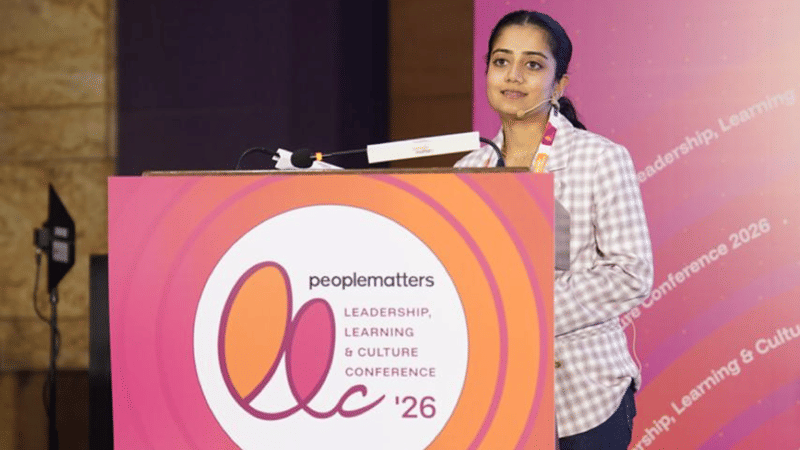
Chaudhary's philosophy shaped Jaipur Rugs' culture, including its decision to rename HR as “Human Soul”, which reflected a belief that employees are people with potential, not simply organisational resources.
For Nand Kishore Chaudhary, the story of Jaipur Rugs did not begin with a product. It began with people.
When Chaudhary started the business in 1978 in Churu, Rajasthan, he had two looms, nine artisans and around INR 5,000 in capital borrowed from his father. There was no large organisation, global vision or established business model. What he did have was a desire to work with people and create something meaningful.
Nearly five decades later, that founding belief has shaped the way Jaipur Rugs approaches its artisans, employees, leadership and business.
Speaking in a keynote at People Matters Leadership, Learning & Culture Conference (LLC) 2026, Sushmita Agnihotri, Retail Excellence Manager, Jaipur Rugs, shared lessons from Chaudhary's journey and how a people-first philosophy became embedded in the company's business model.
Seeing artisans beyond their job
When Chaudhary began working with rural artisans, he did not view them simply as labour. Instead, he saw people with skills, creativity, knowledge and aspirations. He spent time with artisans, visited their homes and villages, shared meals with them and tried to understand the challenges they faced.
That perspective became foundational to Jaipur Rugs. "The artisans aren't the people who just work for the business. They are the whole heart and complete soul of the business," Agnihotri said, describing the philosophy that evolved around Chaudhary's leadership.
His approach was shaped not only by conventional business education but by years of travelling through villages in Rajasthan and Gujarat and spending time with weavers and their families.
Those experiences became a different kind of classroom. The women and men he worked with taught him about resilience, patience and responsibility, Agnihotri said. Their experiences also challenged conventional assumptions about rural workers and what they were capable of achieving.
The shift was from seeing people according to their roles to recognising their potential.
"People should be seen for their potential and not just for their job role," Agnihotri said, identifying one of the key lessons from Chaudhary's journey.
A founder's growth is part of organisational growth
As Jaipur Rugs expanded, Chaudhary's own approach to leadership had to change.
Like many founders, he was initially involved in almost every decision. Problems, challenges and opportunities ultimately came back to him. But as the organisation grew, he realised that he could not solve everything himself.
That required something many founders struggle with: letting go.
Delegating responsibility meant trusting others to make decisions, and accepting that they would sometimes make mistakes. For Chaudhary, this became part of his evolution as a leader.
"Trust them in the mistakes that they make, in the successes that they have," Agnihotri said, explaining how Chaudhary learned to move from directly managing the organisation to developing people who could lead it.
The lesson went beyond delegation. For an organisation to grow, its founder must also grow.
Taking the same decisions that worked in 1978 would not necessarily work for the organisation decades later. While leaders often focus on changing the business around them, Agnihotri said, it can be harder to examine what needs to change within themselves.
Over time, Chaudhary increasingly focused on listening, understanding challenges, developing people and creating leaders rather than retaining every responsibility himself. "To grow the world, you need to grow your inner self as well," Agnihotri said.
From following designs to creating them
Perhaps the most powerful example of this philosophy emerged through Jaipur Rugs' approach to its weavers.
Traditionally, a weaver creates a rug according to an existing design. But Chaudhary began exploring what could happen if weavers were given the freedom to create their own designs.
That idea was reinforced by his daughter, Kavita Chaudhary, who had spent time working in the field and believed that the weavers possessed extraordinary creativity.
At first, Chaudhary found it difficult to understand how the weavers could possess more creative potential than his daughter, who had received formal education at the School of the Art Institute of Chicago. But the experiment changed his perspective.
The initiative eventually became Manchaha, a collection that gives weavers the freedom to create their own rugs rather than simply reproduce predetermined designs.
Once the women weavers were given that freedom, their personal experiences began finding expression in their work. Memories became colours, experiences became designs and imagination became art.
The result demonstrated something Chaudhary had previously been unable to see: the creativity and artistic ability had always existed. What was missing was the opportunity to express it.
The weavers could now look at a finished rug and say, in effect, I made this. I created this from my own ideas and thoughts.
Some of these rugs went on to receive international recognition, including a German Design Award. For Jaipur Rugs, the significance went beyond employment.
It was about recognising capability, giving people a voice and creating an environment in which they could explore what they were capable of.
The transformation was therefore not simply from artisan to designer. It was from being given a design to being given the freedom to create.
Making purpose visible in everyday decisions
Chaudhary's philosophy also influenced the culture within Jaipur Rugs. Purpose, Agnihotri explained, cannot simply exist as a statement on a wall or inside a corporate document. It has to be visible in everyday decisions, in how people are treated, how leaders behave, how employees work, how problems are addressed and how much freedom people are given.
Even the language used within the organisation reflected this philosophy.
The HR function was renamed Human Soul, reflecting the belief that employees were not simply resources hired to perform jobs. They were part of the organisation's broader journey and should have opportunities to develop their capabilities.
The underlying principle was that when people enter an organisation, they should have the opportunity to grow, both in their roles and as individuals.
When purpose and business become one
Perhaps the most important lesson from Chaudhary's journey is that he did not see purpose and business as competing priorities.
A business still has to be financially sustainable. It has to serve customers, maintain quality, innovate and grow. But the way it grows matters.
When people are given opportunities to develop, they can create better work. Better work can build customer trust. Customer trust can create new business opportunities, which in turn can provide the organisation with greater capacity to invest in its people.
It becomes a cycle in which people, purpose and business reinforce one another. "It is not about choosing people instead of a business. It is about creating a business in a way that allows people and business to work together," Agnihotri said.
That distinction lies at the heart of Jaipur Rugs' story.
Leadership as a movement, not a moment
Agnihotri said the story of Jaipur Rugs is ultimately not about rugs, even though rugs are the product. It is about what can happen when people who have historically been overlooked are given opportunities; when leaders choose to listen rather than simply instruct; and when individuals are given responsibility and enough trust to discover their own potential.
She identified three lessons from Chaudhary's leadership journey: see people for their potential rather than merely their job roles; understand that trust enables an organisation to grow beyond one individual; and recognise that leadership is not only about building a business, but about building people alongside it.
The metaphor of weaving captures that philosophy. A rug is not created in a single moment or through one decision. It is built knot by knot and thread by thread, with thousands of individual actions eventually coming together to create the final picture.
Organisations are built in much the same way. Jaipur Rugs did not become what it is because of one decision or one defining moment. It evolved through relationships with villages, artisans, employees and customers, and through the belief that every person involved in the journey has a role to play.
Chaudhary began with two looms and nine artisans. What followed was a journey across villages and countries, but also a journey into a different understanding of what it means to build an organisation.
The objective, in this view, is not simply to create a larger business. It is to create an environment in which people can become more capable, confident and independent.
That is the essence of building a business around human dignity, and, ultimately, the purpose behind the story of Jaipur Rugs.
Topics
Author
Loading...