







Leadership
Holger Mueller's HR Playbook: Infinite computing, AI, and the rise of the Chief People Officer



|
Updated on


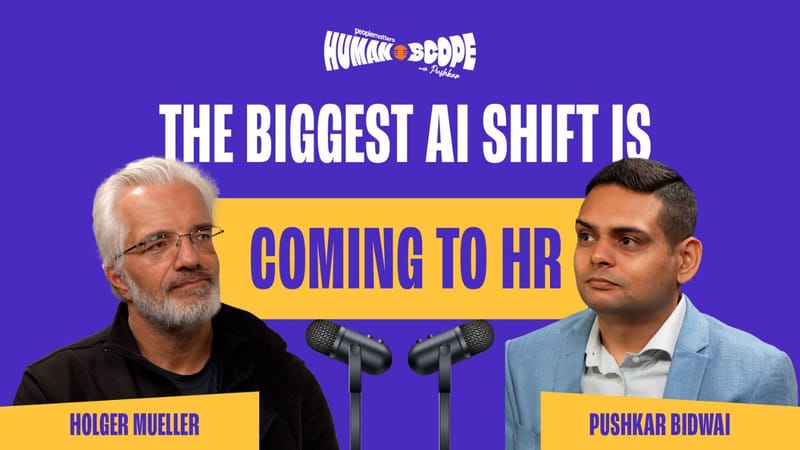
Mueller, whose career traverses engineering, enterprise software, research, and advisory across continents, has witnessed—and shaped—the evolution of work firsthand and offers a perspective that is as technically grounded as it is strategically visionary.
In the rapidly shifting landscape of global enterprise, the conversation often oscillates between the "human" at the centre of work and the "machine" powering its efficiency. In a recent episode of the People Matters Humanscope Podcast, Pushkar Bidwai, CEO of People Matters, sat down with Holger Mueller, Vice President and Principal Analyst at Constellation Research Inc., to bridge this divide.
Mueller, whose career traverses engineering, enterprise software, research, and advisory across continents, has witnessed—and shaped—the evolution of work firsthand and offers a perspective that is as technically grounded as it is strategically visionary. What follows is an exploration of the key themes and actionable intelligence from their exchange, crafted for the talent community seeking clarity and vision amid rapid transformation. For the talent community, the takeaway is clear: the age of HR as a purely administrative or "compliance-first" function is over. We are entering an era of "Infinite Computing," where the Chief People Officer must become a master of technology to truly serve the human resource.
The Role of HR: From “HR IT” to Chief People Officers
Mueller offers a sweeping perspective on HR’s often uneasy alliance with technology. Where functions like finance or manufacturing have long made their own decisions about digital tools, HR’s relationship with IT has been far more dependent and, at times, fraught. The emergence of the “HR IT” function—a role intended as a trusted technological bridge—created a subtle but significant disconnect. Unlike their peers in other functions, many HR leaders became accustomed to deferring technology decisions, relying on intermediaries rather than developing their own digital fluency.
This, Mueller asserts, has prevented HR from owning its own technological evolution, leaving it less agile and less influential than other CXO roles. He challenges today’s HR professionals to reclaim that ground: “Are you tech-savvy? Are you actively learning and mastering the new tools that shape work, or are you still handing off those decisions?”
For Mueller, this reckoning is not just about tools, but about identity and purpose. He urges a rebranding from “HR” to “Chief People Officers”—a shift that places people, rather than resources, at the very heart of the function. This is more than semantics: it signals a new era where people leaders are expected to be genuinely bilingual—able to navigate the nuances of human behaviour and organisational culture, while also confidently leveraging data, AI, and emerging technology to drive real outcomes. The Chief People Officer, in Mueller’s view, is the architect of an integrated future where empathy and digital dexterity go hand in hand.
AI in HR: The biggest lever for organisational change
Mueller is unequivocal: “AI is not the future—it’s now.” HR, he contends, is poised to see the most profound impact from AI adoption. Why? Because every employee interacts with HR processes, and the function is simultaneously less complex than, say, manufacturing, but more universal in scope.
AI’s first and most immediate contribution, he says, is the elimination of drudgery—the repetitive, low-value tasks that sap HR’s bandwidth. Payroll queries, compliance checks, and policy clarifications are ripe for automation. But rather than a threat, Mueller frames this as liberation: “The change will free up so much. It’s the first priority of AI: get rid of what nobody really wants to do, and make space for what matters—talent management, coaching, and nurturing.”
Talent Management: From fragmentation to the “talent depth chart”
One of Mueller’s most compelling ideas is the “talent depth chart”—a concept borrowed from sports, where teams know exactly who can step in if a key player is unavailable. In enterprises, achieving this means integrating performance, skills, and career aspirations data—something historically stymied by fragmented systems.
With the rise of data lakes and AI, for the first time, all enterprise data can be unified, enabling real-time insights into organisational capability. The implications are profound: internal mobility, succession planning, and skills mapping can become dynamic, data-driven processes. This, Mueller suggests, is the “holy grail” for talent leaders: getting the right person in the right role at the right time, and knowing where to find them—across functions, geographies, and levels.
Skills, learning, and the end of “one-size-fits-all”
AI, argues Mueller, will finally allow organisations to deliver truly personalised learning. “There are five types of learners. We’ve always known this, but enterprise training has been school-style—one size fits all.” Now, with AI-generated content at near-zero marginal cost, learning can be tailored to individual needs, existing capabilities, and business objectives. Enterprises that seize this opportunity will accelerate capability-building and unlock untapped potential.
Yet, the skills conversation is not just about training, but about accurately mapping, updating, and matching skills to evolving roles—a task that has defied past technology waves. Mueller is cautiously optimistic, noting recent industry moves (such as Workday’s push on skills ontology) and the promise of AI to automate and maintain a real-time “skills inventory.”
Data Architecture: The race for integration
Much of the promise of AI hinges on data. Mueller is blunt about the failures of past big data projects—abandoned due to technical and human limitations. Now, AI’s appetite for data is breaking organisational silos. “If you don’t unify your data architecture, you’re at a significant disadvantage. Data lakes, not data warehouses, are the foundation for tomorrow’s HR.”
The shift from monolithic suites to best-of-breed hybrid strategies is apparent, especially in the Asia Pacific, where organisations are comfortable experimenting with multiple solutions. However, Mueller cautions that as AI scales and data gravity intensifies, the advantage may tip back towards integrated suites—unless best-of-breed vendors solve for seamless data integration.
Build vs Buy: Owning your automation destiny
The perennial debate—whether to build or buy HR technology—has gained new urgency in the age of AI and no-code/low-code tools. “If what you need isn’t on the vendor’s roadmap, it’s easier than ever to build it yourself,” says Mueller. The bar to automation has dropped dramatically, empowering even non-technical users to create bespoke solutions.
Yet, he warns against isolation: “Don’t get in trouble with your CIO or CISO. Standardisation and governance are critical, especially as agentic networks—where AI automates AI—become reality.” The future will be shaped by those who can balance agility with security and “own their automation destiny” without fracturing the enterprise ecosystem.
Measuring Value: The infinite computing era
With escalating investments in HR tech, the pressure to demonstrate ROI has never been higher. Mueller sees this as a function of a broader shift—the arrival of “infinite computing”: ubiquitous connectivity, storage, and compute power. AI will soon deliver “infinite machine learning” and, ultimately, “infinite deep learning”—where software learns from human behaviour at scale.
This will not only enable unprecedented personalisation and automation, but also enable new models for tracking impact and value realisation. For talent leaders, this means building business cases that move beyond efficiency, focusing instead on effectiveness—are we doing the right things, not just doing things right?
Leadership in the era of disruption
Perhaps most provocatively, Mueller calls for a new breed of leaders—those willing to act, take risks, and challenge orthodoxy. “If you’re not moving fast, you’re becoming a risk. The effectiveness question is super important right now.”
He draws a parallel to the steam engine and electricity revolutions: those who adapted early thrived, those who clung to the old ways were left behind. The pace of change today, however, is orders of magnitude faster. Leaders must be “mavericks”—agile, experimental, and ready to fail fast. Organisations, boards, and investors must also evolve, recognising that scale and stability, while important, cannot come at the expense of innovation and effectiveness.
Predictions for 2030: Ephemeral work, continuous transformation
Mueller’s forecasts for the next decade are both bold and sobering. By 2030, work will be “ephemeral”—with AI agents permeating every aspect of professional and personal life, blurring boundaries and enabling continuous, real-time adaptation. The talent and HR community must prepare for a world where:
- AI-driven personalisation is ubiquitous, and the employee experience is hyper-individualised
- Internal mobility, succession, and skills management are automated, dynamic, and data-rich
- The value gap between technology investment and business outcomes narrows, but only for those who unify data and embrace agentic automation.
- Leadership effectiveness trumps efficiency; those who take calculated risks outpace the rest.
- Startups and agile players will disrupt slow-moving incumbents, redrawing the landscape of “most valuable” companies.
The future of work is unfolding faster than ever, and the role of people leaders is being redefined in real time. As Bidwai’s and Mueller’s conversation makes clear, those who combine technological fluency with human insight will shape the next era of business. The challenge is formidable, but the mandate is clear: act boldly, invest in people, and architect cultures that foster innovation. In an age of relentless change, it’s not enough to keep pace—you must set the direction. The opportunity to lead transformation is here; the moment to seize it is now.
Watch the complete episode of this Humanscope Podcast, here.
Loading...