







Leadership
From People to Power: Apollo Hospitals' Madhavan on CHRO's path to CEO




While we're not there yet, their inclusion in key management personnel lists and strategic decision-making sessions is a huge step forward, feels Madhavan.
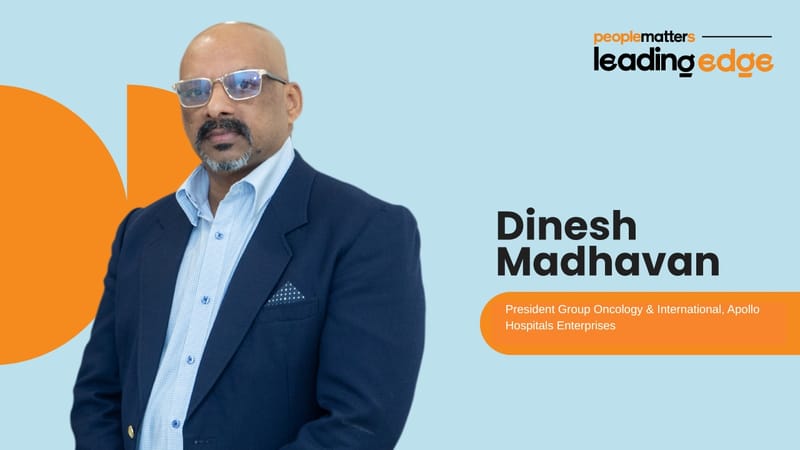
In an era of relentless disruption and rapid technological advancement, the role of the Chief Human Resources Officer (CHRO) is undergoing a profound transformation. No longer merely a supportive function, the CHRO is emerging as a central strategic partner to the C-suite, directly influencing business outcomes and shaping organisational culture. People Matters recently delved into this critical shift, particularly within the demanding healthcare sector, with Dinesh Madhavan, President of Group Oncology & International at Apollo Hospitals Enterprises.
With three decades of healthcare experience and a driving force behind Apollo Cancer Care's success, Madhavan offers a compelling perspective on leadership, the complexities of healthcare, the burgeoning power of human capital, and the evolving relationship between C-suites and CHROs.
Madhavan, a self-proclaimed "blue-blooded healthcare professional," emphasises that the sector inherently demands selflessness, humanity, and unwavering focus on patient access. However, this altruism must be balanced with harsh economic realities, such as India's high import duties on medical technology, which directly impact patient costs. He highlights the talent paradox in India, where nurses aspire to work abroad and doctors gravitate towards metros, creating a constant demand-supply imbalance.
"Leading in such an ecosystem requires a versatile set of leadership skills," Madhavan explains.
To cultivate a "people-friendly" and empathetic environment for internal stakeholders at Apollo Cancer Care, Madhavan focuses on four key factors for talent retention and growth:
Recognition: Moving beyond symbolic gestures, Apollo ensures consistent, tangible recognition for its workforce. The sector has evolved to offer better working conditions and robust nurse leadership programs, enabling nurses to advance to higher roles, including becoming CEOs.
Collaboration with Academia: Apollo partners with top academic institutions, such as ISB and IIM, to identify hidden talent and provide academic management programs. They co-create healthcare curriculums and have a significant Global Task Force program that offers employment opportunities for nurses in the Middle East, the US, and Europe. This "strategic thinking" aims to retain talent within the Apollo ecosystem rather than losing them entirely.
Economic Factors: Significant improvements in nursing pay scales, partly due to government initiatives, have been crucial. Private enterprises, Madhavan asserts, must build on this, exceeding basic requirements.
Dignity at the Workplace: This encompasses regular recognition, celebrating milestones across all categories, and offering flexible working hours. For many nurses from Tier II and III cities or the Northeast, providing accommodation and robust welfare schemes makes a significant difference in their lives.
Despite these efforts, Madhavan points out a gap: India lacks "magnet hospitals" – a concept in the West where hospitals are recognised as exemplary workplaces for nursing, attracting both talent and consumers based on internal stakeholder management.
Madhavan acknowledges that traditional leadership qualities like empathy, economic understanding, and resilience are now "tick boxes." His leadership style has evolved to prioritise empowering teams and building a purpose-led work culture. He has personally embraced a "leap year concept," encouraging teams to think four years ahead: "Where am I in my professional journey? Where am I in the organisation? What impact am I making on society?" This futuristic thinking, aligning individual growth with societal impact, is crucial.
Another significant shift is fostering ownership at every level. "Our employees no longer see themselves as mere workers but as owners of their roles, totally accountable for their success," he explains. This deep sense of belonging drives consistent effort and the adoption of global best practices, leading to continuous workshops and initiatives that uplift both internal and external stakeholders.
Madhavan keenly observes the evolving role of the CHRO, noting that in healthcare, such a function didn't even exist in its current form not long ago. Today, the CHRO sits at the same leadership table as the CTO and CFO, acknowledging the immense importance of people management.
"The CHRO is now definitely seen as a 'support mechanism' to the CEO, but I believe the ultimate evolution is for the CHRO to be seen in parity with the CEO," Madhavan states.
He argues that even with the best infrastructure and technology, "without the right human capital – clinicians, paramedical staff, and management – you cannot build the crucial interface between a patient and a provider."
He envisions a CHRO leading a large healthcare group, similar to how nurses are now advancing to CEO positions. "I aspire to see a CHRO leading a large healthcare group, similar to how nurses are now ascending to CEO positions. While we're not there yet, their inclusion in key management personnel lists and strategic decision-making sessions is a huge step forward."
For CHROs to further ascend, perhaps even becoming CEOs, Madhavan believes they must:
Move beyond traditional HR functions to understand the entire business, including its financial implications, strategically.
Create an ecosystem where human capital is a defining force in the industry.
Transition from being perceived as a "cost centre" to a "profit centre," transforming from a support system to the fulcrum of change.
Today, CHROs are involved from Stage 1 of new projects, assessing talent availability and ensuring the brand can attract the best in new geographies. Their insights are crucial in critical decision-making, from market expansion to new vertical development, as they manage the biggest drivers of the organisation: its people.
To navigate this evolving landscape, Madhavan identifies key qualities every HR leader should possess:
Agility: The ability to think about the future and quickly change course, as demonstrated during the pandemic.
Empathy: Non-negotiable in today's world, especially with the growing focus on mental health. Compassion and understanding are vital for leading an organisation effectively.
Leadership in AI and Technology: The ability to lead conversations on and catalyse the adoption of AI and technology is crucial for future-proofing the organisation. It's about having a truly digital mindset.
"You can excel in everything else, but if you don't lead the organisation through technological change and catalyse its adoption, you're not scaling for the future. It's about possessing a truly digital mindset in everything you do."
Reflecting on recent reports, Madhavan agrees that the responsibilities of CHROs have significantly increased, particularly in developed markets like the US and Singapore, where financial institutions and investors drive a higher level of strategic involvement from HR. While India is maturing, he notes that Indian CHROs are still primarily seen as a "support mechanism" rather than being in full parity with the CEO in strategic decisions regarding executive structures or succession plans. These remain joint decisions with the CEO and the board.
However, Madhavan sees a "ray of hope" and a "silver lining." CHROs in India are becoming increasingly empowered and involved in crucial decision-making, particularly when it comes to expanding into new geographies or verticals. The increasing engagement of consulting agencies to assist CHROs in analysis, strategy, and measurement also signals a more sophisticated approach to human capital management.
"We are moving towards a direction where they're getting more empowered. They're taking part in decision-making," Madhavan concludes.
Topics
Author

Loading...