







Leadership
Inside the Mind of a Banking Titan: Dinesh Khara’s playbook for India’s next leap





The future, Khara says, will demand not just technical know-how but the ability to blend AI-driven insights with sound human judgement. “AI can process the data, but unless the models are validated by humans, they cannot be implemented in the financial sector.”
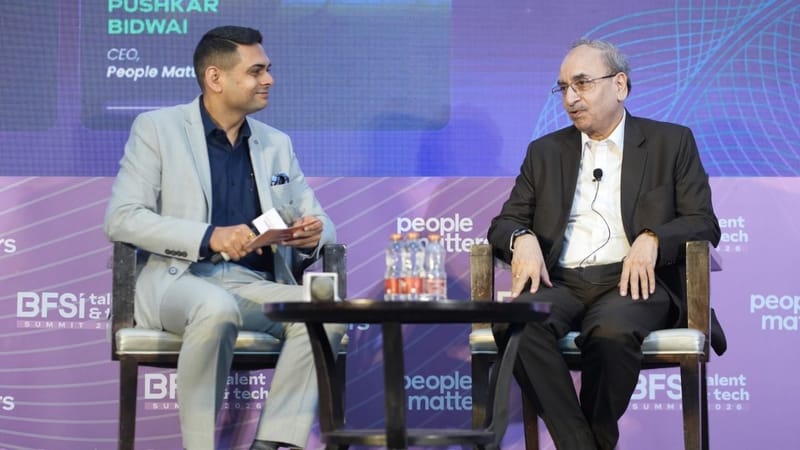
In a packed auditorium, with the energy of a day’s worth of ideas still crackling in the air, Dinesh Khara, former Chairman of State Bank of India and current Board Chairman at PeopleStrong, sat across from Pushkar Bidwai, CEO of People Matters. The audience leaned in, knowing they were about to witness a rare masterclass at the People Matters BFSI Talent & Tech Summit 2026 on leadership and transformation from the man who turned India’s largest bank into a powerhouse of growth, innovation, and resilience.
A legacy forged in change
When Dinesh Khara took the helm at State Bank of India (SBI), the bank’s annual profit stood at over Rs 20,000 crore. In just three and a half years, by the time he stepped down, that figure had soared to nearly Rs 61,000 crore. For a public sector institution often stereotyped as lumbering and slow, this was not just growth—it was an earthquake.
But how did a banker, schooled in the rigours of compliance and legacy systems, engineer such a transformation? And more crucially, what lessons does his journey offer as India’s BFSI sector stares down a future of digital disruption, regulatory flux, and existential uncertainty?
“The most critical resource in BFSI is not capital. It’s human resources,” Khara states, cutting through the noise that often surrounds discussions on digital transformation.
Tracing the evolution of HR from its “investigative, administrative” roots to its current role as a strategic force, Khara highlights SBI’s deep investment in people—over 50 training institutions, six apex colleges, and a culture that has produced not only banking leaders but CEOs across India’s financial landscape.
Yet, this emphasis on talent is not without its challenges. “How can you retain human resources?” he muses. In a world where skilled professionals are courted by every sector, the cost of attrition is staggering, not just in rupees but in the loss of institutional memory and momentum.
Communication: The secret weapon
If talent is the raw material, Khara’s other obsession is communication—the art of aligning thousands of employees to a singular vision. “The enabling environment has to be created,” he explains. “Everybody should be aligned with the group goal. That’s easier said than done.”
The pandemic tested these convictions like never before. In 2020, as COVID-19 forced banks to operate virtually, Khara doubled down on transparent, honest, and frequent communication. The results were spectacular: not only did SBI’s profits balloon, but its stock price leapt from ₹170 to ₹812—a feat Khara attributes as much to clear messaging as to operational excellence.
“Be very clear in your communication. Articulate the challenges. Share the action plan. If your message is not understandable, the very purpose is lost,” he asserts, his words echoing the lessons of crisis leadership that are now gospel in boardrooms across the country.
Innovation at Scale: The public sector’s quiet revolution
Innovation is often seen as the preserve of nimble fintechs, but Khara is quick to challenge this narrative. “Financial sector entities are the most tightly regulated, not just in India but globally. Fintechs are like free birds, but the reality is you have to operate within boundaries.”
His solution: collaboration. Legacy institutions, with their massive scale and deep pockets, and fintechs, with their agility and fresh thinking, must join forces. “Fintechs benefit from our infrastructure. We benefit from their speed. The future is about incubation, collaboration, and mutual learning.”
But Khara warns: “Scaling up is never free from challenges. Hiccups are inevitable. Seamless experience only comes through persistent effort.”
The unseen power of organisational memory
Khara’s fascination with technology is not about the latest gadget or buzzword. It’s about using digital tools to build what he calls “organisational memory”—systems that capture not just transactions, but the collective experience, insights, and learnings of an institution.
This is where HR tech platforms like PeopleStrong excite him. “The payout should be frictionless. Leave and other hygiene factors must be addressed through HRMS. But the real value is in capturing employee experiences. That builds the organisation’s memory and leads to durable solutions.”
Customisation, flexibility, and the willingness to adapt solutions for each client are, for Khara, non-negotiables. It’s these qualities that attracted him to PeopleStrong’s board—a role he sees as a chance to shape not just a company, but an entire industry.
Compliance: The double-edged sword
As AI and digital platforms reshape the HR and BFSI landscapes, compliance presents both challenges and opportunities. With sweeping changes in labour laws and regulatory frameworks, Khara sees SaaS solutions as essential allies for institutions seeking to stay ahead.
“Nobody wants to breach compliance and get into trouble. Professionals can interpret the law, but it’s the applications that ensure organisations don’t cross the line. Platforms like PeopleStrong make staying compliant easy, scalable, and audit-ready.”
The intensifying skills gap
Yet, even as technology advances, Khara is acutely aware of the growing skills gap within BFSI. “Risk is talked about a lot, but appreciation of technology is still lacking. The global economic situation has made credit risk more significant than ever.”
He advocates for a new focus on risk management, data analytics, and—crucially—design thinking. “Product design is becoming critical. It’s not just about replicating offerings, but about creating hyper-personalised solutions that optimise computing costs. We need to sharpen skill sets in these areas.”
The future, he says, will demand not just technical know-how but the ability to blend AI-driven insights with sound human judgement. “AI can process the data, but unless the models are validated by humans, they cannot be implemented in the financial sector.”
Scaling Leadership: The role of managers as mentors
As the conversation turns to leadership at scale, Khara draws on his experience managing a 200,000-strong workforce. His advice is deceptively simple: policies must be clear, consistent, and transparent.
“When you’re small, you can customise. When you’re big, you need defined policies. But they shouldn’t be watertight—there must be room for exceptions, clearly justified and documented. Otherwise, people perceive subjectivity, and that breeds negative energy.”
Mentorship, he believes, starts with immediate managers. “They are the first line of mentorship for future leaders. They can help identify gaps, provide feedback, and support growth. Only when those limits are reached should you look outside for coaching.”
The Next Leap: India’s BFSI in 2047
Looking ahead, Khara’s vision is both ambitious and grounded. By 2047, India’s banking system could see a loan book the size of today’s entire economy. To manage such growth, he insists, “We’ll need everything—people, technology, AI. We must leverage every tool to match the aspirations of a developed economy.”
But the journey will be fraught with volatility. “We have to be ready for uncertainty. Reconciling with reality is essential before adapting to change.” It’s not just about technological adoption but about cultivating a mindset comfortable with ambiguity, rapid change, and relentless innovation.
As the conversation draws to a close, Khara’s message to the assembled leaders is clear: the future belongs to those willing to evolve. Embrace technology. Invest in people. Build institutional memory. Communicate with clarity. And above all, be prepared to ride the waves of uncertainty with courage and conviction.
Loading...