







Leadership
Look Before You Leapfrog: Why Asia's AI shortcut may be a mirage (Part Two)


 ||
||


Reframing to growth is not a matter of finding the right words. It is a matter of holding the ground when the room is pulling the other way.
By Anand Shankar
Building the muscle the leap was meant to skip
This is the second of a two-part series on AI in HR. Part One examined the leap rhetoric across Asia Pacific — what it asks us to skip, and what that costs. Part Two turns from diagnosis to practice. What HR leaders can actually do, week by week, to build the muscle the leap was meant to skip.
Where we left off
Part One ended with a framework — three questions to hold before any AI investment. Foundation. Capacity. Cost. Rendered as a 2x2 matrix that lets senior leaders locate their own organisation on the map, and decide for themselves whether they are on solid ground or on thin ice.
The response to the piece has been more substantive than I expected. Senior HR leaders across the region have written in with their own versions of the question. L&D practitioners have named the specific irony their function faces — being asked to lead an adoption that structurally bypasses the patient capability building. Software engineering leaders have pointed to the same pattern inside their own teams. Almost every serious practitioner engaging with Part One has said some version of the same thing. You have named what I have been sitting with. Now what do I do.
This piece is the now what do I do.
What the last month has confirmed
BCG's Institute published a piece in mid-June titled When Everyone Uses AI, Companies Risk Losing Critical Skills. Their survey of C-suite leaders finds that half are already observing measurable de-skilling. More than sixty percent expect it to become a material threat within three to five years. Only ten percent report having an organisation-wide strategy to address it. A third have not explicitly discussed it at all.
The skills most at risk, in their reading, are exactly the skills most critical to long-term performance. Judgement. Problem framing. Analysis and causal reasoning. Creative thinking. These are not soft skills to be protected out of nostalgia. They are the cognitive muscles the organisation depends on to make decisions that matter.
The BCG work is useful. But it treats the problem as a management problem to be solved through interventions. That is not the whole of it. The problem is deeper — it is a stewardship problem. The function that has historically been responsible for building human capability is being asked to lead an adoption that undermines the conditions for its own most important work. HR is not the implementation partner in this story. HR is the custodian of what is being quietly lost.
Why the productivity story is the wrong story
The dominant story HR is telling about AI, across the region, is productivity and reductions. Automate the existing function. Run it with fewer people. Deliver the same outcomes at lower cost. This is the conversation dominating almost every CHRO offsite I have sat in over the last twelve months. It is the story the consulting industry is fuelling. It is the story the CFO wants to hear.
It is also the wrong story.
Productivity gains are real. But they are a hygiene factor. Any function that is not getting more efficient year over year — with or without AI — is not being managed properly. Productivity is the floor, not the ceiling. It should not be the headline story HR tells about AI, because the moment HR's headline story becomes we can run leaner, the function's strategic weight collapses. HR becomes an operational back-office that happens to be cheaper this year than last.
The story worth telling is growth. Not headcount growth. Capability growth. The number of people in the organisation who are visibly becoming senior practitioners. The number of moves being made that better match capability to work. The number of relationships in which one person is actively developing another. These are the outcomes that compound. Productivity gains flatten after eighteen months. Capability growth compounds for years.
This reframe is harder than it sounds. Every HR leader who reads this will nod in agreement, then walk into their next ExCo meeting and be asked how much cost has been taken out this quarter. The gravitational pull of the productivity story is real. Reframing to growth is not a matter of finding the right words. It is a matter of holding the ground when the room is pulling the other way.
The individual and the institutional
There is a distinction underneath all of this that most AI-and-HR conversations miss. Individual capability and institutional capability are not the same thing.
Individual upskilling — training people to work with AI, teaching them to prompt well, giving them technical fluency — is necessary. But it is not sufficient. It produces one hundred people who can each use AI reasonably well. Institutional capability produces a function in which those hundred people can teach the next hundred, in which judgement can be captured and transmitted, in which the collective wisdom does not evaporate when the individual leaves.
Institutional capability is harder to build because it is invisible. It is not a course. It is not a certification. It is the pattern of how people teach each other, how disagreement is resolved, how expertise is transmitted, how the organisation catches its own mistakes. These are the muscles being quietly lost when AI takes over the tasks through which they used to be built.
The apprentice at the bench
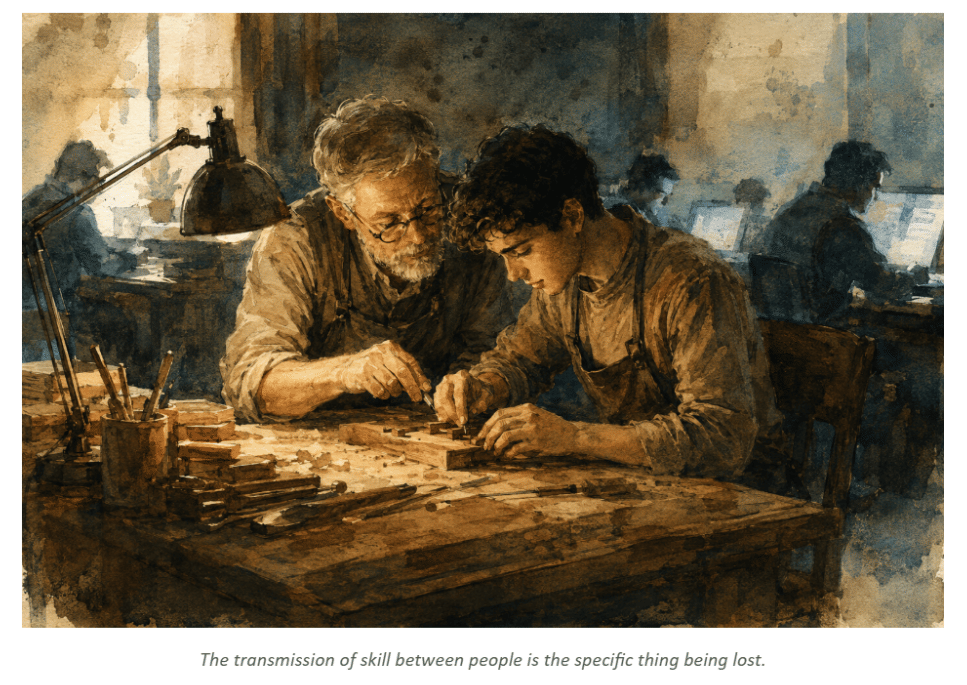
The specific thing being lost is the transmission of skill between people. Not the content of what is transmitted — that can be captured in a manual. What is being lost is the how of transmission. The small corrections a senior makes to a junior's work in real time. The reasoning that gets spoken out loud when two people are looking at a problem together. The judgement that gets modelled rather than taught. The instinct that gets acquired through watching, and that cannot be acquired through reading.
Apprenticeship is the oldest capability-transmission technology human beings have. It works because tacit knowledge cannot be transferred any other way. It requires the reps. It requires the shared attention. It requires the presence of someone who has done the work well, watching someone else attempt it and adjusting them in the moment.
AI usage at scale is quietly dismantling this. The tasks through which apprenticeship used to happen are the tasks being automated first. The first draft that a junior writes and a senior corrects. The initial analysis that gets shown to a mentor. The junior version of a client presentation that gets marked up by the practice lead. These are the reps. When they disappear into AI, the reps disappear with them.
Part Two's central prescription starts here. Before anything else, protect the apprenticeship. Everything else follows from that.
Eight practices that move the engine
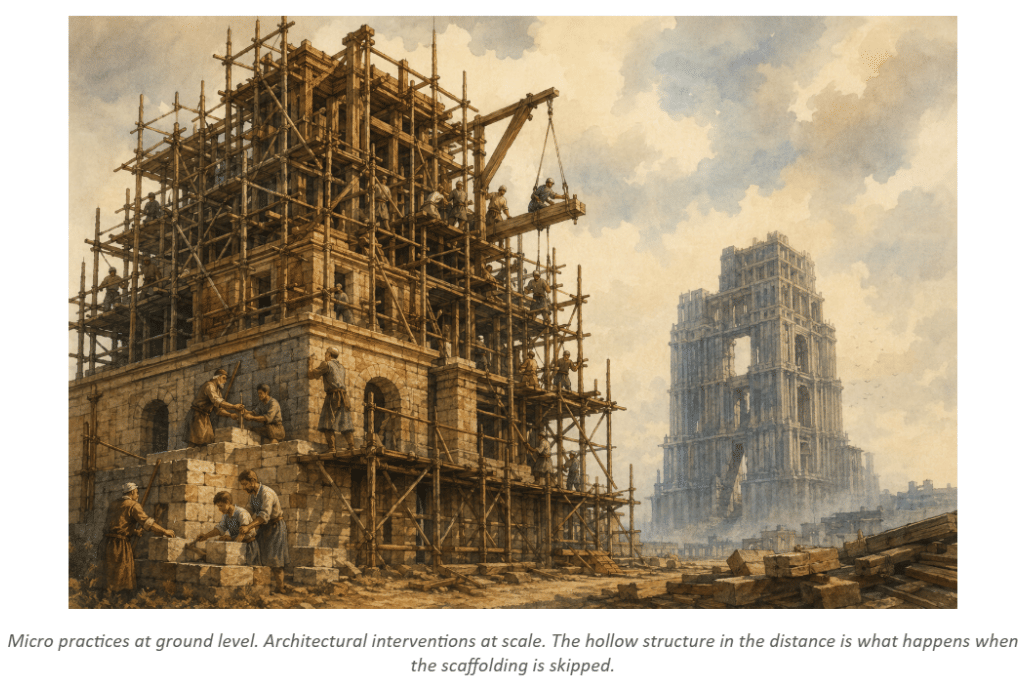
What follows is the operational spine. Eight practices, in two tiers. Four micro practices that teams can hold week by week. Four architectural interventions that the function itself must design. Micro practices without architecture fade. Architecture without micro practices does not land. The engine moves when both hold.
Problem framing first. Before any AI is used on a substantive task, the junior on the task frames the problem in their own words. What is the actual question. What are the constraints. What are the assumptions we are making. The framing itself is the training. It cannot be delegated. The senior reviews the framing before AI enters the workflow. This one practice, held consistently, protects most of the judgement that would otherwise be lost.
AI-free deep work. One protected block per week, per team, where substantive thinking is done without the tool. Not as a novelty. As a discipline. Three hours is sufficient. The muscle stays alive because it is exercised.
Explicit review discipline. Every AI-generated output is reviewed with a specific question. Do I understand why this works? Not does it look right. Not does it produce the expected answer. The question is whether the human can reconstruct the reasoning. If the answer is no, the output is not ready. Or in the sharper formulation of a senior engineering leader who wrote in response to Part One — what judgement will this organisation no longer have the muscle to exercise in three years?
That question is the one every practitioner should carry.
Structured debate slots. AI produces convergence — given similar prompts, most large language models return similar answers. The counter is deliberate divergence. Twenty minutes at the end of a significant decision meeting, in which the strongest opposing case is heard. Not as devil's advocacy. As institutional protection against premature agreement.
The apprenticeship engine. The first architectural intervention and, in my view, the most consequential. Most L&D functions track content — courses delivered, hours logged, certifications earned. Very few track apprenticeship — who is developing whom, in real reps, on real work. AI can change this. Properly built, an apprenticeship engine makes the transmission of skill visible. What gets tracked gets valued. What gets valued gets held. The function that builds this engine is the function that has decided AI will not be used to skip the patient work through which senior practitioners are made.
The mobility engine. External hires are sourced, screened, interviewed, onboarded, measured. Internal moves are mostly approved case by case with no underlying intelligence. AI closes that gap. A properly built mobility engine maps every person against every opportunity — every role, project, stretch assignment, team formation. The function shifts from reporting it hired forty-three people externally last quarter to reporting it deployed two hundred and seventeen people into work that better matched their capability and ambition. Growth outcome. Retention outcome. A quiet institutional signal that this organisation grows its own.
Capability measurement. Performance systems have historically tracked output. In an AI-mediated environment, output is a lagging and increasingly meaningless signal because AI produces output at scale regardless of underlying human capability. The measurement that matters is the capability itself. What can this person still do without the tool. What judgement can they exercise unaided. What can they teach someone else. Not easy to build. Not optional to try.
Cognitive guardrails. Some parts of the work should be protected by design. Junior practitioners in the first two years of a function should have structured limits on AI use on the tasks through which their judgement is being built. Not because AI is bad. Because the reps have to happen for the judgement to form. Cognitive guardrails are an institutional statement — this ground is protected because the capability being built here compounds for the next twenty years.
The region's sharper discipline
Everything above applies globally. But the Asia Pacific reader deserves a specific version. The region is adopting AI faster than any other. The anxiety is higher. The governance is lagging further behind. Which means the interventions that might work in slower-moving markets — Frankfurt has time to build institutional guardrails while it decides its adoption strategy — will not work fast enough here. Bangalore does not have that time. Neither does Jakarta or Manila or Ho Chi Minh City. The adoption has already happened. The capability has already started eroding. The window for institutional response is measured in quarters, not years.
The apprenticeship engine cannot be a two-year build. It has to be a six-month build with a version-one that improves quarterly. The capability measurement cannot be a slow consultation. It has to be a decision that gets made and refined in flight. The cognitive guardrails cannot be aspirational. They have to be in place before the next cohort of graduates enters the workforce.
I have watched senior HR leaders in this region hold this urgency and act on it. I have also watched them defer it, on the reasonable-sounding grounds that the organisation is not ready. The organisation is never ready. The function has to make the organisation ready. That is what leadership in this role now requires.
Four moves for the CHRO
If Part One offered four positional moves, Part Two sharpens them into the specific stances the prescription requires.
Refuse the false binary. The room will ask, again, whether HR is with the AI adoption or against it. The honest answer is neither. HR is with the capability the AI adoption depends on. That is a different position from either enthusiasm or resistance. It reframes the conversation from whether to what have we built underneath what we are deploying.
Hold the unfashionable position. The productivity story will keep pulling. Defending the growth story — apprenticeship, capability, judgement — will sound conservative, unambitious, backward. It is none of those things. It is the function doing its actual job on a longer time horizon than the quarter. The CHRO who holds this ground will be vindicated when the capability bill arrives, two or three years out.
Insist on the diagnostic questions. Before any AI investment above a threshold, three questions get asked out loud. What capability does this build. What capability does it bypass. What will this organisation be unable to do in five years if it depends on the bypass. The questions do not require the CHRO to have the answers. They require the standing to ask. The asking changes the conversation.
Translate the long view into the room's language. Capability erosion is a competitive disadvantage. Say it in those words. The organisations that are quietly building their bench while their competitors are quietly hollowing theirs out will win the decade. Not the quarter. The decade.
The Mirror, Again
Part One ended on a framework and a question. Part Two ends on a discipline and a decision.
The discipline is what I have described across the eight practices and the four positional moves. It is real work. It is not a set of insights to nod at and move past. It is the actual weekly practice of a function that has decided its most important asset is the human capability being built inside it, and that it will not trade that asset for near-term productivity theatre.
The decision is the one the CHRO faces each morning. Whether today, in the room they are about to enter, they will hold the ground the piece has described, or whether they will let it slip one more week because the pressure is real and the alternative is easier. Nobody makes this decision once. Everybody makes it every day.
The engine moves through this. Not through the language around it. Through the daily discipline of protecting what matters, in a room that is louder about other things.
Part One was the diagnosis. Part Two is the discipline.
The rest is up to you.
Topics
Author
Loading...