“I’d be truly happy when we’re at 50-50.”
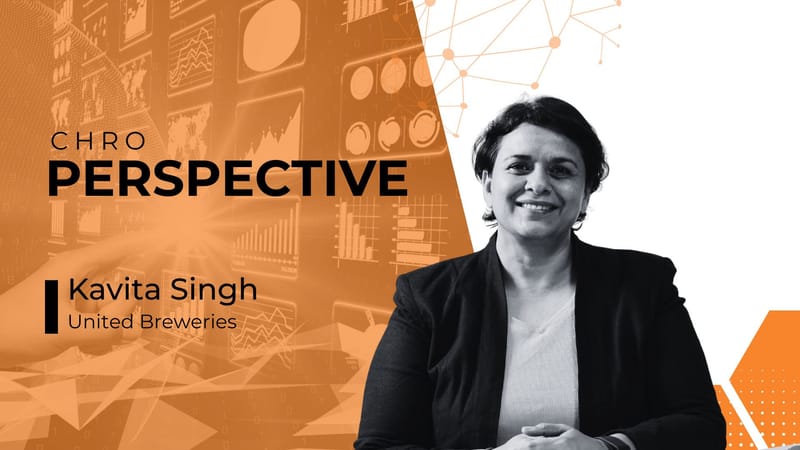
That’s Kavita Singh’s unequivocal vision for gender diversity at United Breweries (UB). As the Chief Human Resources Officer and the company’s first-ever woman management team member in 106 years, she has overseen one of India’s most dramatic transformations in gender representation—from just under 6% women when she joined, to more than 25% today.
But for Kavita, the numbers are only part of the story. The bigger mission is dismantling biases—internal, societal, and systemic—that keep women from thriving in industries long considered male territory.
In an exclusive interview with People Matters, she shared key challenge areas that still persist, the milestones achieved, and the way forward for organisations and for women themselves.
Q. Could you tell us how your early experiences shaped your views on gender issues and your journey towards leading HR in industries traditionally dominated by men?
I grew up in Bikaner, Rajasthan, a small town with very traditional norms. In our home, women wouldn’t sit at the same level as men. We even had different stools for women called pida (peeda).
From a young age, I felt that wasn’t right. Even in high school, I used to teach my two aunts, who’d never been to school, to read and write. During college, I pushed back against traditions at home. I’ve always believed that if there’s logic behind something, and you pursue it persistently, people eventually listen.
Professionally, I’ve somehow always found myself in industries where women are underrepresented: international trade, shipping, mining, and now brewing. And everywhere, I’ve tried to help create an equal playing field.
Q. When you first joined United Breweries, how did you approach gender diversity and the overall environment for women, both culturally and structurally?
When I joined, women made up just 5.8% of the workforce, and there were no women at the senior leadership level. I’m the first woman to join UB’s management team in its 106-year history. Also, the company’s image at the time reflected a legacy brand positioning that didn’t always create a welcoming or inclusive environment. Over the years, we’ve consciously moved away from that and redefined our identity to better align with our values and the diverse workforce we want to attract.
In many of our breweries, there were no women in the workforce, and no infrastructure like washrooms for women. We had to build from scratch.
We knew we couldn’t just hire women and expect them to stay if the environment wasn’t supportive. So the first year, we focused on infrastructure and policies.
For example:
We built proper washrooms for women in all breweries, including for contract workers.
We worked on transportation policies, especially since our factories are mostly in remote areas.
We established partnerships to support childcare and schooling, making it easier for families to relocate.
And culturally, we wanted to shift the narrative. That’s how we launched Queenfisher, our inclusion initiative named to reflect our Kingfisher brand but celebrate women. As part of that, we gifted all women employees a Queenfisher mirror to remind them to look at themselves with pride and confidence.
Q. How has this change translated on the ground? Can you share examples of women breaking barriers at United Breweries and in your earlier roles?
At UB, in Aurangabad, we wanted to hire a woman forklift driver, a role requiring a heavy-duty license. The union opposed it fiercely. Even the then brewery leader said, “Why create problems with the union?”
I went there myself and asked the union leader: If it were your daughter being denied a job only because she’s a woman, how would you feel?
Eventually, not only did they agree to hire her, but the union leader also agreed to mentor her. She’s still with us today, our first woman forklift driver in Aurangabad.
Earlier in my mining career, women were legally prohibited from working underground. I worked with the Ministry of Mines to change that law. For the first time, a woman was certified as a first-class mining manager underground. The mining department had never issued a certificate to a woman before, so they wrote “Sushree” by hand on her certificate.
Q. It’s great to hear stories of progress on the ground. When you look at where you are today, what are your thoughts on gender representation? Where do you go from here.
In three years, we’ve gone from 5.8% to over 25% women in the workforce.
In sales, we moved from 8% women to about 17-18% in just one year.
Our leadership team is now 30% women, three out of ten members.
Women are now visible in brewing, production, asset care, procurement, and quality roles.
Our Golconda brewery, India’s largest, is headed by a woman.
I’d be truly happy when we’re at 50-50. That’s our intent.
But of course, we’ve set milestones along the way. We aim to reach 30% in the next few years and then move closer to 50%. I believe it’s possible.
Our priority is to keep up the efforts and ensure that people don’t experience situations that make it difficult for them to work, whether men or women.
We’ve also ensured that our campus hiring aims for a 50-50 gender split. It’s not just about numbers but changing the entire culture.
But there are quite a few challenges that remain
Societal perception: Many families, across religions, feel uncomfortable with women working in the alcohol industry. Just three years ago, I lost two strong candidates because their families weren’t okay with them joining the industry.
Remote locations: Younger employees sometimes reject postings in breweries where there’s no Swiggy or movie theatre. It’s a new-age challenge we never expected!
Shift work: Traditionally, women worked only day shifts, which created perceptions of inequality. We’ve worked to secure permissions, allowing women to work all three shifts in most breweries.
Misuse of policies: While frameworks like POSH are essential for ensuring safety and respect at the workplace, we’ve also encountered situations where there was confusion between performance feedback and personal grievances. We’re committed to creating greater awareness around these policies, how they protect individuals, and how to use them appropriately and responsibly.
Q. How did you handle building a safe culture, especially on the shop floor?
That’s crucial. Policies like our Code of Business Conduct and POSH need to be more than just words. We’ve taken tough decisions, even at senior levels, when behaviour hasn’t met expectations.
We’ve also:
Created trusted representatives in every location, so people feel safe to report issues.
Translated our policies and POSH materials into local languages so that even contract workers understand them.
A powerful example: A month after I joined, I got a WhatsApp video from five women contract workers in Odisha. They were single mothers being pressured by a vendor. They sent the video in Oriya. We translated it, understood the issue, removed the vendor, and protected those women.
We’ve also invested heavily in unconscious bias training. Our first trainer was an 76-year-old woman who helped draft the Vishaka Guidelines, who spoke seven languages and conducted sessions in breweries, sometimes addressing 800 people at a time.
Q. From policies to culture, how is technology helping you change in these efforts?
Employees can now raise concerns digitally, even via mobile apps. We use AI to translate training sessions into multiple languages instantly, complete with voiceovers. All our policies are accessible in 8 languages across locations. That’s essential for a company operating across diverse regions.
Q. Finally, what would you say to young women considering careers in industries like brewing or other male-dominated fields?
I’d say three things.
First, challenge your own mindset. - If you believe you can work in any sector, you absolutely can. Why should anything be off-limits?
Second, don’t wait until you’re ‘100% ready.’ - Men put their hands up for roles when they’re 40% ready. Women wait till they’re 80% ready. My advice: raise your hand at 50%, seek feedback, and grow.
Third, pay it forward. Whatever you’ve gained, pass it on to help others. That’s how real change happens.
And remember, there’s no job a man can do that a woman cannot.
This story is part of CHRO Perspective. A People Matters series featuring bold ideas and real-world insights from India’s top CHROs. Stay with us for more perspectives that power the future of work.










 ||
||