







Leadership
Strategy Can Be Copied, Culture Cannot: Anil Khandelwal’s stirring call to HR at People Matters Talent & Tech Summit 2026





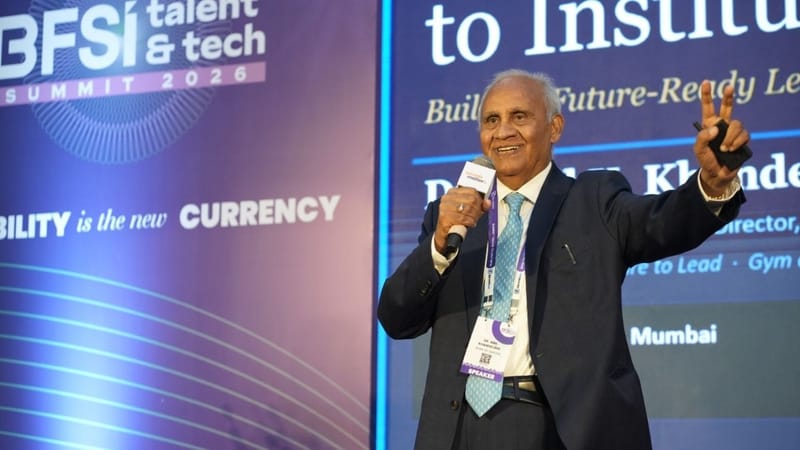
For Khandelwal, the future of HR lies in the stewardship of intangible assets: human capital, culture capital, trust capital, and leadership capital. These are the new frontiers of value creation, eclipsing the traditional focus on financial performance alone.
In an age obsessed with digital disruption, artificial intelligence, and the relentless pursuit of quarterly results, Dr Anil Khandelwal stands as a striking counterpoint—a living testament to the power of people, culture, and leadership in building enduring institutions. Addressing a packed audience at the People Matters Talent & Tech Summit 2026 in Mumbai, the former Chairman and Managing Director of Bank of Baroda delivered a keynote that was at once a masterclass, a challenge, and a call to arms for the HR leaders shaping the future of Indian enterprise.
The Heart of His Message: Intangibles matter most
Khandelwal wasted no time in cutting to the heart of his thesis: “Companies are built through financial capital. Institutions are built through social capital. Companies own assets. Institutions create trust.” In his view, the competitive edge of tomorrow’s organisations will be defined not by technology or access to capital, but by the invisible assets of culture, leadership, trust, and reputation.
He drew a sharp distinction between companies and institutions. While companies may be acquired, merged, or disrupted, institutions endure because they possess something far more valuable than physical resources—the intangible strength of leadership and culture. “Strategy can be copied. Technology can be copied. But culture cannot,” he declared, borrowing from both lived experience and the wisdom of global business titans.
A Veteran’s Perspective: Lessons from the top
At 78, Khandelwal’s presence on the stage was itself a lesson in resilience and relevance. Self-deprecating about his age (“I’m an odd man here... your median must be around 35”), he quickly established credibility by recounting his transformative tenure at Bank of Baroda. Taking the reins of a public sector behemoth with 40,000 employees and little room for manoeuvre—“no bonus, nothing, cannot recruit from outside”—he and his team doubled the bank’s business in three years, married it with India International Bank, and set it on a solid foundation that has lasted nearly two decades since his retirement.
His secret? “It was all people, people, people—and customers.” Khandelwal’s approach was not to chase the latest HR fads, but to invest in the disciplined development of his people and to foster a culture where leadership was practised, not just taught.
The Real HR Challenge: Influencing the top
For all the talk of talent wars and Gen Z, Khandelwal believes the true challenge facing HR is not recruitment, training, or appraisal—it is influencing the CEO and the board. “You have to reverse the equation,” he urged. Too often, human resources is seen as a support function, far removed from the strategic heart of the business. The real bottleneck, he argued, is at the neck of the bottle: unless top leadership is physically and emotionally invested in people, HR’s impact will remain marginal.
He illustrated this with the example of a highly successful financial services firm that eschews external hiring and instead nurtures talent from within under the direct mentorship of senior leaders. The CEO himself writes monthly letters to every employee, cultivating a culture of openness and shared purpose. “These are culture issues,” Khandelwal said, “not just HR policies.”
Leadership Development: Beyond training rooms
Khandelwal was unsparing in his critique of conventional leadership development. “Sending people to a rural cohort or a training program here and there is a waste of time,” he said. The real development of leaders, in his view, comes from “disciplined practice”—70% practice, 10% formal training, and the rest a combination of coaching and self-reflection.
He recounted his own struggles with listening—a skill he worked on for decades, at one point even taking a vow of silence during meetings to force himself to listen more. Leadership, he insisted, is a “serious business,” and HR must move beyond surface-level interventions to reshape the very DNA of organisations.
“The best training programs cannot make you leaders,” he said. “Leaders did practice.” He was particularly scathing about expensive leadership programs that promise transformation but deliver little more than broadened minds and depleted coffers.
Redefining the HR Agenda: Intangible capital
For Khandelwal, the future of HR lies in the stewardship of intangible assets: human capital, culture capital, trust capital, and leadership capital. These are the new frontiers of value creation, eclipsing the traditional focus on financial performance alone. Organisational health, he argued, creates endurance; financial performance may drive value, but it is only half the equation.
He challenged HR leaders to embrace self-critique and scepticism, to question the efficacy of their initiatives, and to demand accountability for training investments. “Training has become just like a London here,” he quipped, highlighting how many senior managers treat overseas training as a perk rather than a developmental opportunity.
Culture: The ultimate differentiator
Khandelwal’s definition of culture was refreshingly grounded: “How decisions are made beyond edicts from the top... what is the grassroots wisdom? What is the field wisdom?” He cited examples of CEOs personally engaging with frontline employees and customers to understand their realities—in contrast to organisations where culture is little more than a slogan or a set of values posted on a wall.
“Strategy can be copied; culture cannot,” he repeated, urging leaders to pay attention to the “smell of the place”—the intangible vibe one experiences upon entering an organisation. “Is this an organic, vibrant, on-sitting organisation, or is it an organisation where three people are standing near the receptionist’s desk and yawning?”
Culture, he argued, is revealed in the smallest details: how customer complaints are handled, how people behave when no one is watching, the level of responsiveness, and above all, the trust stakeholders place in the institution.
Preparing for the Future: New leadership capabilities
As organisations grapple with the onslaught of AI and technology, Khandelwal warned that most will be outdated within a decade unless they reinvent themselves as learning systems. He outlined the leadership capabilities required for the future: strategic foresight, ethical judgement, stakeholder management, resilience, learning agility, and digital competence.
Crucially, he noted, technology can automate decisions but not values. “Can we trust its leaders? Can we trust the use of technology and data?” These are the questions stakeholders are asking, and the answers depend on the strength of the organisational culture.
He urged Indian HR leaders to find inspiration in local success stories. Of 6,000 listed companies in India, he estimated, only a handful truly qualify as institutions. The task ahead, he said, is to build organisations that outlive their founders and endure across generations.
A Closing Note: The human element
Khandelwal’s keynote ended as it began—with a human touch. He spoke candidly of the hard work and self-doubt that come with leadership, joking that his wife often wonders why he continues to take on such demanding speaking engagements. “Unless I do this, I won’t be invited by others next time. It’s hard work. Life is hard. This is my gym for speaking.”
The applause that followed was a testament to the impact of his words—a reminder that, even in the age of AI, the true differentiator remains the human spirit.
Loading...