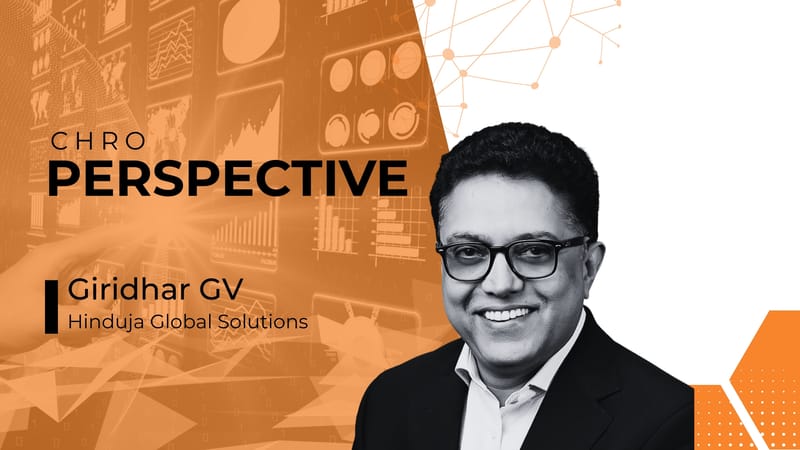
If you walk into a leadership meeting at Hinduja Global Solutions (HGS) today, you’ll notice something subtle but unusual. The CEO for APAC is talking about psychological safety. The Global CHRO is obsessing over P&L, margins and deal structures. And then you realise — it’s the same person.
As CEO – APAC & Global CHRO, Giridhar G V sits at a rare intersection: accountable for business growth on one hand and human capital on the other, across a 18,000-strong workforce, 30 delivery centres and 10 countries. He calls himself “more a people leader than a typical HR person”, but his journey spans hard-core operations, scaling Global Capability Centres and running large global P&Ls long before he took on the CHRO title.
Under his watch, HGS is pushing hard into digital operations — taking a traditional BPM backbone and layering it with AI, analytics and platforms like Agent X and Interaction Intelligence to create tech-augmented customer experience. At the same time, he is quietly redesigning how leaders are measured, rewarded and prepared for a future where up to 40% of transactional BPM work could be automated.
In this edition of CHRO Perspective, we spoke with Giridhar about leading while “flying partially blind”, why ambiguity is now a core leadership competency, and what it really takes to build a boundaryless, AI-ready enterprise without losing the human core.
Q. You hold a rare dual mandate — CEO for APAC and Global CHRO at HGS. How did your journey prepare you to sit at the intersection of business strategy and people transformation?
It’s only in recent years that the dual role has become formal, but in many ways my journey has always straddled both sides.
I’ve never seen myself as a “classic HR person”. I think of myself as a people leader who happened to grow through multiple lenses — operations, P&L ownership and talent. At EY’s GCC, then called EY GDS, I spent over 15 years helping build and scale the set-up. For twelve of those, I wasn’t in HR at all. I was the Chief Operating Officer for the India GCC, running a large P&L across multiple functions and delivery lines.
In my last three years at EY GDS, I moved into a global talent leadership role, driving the talent agenda across five countries. So I’ve lived both lives: the pressure of making the numbers work and the responsibility of shaping people strategy at scale.
What I carried from that experience was a very simple belief:
At a certain level, leadership is about enabling other people to perform at their best. It matters less what you are leading, and more how you are adding value to the people doing the real work.
That’s why the dual mandate at HGS felt like a natural fit. I’m comfortable running a business P&L. I’m equally comfortable owning the people agenda. And importantly, I don’t do it alone. On both the APAC business side and the global HR side, I have strong teams who know their work; nobody is waking up every morning waiting for me to tell them what to do.
So I see my role as being a connector and an enabler — joining the dots between strategy, talent, technology and culture so the organisation can move in one coherent direction.
Q. HGS has around 18,000 employees across 10 countries and over 30 delivery locations. When you think about “future-proofing” HGS, what does that practically mean for workforce strategy?
If you zoom out to 30,000 feet, HGS broadly has two businesses:
- Our core BPM / customer experience business, and
- A technology business, where we’ve been investing heavily over the last few years.
Our strategic direction is to bring these two together in a way that genuinely differentiates us. We call this digital operations — using technology to make our BPM business more competitive, both for us and for our clients.
Everyone in the industry talks this language. The real question is: how do you differentiate in the way you bring that technology layer into a traditional CX business?
From a people and HR lens, the fundamentals don’t change:
we still need competent, capable, fit-for-purpose talent for both sides of the business. But the expectations from that talent are changing.
We’ve always had colleagues who are excellent at running customer experience operations. Over the last few years, our focus has been:
- Starting at mid-level and above, building digital literacy among leaders
- Creating awareness of what is possible with technology
- Making sure leaders don’t see tech as a threat, but as an enabler of better outcomes
Take a typical CX role — it might look like a “simple” call or chat interaction. In reality, we are now layering with our own proprietary like Agent X so that a frontline agent or supervisor has information on tap: customer history, preferences, sentiment, product details, troubleshooting paths.
You no longer need three weeks of classroom training to memorise everything. You can move someone into production in a week because the system is intelligent enough to support them in the flow of work. It’s like how you and I use a search engine — you don’t need to know everything, you need to know how to find what you don’t know in the next five minutes.
So future-proofing, for us, is a combination of:
- Hiring people who can thrive in a tech-augmented environment
- Providing infrastructure, tools and learning so they can keep adapting
- And building a broader employee experience where, in a competitive market like India, people actually want to work with us and grow with us.
Q. Technology is evolving faster than organisations can always upskill their people. In a world where up to 40% of transactional BPM processes could be automated, how are you preparing your leaders and managers to steer through this AI-driven change?
The first thing we have to acknowledge as leaders is that in some areas, we are flying partially blind.
Nobody has a crystal ball that tells you exactly what the BPM landscape will look like in 2027. New technologies can emerge and completely change the equation. So step one is honesty.
We focus a lot on:
- Transparent, authentic communication with our leadership
- Being clear on where we are headed, what we’re experimenting with, and what may need course correction
- Explicitly stating that plans can and will change
In that context, one of the most important competencies for leaders today is comfort with ambiguity. You have to be okay with “flying blind” to a reasonable extent — taking informed bets without perfect information.
The second piece is psychological safety. When you do large-scale change without context, the natural human reaction is fear — fear of redundancy, irrelevance, loss of status. If you want leaders to lean into change, they must feel:
- Safe to say, “I don’t know how this works yet.”
- Safe to admit they need help adapting
- Safe to experiment and fail in responsible ways
We invest a lot in coaching and mentoring our next-level leaders to:- Reframe automation and AI as enablers of their leadership, not threats
- See that their job is shifting from “managing transactions” to creating value using technology and people together
- Spend time on self-learning — not coding, but understanding where and how to use automation intelligently
Of course, there will be a small segment of leaders who may not be able or willing to make that shift. That’s a reality. We try to deal with it humanely and thoughtfully. But for the majority, the combination of candid communication, learning opportunities, and psychological safety helps them build comfort with ambiguity and change.
Q. You spoke about workforce design and sales roles evolving as well. What does that look like on the ground at HGS?
The traditional BPM model was often about selling FTEs: you scope the requirement, estimate the number of people needed, and build a proposal around that.
We’re deliberately moving away from that mindset.
Today, when our sales teams go into a client conversation or respond to an RFP, we want them to think:
“What is the client’s real problem, and how can we solve it by combining technology and people — not just adding more heads?”
That has required a lot of learning and re-wiring.
We have, for example:
Built a Global Partnerships & Solutions (GPS) team with experts from technology, CX and sales
Encouraged sales teams to work closely with this group to explore what’s possible with platforms like Agent X and other tools
Created a culture where it is okay for a salesperson to say, “I don’t know this tech deeply — let me bring in my colleague who does.”
A concrete example: we recently closed a deal in the diabetic management space where the entire solution is powered by technology — no human agents involved. Traditionally, this would have been a classic CX deal with people managing long wait times and complex interactions. Instead, we’ve designed a solution that is:
It’s not yet a massive deal in size, but it is a proof point. It shows our teams what the “art of the possible” looks like when you reimagine the problem from scratch.
At the same time, we recognise that not every role can be broad and integrated from day one. Some roles will remain hyper-specialised, and that’s fine. As you go up the ladder, however, the expectation is that you’re able to connect multiple domains, see patterns, and work in a more boundaryless and integrated way.
Q. When it comes to boundaryless thinking, how are you practically building a culture across geographies and functions?
Some of this has always existed at HGS. We’ve long worked with global accounts where the relationship sits in one country and delivery happens in two completely different ones. So cross-border collaboration isn’t new for us.
What is new is the degree of cohesion and accountability we are now driving.
One hard truth in organisations is: you get what you measure. If you measure each geo leader only on what they close in their own country or restrict only their area of work, you will get siloed behaviour — however, if leaders at a certain level are measured on organization’s results apart from their own, collaborative mind set is encouraged.
So we’ve been changing how we measure and reward.
For certain levels, we now look at global numbers and shared outcomes, not just local ones. We’ve also reconfigured bonus structures so that collaborating across geographies and winning together is actually rewarded.
In parallel, we’ve:
- Set up the Global Partnerships & Solutions team as a shared global resource, not geo-owned
- Host regular cross-geo calls
- Encourag leaders to think of themselves as one global sales community, not “Australia vs UK vs US”
We’re already seeing results: recent proposals where colleagues from the UK and US worked as one team, or where a leader in one market could say, “I’ve known this client for 10 years, let me help open that door.”
These are the building blocks of a boundaryless culture. It doesn’t come from a training programme alone. It comes from the way you structure teams, design incentives and create forums for people to work together on real problems.
Q. How are you building a culture of learning that actually helps people adopt new technologies and ways of working?
Learning has two sides: access and appetite.
On access, we’re doing what most progressive organisations are doing:
Investing in our own internal learning platforms
Providing self-paced digital content
Leveraging external options like LinkedIn Learning and group-led programmes such as the Digital Ninja initiative from the Hinduja Group
Making micro-credentials and short, sharp courses easily available
But that’s only one part of the equation. You can “take a horse to water”; you can’t make it drink.
So we are very deliberate about how we talk about learning:
We emphasise that learning is not a compliance exercise. It has to have personal value for the individual.
Our leaders are encouraged to discuss learning in town halls, team meetings and one-on-ones, framing it as a way to stay relevant and grow, not to tick a box.
We avoid carpet-bombing programmes where everyone is forced to learn everything. We target learning to the people and roles where it matters most.
We also have to be realistic. Not everyone, at every level, will become a tech expert or take advanced AI courses. In some roles, people simply need to know how to use the tools intelligently, not how to build them.
What matters is that, across the organisation, there is a healthy bias towards being curious, staying updated and seeing learning as part of your job — especially for leaders.
Q. Let’s talk about people analytics. How far has data transformed HR decision-making at HGS, and what’s your aspiration for the future?
We’ve made significant progress, but I would still describe it as work in progress — both for us and for the industry.
We use analytics today in multiple areas:
- Hiring: understanding which profiles tend to succeed and stay
- Attrition: building early-warning indicators and predictive models (especially pre-COVID, when attrition was a bigger issue)
- Performance and potential: identifying who might be ready for certain roles or moves
A big step has been building our own HR data lake, completely in-house, with support from our IT team. Once you have clean, structured data in a single place, the possibilities open up — predictive, prescriptive, scenario modelling.
But the real aspiration is larger.
I often use the banking analogy. Think about how banking has evolved in India. Today, you rarely walk into a branch. Almost everything happens on your phone. When Citibank first launched that model years ago, people were shocked at the idea of being charged for visiting a branch. Now it’s normal.
I’d like HR at HGS to move in that direction:
HR should be almost invisible — a seamless, digital layer that gives employees what they need, when they need it, on their phone.
Imagine:
Onboarding, induction plans, policies, leave rules, benefits eligibility, grievance raising — all handled through a single, intuitive app.
A GenAI-powered assistant that surfaces the exact policy clause you need, explains deductions in your payslip, helps you file a request, all in seconds.
Only when there is a complex, human issue — like a serious grievance or a sensitive conversation — does a real HR partner show up.
We already use bots for recruitment and conversational AI in some areas. But the larger project is to reconfigure the HR operating model so that:
Routine interactions are automated, consistent and high quality
HR professionals are freed up for higher-order work — culture, leadership, critical experiences
Employees receive fast, reliable, self-service support for 90% of their needsThat’s the direction we’re moving in: an HR function that operates more like a high-quality digital service, without losing the human touch where it really matters.
Q. In your view, what will define the CHRO of 2030? And how should today’s leaders prepare for that future?
I’ve always believed — even when the working world didn’t fully look like this — that the best CHROs are people with real business experience.
In an ideal world, more CHROs would come from roles where they have:
- Run a P&L
- Sold to clients
- Managed operations and delivery
- Lived with commercial accountability
Right now, perhaps majority of CHROs come from deep HR backgrounds and 20–30% from business. I think that needs to shift over time.
What does that mean for HR professionals?
In the early years, learn your HR basics deeply — it’s a specialised craft.
At some point, step into the business. Go into sales if you can, or operations, or any role where you feel the pressure of revenue, margins and clients.
Understand P&L. Understand what your decisions mean in financial terms.
When you come back to a CHRO role with that experience, three things happen:
Your voice carries more weight in the room. You are speaking the language of business, not just the language of HR.
You can truly be the conscience keeper of the organisation — balancing what is right for people with what is viable for the business, not one at the cost of the other.
You can design systems that are both human-centred and economically sound — whether it’s pay positioning, long-term incentives, career paths or workforce design.
I often tell my team:
Ask yourself in every hiring conversation — why should this person choose to work for us when they have so many other options?
In a large market like India, even someone who is “half capable”, to use a simple phrase, can usually find a job. So if you want the best talent, you need to think like a salesperson of your organisation — what unique growth, learning and experience are you offering?
The CHRO of 2030, in my view, will be:
Deeply business-literate
A strong people leader and conscience keeper
Courageous enough to say “no” to the CEO or the Board when something isn’t right
Skilled at experience design — understanding the moments of truth that matter to employees
And comfortable in a world where some parts of their job may well be done by AI
That’s why I encourage young HR professionals: don’t spend your entire career only in HR. Take some risks. Step into business roles. Expand your horizon. That’s how you’ll be truly ready for the CHRO role of the future.
As organisations race to automate processes, digitise customer journeys and rewire operating models, it can be tempting to treat people strategy as an afterthought — something that will “catch up later” once the tech is in place.
Giridhar’s philosophy offers a different starting point: start with the North Star of your business strategy, then align every downstream people decision to it — without jargon, without overcomplication. From digital operations and boundaryless leadership to learning culture and reward architecture, his playbook is simple but demanding: keep technology and empathy in the same frame, and never forget that leaders must be comfortable “flying blind” in a fast-changing world.
This story is part of CHRO Perspective. A People Matters series featuring bold ideas and real-world insights from India’s top CHROs. Stay with us for more perspectives that power the future of work.