







Leadership
The CEO's Co-Pilot: Vikas Chawla on the non-negotiable role of CHRO in strategy and execution




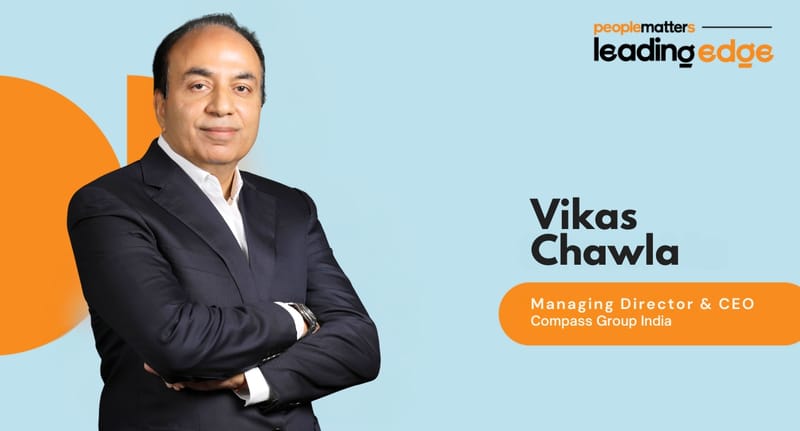
The decision to invest heavily in recruiting top talent and raise the compensation bar—a decision that directly impacts the P&L—was made with his HR partner, says Chawla.
In the modern corporate landscape, the path to sustainable success runs through people, culture, and strategic foresight. Vikas Chawla, MD & CEO of Compass Group India, embodies this new ethos. A veteran leader whose career spans three continents and multiple businesses, Chawla's journey has culminated in a leadership philosophy that is both relaxed and relentlessly growth-oriented. His journey, marked by a relentless drive for growth and a steadfast belief in people, offers a compelling study of modern leadership and its crucial relationship with the Chief Human Resources Officer (CHRO).
This comprehensive feature dissects Chawla's leadership blueprint, the driving forces behind Compass Group's "tectonic" growth, and his conviction that the CHRO is now the indispensable strategic partner to the modern CEO.
It was always about the people
Chawla’s career is marked by consistent breakthrough growth, often achieved in challenging assignments, like transforming an underperforming business in the Maldives, which he initially saw as a "punishment posting," into a successful operation.
"Looking back, the ups and downs have shaped a career that I truly enjoyed," Chawla reflects. He spent his early years in M&A at Coca-Cola but volunteered to become a general manager, driven by the desire to "get my hands dirty" and understand the business from the ground up.
“Over the years, I've been fortunate to achieve breakthrough growth in every business I've led. Early on, I thought success came from innovation or geography, but I soon realized it was always about the people. Surrounding myself with talented individuals—often smarter than me—was the real driver of success. That became my leadership "aha": build great teams and empower them,” explains Chawla.
According to Chawla, his leadership style is relaxed and non-hierarchical. He possesses a relentless hunger for growth but prefers to foster a collaborative, accessible environment. He is passionate about the power of culture, he sees it as the ultimate differentiator and the glue that binds teams together.
Chawla explains that he has witnessed, time and again, that when people are united by a strong culture, extraordinary things happen. Finally, he believes resilience is crucial, knowing that no setback is ever the end of the world; if one perseveres, one often emerges stronger on the other side.
Despite running businesses in nearly 18 countries, Chawla discovered that while external cultures differ (Europeans are "more direct and combative," while Indians are "more compliant"), the core motivators are universal: integrity, trustworthiness, and a hunger for growth.
Success, for Chawla, is never top-down. The formula for limitless growth relies on a compelling vision, a sharp but adaptable strategy, and a highly empowered team where "everyone is CEO." This philosophy is why Compass Group, with 45,000 employees in India alone, is growing at a "tectonic rate."
The workforce of tomorrow and the AI advantage
Compass Group operates in the resilient food and support services sector, providing a unique lens on the future of work. Chawla views technology as an amplifier, not a tool for mass replacement.
In contrast to the "shrink and grow" model adopted by some industries, Chawla maintains a strong commitment to employment generation:
"I don't foresee us shrinking our workforce. If we double our business, our workforce might grow by 50 percent rather than 100 percent. We aim to reach 100,000 employees in the near future and remain committed to generating employment."
Technology drives efficiency and safety. From automated menu planning driven by consumer insights to robotics used for cleaning carpets "five to seven times more efficiently," technology is a force multiplier that makes the operation smarter and safer, suggests Chawla.
“Our 150-strong technology team in Bangalore not only serves our India operations but also exports solutions to 18 other Compass Group countries. We're not fearful of AI; instead, we see it as an opportunity to drive growth and empower our people. Our role as leaders is to inspire excitement about technology as a tool for progress, not a threat. So far, that's exactly the mindset our teams have embraced.”
Chawla notes that the organisation's culture is deeply appealing to the younger, multi-generational workforce. The current workforce, particularly the 25- and 26-year-olds, "deeply values the breakdown of traditional hierarchies." They appreciate that the leadership team is highly accessible, making it safe for anyone to share ideas and propel them to life.
The ideal workforce of 2030, according to the leader, will be defined by resilient, tech-savvy, adaptable people.
He stresses that while the younger generation brings a native understanding of AI, the older generations bring necessary wisdom, creating a "nice mix" where there is a place for everybody.
The CEO-CHRO convergence
Chawla holds the view that the CHRO is an absolutely critical strategic partner, whose role has evolved into the core driver of sustainable business success.
He views his HR leader as a co-pilot who is deeply involved in major financial decisions. He highlights that the decision to invest heavily in recruiting top talent and raise the compensation bar—a decision that directly impacts the P&L—was made with his HR partner.
"It's not just a people decision, it's a P&L decision... The HR leader needs to be deeply involved in your journey, in terms of being able to drive your results."
The CHRO is also indispensable in driving core strategy: nurturing the talent pipeline (60 percent of managerial roles are filled internally), leading learning and tech adoption, and setting the culture that achieved "the best engagement scores" across the global Compass Group.
Chawla tackles the question of why HR leaders are often overlooked for the top job. He argues that the roles are fundamentally converging, making the CHRO potentially the most suited candidate:
"I actually think that the core role of a CEO is more about strategy, people, and culture. Who is better suited to do that than an HR leader who also has an understanding of numbers? If HR leaders flex themselves to be able to understand the business, they can 100 percent be CEOs."
Going forward, people will be the ultimate differentiator. In a war for talent, organisations that genuinely care for their employees—and have strong people managers and talent leaders—will stand out and succeed. I believe the very best HR leaders and CHROs will increasingly become CEOs, since their core responsibilities already overlap so much with what the CEO role now demands. Unfortunately, the business world hasn’t fully embraced this perspective yet, but Chawla is confident it will change.
He advises that the CHROs who will reach the pinnacle are those who actively shape culture in a significant way, act strategically, and are not afraid to "roll up their sleeves and get involved in the business."
The CEO's role is to believe that the people-and-culture piece is their real job, and to ensure they actively leverage their CHRO to drive long-term, sustainable success.
However, the perceived importance of the CHRO is directly proportional to how much the CEO leverages them. If a CEO views the people, culture, and strategy piece as their true job and equally prioritizes long-term sustainable success over immediate results, the CHRO becomes indispensable. Conversely, if the CEO spends disproportionate time focused solely on short-term numbers, the HR role is devalued, often becoming less important than that of an operating leader, concludes Chawla.
In this season of LeadingEdge, we are delving deeper into the leadership styles of C-Suite leaders with a significant focus on their ability to empathise with their people, understand the challenges of their workforce, and initiatives to build a people-friendly organisation. We are also decoding the evolving relationships between the C-Suites and the CHROs to drive the company towards a growth trajectory.
Author
Loading...