







Leadership
The CHRO who aspires to be CEO: Dr Harpreet Anand’s radical blueprint for HR’s next frontier


|
Updated on


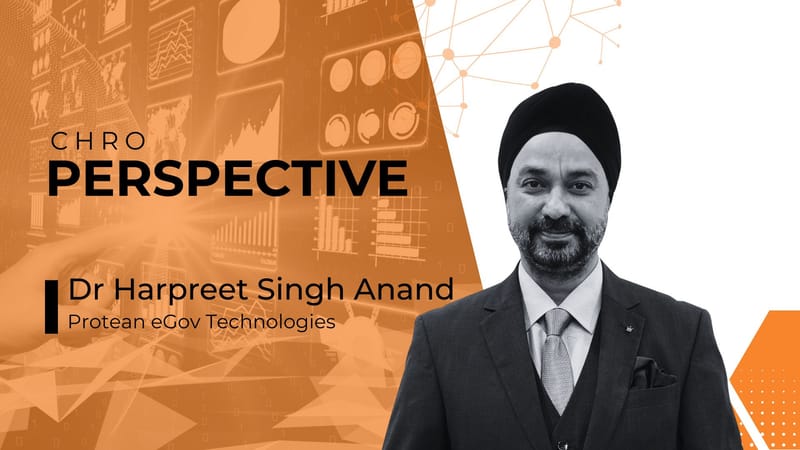
Protean eGov Technologies CHRO Dr Harpreet Anand on why HR leaders must master AI, business strategy, and productivity to earn the CEO’s chair.
When Dr Harpreet Singh Anand, the Chief Human Resources Officer of Protean eGov Technologies, sits down to talk about the future of work, he doesn’t start with employee engagement scores or wellness retreats. Instead, he starts with the mindset of a portrait painter from the era of the Maharajas.
"The most prized employee at one point was the portrait painter," he reflects. "He got his worth in jewels if he got the art right. Then came the photograph. The painters didn't die; the audience shrank, but avenues like modern art and wild photography opened up for those who were ready."
This is the central thesis of Dr Anand’s leadership: the world is changing at a pace that renders traditional education obsolete before the ink on the degree has dried. In a high-octane conversation with People Matters, Dr Anand outlines a vision in which HR leaders aren't just supporting the business—they are poised to lead it.
Edited excerpts
Resilience over pedigree
Protean eGov Technologies is not your average tech firm. It is the architect of India’s Digital Public Infrastructure (DPI)—the backbone of everything from the dematerialisation of shares to the foundations of Aadhaar, PAN, and UPI. In such an environment, the "shelf life" of a skill is no longer measured in decades, but in months.
"By the time an engineer passes out of an IIT or an IIM, what they’ve learned is already outdated," Dr Anand says candidly. He describes the modern technology landscape as a library where the books change every single day. If you aren't updating your personal library daily, you’re irrelevant.
Consequently, Protean’s hiring strategy has shifted from a focus on pedigree to a focus on will and resilience. While he acknowledges that elite institutes provide a valuable network—a "proximity to prominence" that he, as a graduate of Amaravati University, had to build manually—he is far more interested in a candidate’s failures.
"I look for the failures. I want to know the behaviours a person exhibited when things went wrong. Resilience is the ability to rebound. In an industry where a new version of an AI model like Claude can render half your business model irrelevant overnight, I need people who can unlearn and relearn quickly."
AI First: From the boardroom to the EA’s desk
While many organisations approach AI with a mix of trepidation and "bottom-up" experimentation, Protean has taken a "top-down" hammer to the status quo. Dr Anand, alongside the CIO, sponsors an AI Task Force involving 13 ‘AI Champions’ across every function of the company—from finance to marketing.
But the real disruption started at the very top. Dr Anand insisted that the CEO and the board be the first to get their hands dirty.
"Seniors often talk about AI without knowing what it is," he explains. He conducted a workshop where CXOs took selfies and used prompt engineering to transform themselves into Maharajas and Maharanis. "That’s where the excitement comes from. Once they saw the power, they started using AI for their thought leadership, their strategy decks, and their LinkedIn posts."
This "top-down" fluency has created a new standard of productivity. Now, when a team member tells a CXO that a task will take three days, the leader can demonstrate how to do it in ten minutes. "Next time onwards," Anand smiles, "any deadline above two hours becomes a conversation."

The New Organogram: People + Agents
Perhaps the most radical change Dr Anand is implementing is a reimagining of the company’s structural DNA. Protean’s new organogram doesn't just feature on-roll and off-roll staff; it features AI Agents.
"These agents will have job descriptions. They will have APIs. They will have performance metrics," he explains. He is even "forcing" his own Executive Assistant to learn AI to automate scheduling, allowing them to take on more "meaty" strategic responsibilities. "It’s about building a safe place where trust exists. AI isn’t replacing people; it’s giving them an EA to manage the mundane so they can move up the ladder."
The CHRO as the future CEO
The most provocative moment of the conversation arrived when Dr Anand was asked about the evolution of the CHRO role. For decades, the path to the CEO’s chair was paved with sales targets or finance ledgers. Dr Anand believes that the era is ending.
"In the next three to five years, you will see CHROs being preferred as CEOs," he predicts.
His logic is simple: AI has commoditised technical skills. A CEO can now build an AI agent to replicate sales-calling or financial-auditing tasks. What cannot be commoditised is culture, learning, and productivity.
He expressed his own ambition and belief in this shift: “I think it's my aspiration also, to be very honest. I feel that CHROs now not only have a seat. They are one of the biggest seats.”
However, he is quick to critique his own community. He sees two cohorts of HR leaders: those stuck in the "people agenda" as a separate silo, and those who understand that if you don't understand the balance sheet, you have no credibility.
"Layoffs and business decisions hit HR eventually. If you are in sync with the business, why wait for the storm to hit the roof? If I know the balance sheet and the one-year outlook, I can tweak policies, stop hiring, or adjust attrition rates naturally before a crisis occurs. You have to understand the business better than your colleagues."

Privacy, guardrails, and the "AI native"
Operating in the Digital Public Infrastructure sector means Protean handles some of the most sensitive data in the world. Dr Anand is under no illusions about the risks.
While the company is experimenting with open-source AI for general productivity, there is a "non-negotiable" ban on using public AI for sensitive data like Aadhaar or PAN details. "That is a no-no from the CISO (Chief Information Security Officer)," he says.
Instead, Protean is looking to build its own internal Small Language Models (SLMs) and LLMs to ensure data remains confidential while still leveraging "agentic" efficiencies. The goal is to make the workforce "AI native."
"The youngsters coming in today don't go to Google; they go to ChatGPT. They are born with AI. We want to build an internal ecosystem so that when we launch new products—and we aim to move from two products a year to 40 or 50 a month—our people are already used to working in that environment."
Nurturing the "grandpas" of the ecosystem
Interestingly, Protean is a 30-year-old legacy organisation, with 50% of its workforce having been with the company for over a decade. In the tech world, this is unheard of. Dr Anand views this with a nuanced eye.
On one hand, these long-term employees are the "grandpas" of the family, holding the sentimental value and historical context of the "battles fought" during India's digital revolution. On the other hand, if an employee has been in the same role for 20 years, Dr Anand sees it as a "gross inefficiency."
"If you are doing the same job for 20 years, we are paying you seven or eight times more than the role is worth. It means the organisation hasn't nurtured you. My goal is to ensure that while people stay, they continually take on new responsibilities and grow.

Profitability unlocks HR resources
Dr Anand spoke candidly about the relationship between business performance and securing resources or funds from the CEO to drive HR initiatives. He emphasised that, ultimately, HR’s ability to request and justify additional resources for employee engagement, rewards, or well-being is directly tied to the organisation’s profitability and growth.
He explained his approach with clarity: rather than asking the CEO for a bigger budget simply to enhance employee happiness, he believes in first contributing to the business’s financial success. Dr Anand stated, “If the organisation is not profitable, I can’t do anything. The CEO is not going to open the purse and say, ‘We made 100 crores, you take 10 crores.’ If I want 10, 20, or 30 crores, why don’t I take the business from 100 crores to 1,000 crores? Simple. Then I can go to the CEO and say, ‘Boss, I want my employees to be happy.’”
His message is clear: the best bargaining chip with the CEO is to drive business growth. By aligning HR’s goals with the business’s financial objectives and contributing to revenue expansion, HR leaders gain credibility and strengthen their position when requesting support or funding for people-related initiatives.
The hard truth for talent leaders
Dr Harpreet Anand passionately urges HR professionals to evolve from traditional transactional roles into true business leaders. He believes that, to truly make an impact and rise to the highest levels of leadership, HR must go beyond the confines of people management and actively immerse themselves in the organisation’s core business.
This means developing a deep understanding of business metrics, financials, and strategic objectives, and being fully present and engaged during board meetings and executive discussions—even when the conversation veers into technical or commercial territory. Dr Anand encourages HR professionals to resist the urge to retreat into administrative tasks or familiar HR literature during these moments and instead, seize the opportunity to learn, ask questions, and contribute meaningfully.
He stresses the importance of speaking up with insight and confidence, demonstrating business acumen and a thorough grasp of organisational challenges. According to Dr Anand, HR leaders who proactively seek out knowledge, adapt to change, and continuously invest in their own learning become not just valuable partners, but also trusted advisors whose opinions shape company strategy.
In this rapidly transforming landscape—where AI and technology are changing the way organisations operate—he believes HR must be agile, resilient, and forward-thinking, championing a culture of learning and productivity across the business.
This story is part of CHRO Perspective. A People Matters series featuring bold ideas and real-world insights from India’s top CHROs. Stay with us for more perspectives that power the future of work.
Dr. Anand will also share his perspectives during the upcoming People Matters BFSI Talent & Tech Summit 2026, happening on June 4 at Taj Santacruz, Mumbai.


Loading...