







Leadership
"Think Big to Achieve Big": A CEO's advice to today's HR leaders




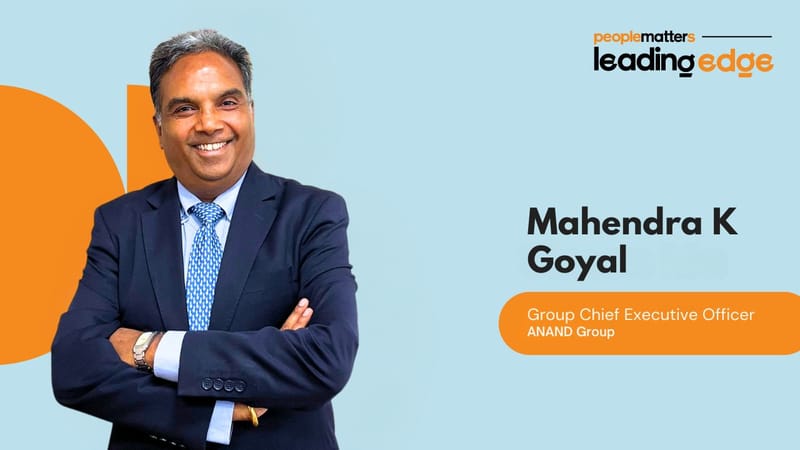
It's people who make the difference, by making decisions, driving innovation, and shaping the organisation's future, that's why RPRS is absolutely critical.
In the high-stakes world of corporate leadership, where a company's success is increasingly tied to its people, the relationship between the CEO and the CHRO has never been more critical. This is a dynamic that Mahendra K. Goyal, the Group CEO of Anand, a leading automotive component manufacturer, understands profoundly. With a career spanning three decades, Goyal has witnessed a fundamental shift: HR is no longer just a support function but a key driver of business strategy and organisational transformation.
In a comprehensive dialogue, Goyal shared his insights on leadership, talent, and the evolving power of the CEO-CHRO partnership. His perspective offers a robust roadmap for how leaders can navigate a future defined by rapid change, technological disruption, and a multi-generational workforce with new expectations.
Goyal's leadership journey, which began in 1995, is guided by an entrepreneurial mindset and a relentless focus on outcomes. His philosophy is simple yet powerful: leadership is fundamentally about accountability. "I set high expectations, but I also ensure my teams have the resources and support they need to succeed," he explains. "While I may not be a technical expert, I specialise in empowering those who are technically inclined to perform at their best," he quipped.
A core tenet of his approach is visibility and accessibility. Goyal travels extensively to meet employees across the Group's various locations. He believes that a leader must be present and engaged to truly understand the pulse of the organisation. He emphasises the importance of leading with "concern but not being paralysed by the presence of risk." This balanced approach allows for proactive decision-making and a focus on opportunity, even in the face of uncertainty.
This vision extends to how he manages his diverse workforce. Talent assessment and development are foundational to effective leadership, according to Goyal. "I believe in identifying genuine potential early, nurturing it thoughtfully, and creating meaningful opportunities for individuals to demonstrate their capabilities. Without opportunity, talent remains unseen."
Goyal champions role rotation every three to four years, a practice he sees as crucial for identifying and nurturing new talent. "When one person holds a role indefinitely, it limits the growth of others," he states.
For Goyal, the evolving CHRO role is a testament to the belief that people are at the heart of the business. "At Anand, we believe that success is 90 percent about people," he says.
"It's people who make the difference—by making decisions, driving innovation, and shaping the organisation's future. That's why having the right people in the right roles is absolutely critical," believes Goyal.
The CHRO's role, therefore, is not merely to handle basic people management but to act as a strategic partner who is deeply aligned with the Group's long-term vision.
The traditional perception of HR as an administrative function is obsolete. Today's CHRO is a key driver of organisational transformation, working in close collaboration with the CEO to formulate and achieve overarching goals. This partnership is essential for ensuring that HR initiatives are not just about hiring, but about building a future-ready organisation. This involves enabling talent with the latest technologies, skills, and continuous learning opportunities.
Goyal's own collaboration with his CHRO is a model of this integrated approach. They work together to ensure that HR initiatives are fully aligned with the Group's long-term objectives, a dynamic that goes far beyond traditional HR functions. This partnership is what drives sustainable growth and navigates complex challenges.
"We aspire to include younger professionals who bring fresh perspectives, evolving mindsets, and an understanding of the latest environment," the leader said.
For Goyal, work-life balance is a personal choice, and a mindset he both practices and promotes. His mantra is simple: "Complete your work during the day and leave on time."
When faced with significant crises, like the pandemic, Goyal's strategy is centred on proactivity and conviction. "The ability to digest both good and bad news with the same composure is essential," he notes. He doesn't overstress but takes action with self-belief, encouraging his teams to take initiative without fear of failure. He believes that an organisation's future is always its own to shape, and this belief guides every decision he makes.
Goyal views technology and AI as powerful tools for enhancing efficiency and capabilities, rather than just reducing human roles. He stresses the importance of staying continuously engaged with these emerging technologies and fostering an open mindset among employees, viewing their roles as constantly evolving.
When asked for his single most crucial piece of advice for HR leaders, Goyal's response is direct and aspirational: "Think big to achieve big." He urges HR leaders to embrace ambition—not just for the organisation, but for the people they nurture. Their role is to build systems and a culture that empower individuals to grow and contribute meaningfully.
And what about the possibility of a CHRO one day leading a large automobile company? Goyal is unequivocal.
"Leadership is not confined to a specific function—it's rooted in individual capability," he asserts.
What matters is the ability to think strategically, inspire teams, and drive transformation. The future of leadership, he believes, is inclusive and ability-driven, not title-bound, proving that a CHRO is just as capable as any other leader of steering a company toward success.
Topics
Author
Loading...