







Leadership
Woven for Growth: How Gokaldas Exports is turning factory floor into launchpad for women leaders





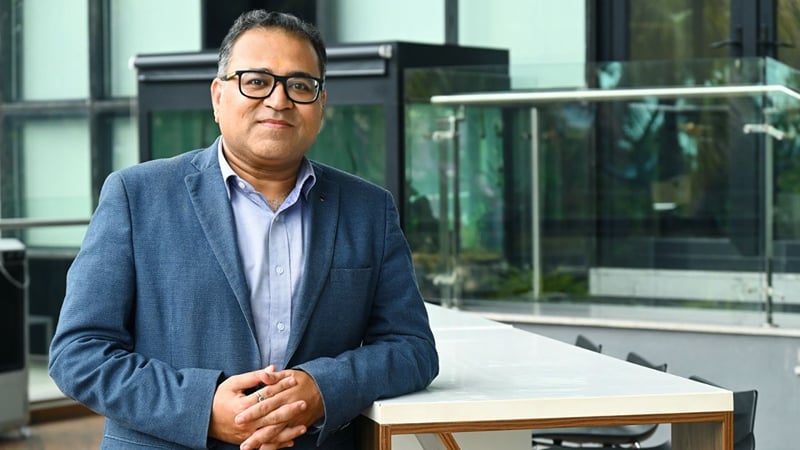
Amit Sharma discusses the barriers women face in moving into supervisory roles, the realities of factory life and the changing expectations of India's manufacturing workforce.
Walk onto the shop floor of any Gokaldas Exports manufacturing unit—whether across Indian states like Karnataka, Tamil Nadu, Andhra Pradesh, Madhya Pradesh, Jharkhand, and Haryana, or across the ocean in Kenya and Ethiopia—and a striking reality immediately takes shape. Of the apparel giant’s 55,000-strong global workforce (including roughly 35,000 employees in India), an overwhelming 85 percent are women.
In an Indian corporate landscape where most sectors struggle to push female participation past the 20 to 25 per cent mark, the textile and garment industry has long been an outlier. Yet, for Amit Sharma, Group CHRO at Gokaldas Exports, simply employing women is not enough.
Having spent over 26 years leading human resources at industrial heavyweights like Volvo Group India, TE Connectivity, Philips, Johnson & Johnson, and Indian Oil before stepping into his current role in 2024, Sharma views the factory floor through a distinctly human and socio-economic lens.
"Our fundamental belief is that this industry is not just about making apparel," Sharma reflects.
"There are enough people who can do the tailoring job. It is also about ensuring that women in every stratum of society are getting financial independence—that they are earning their own livelihoods and have a larger say in their homes."
This conviction holds true across borders, even when cultural dynamics shift. Having observed operations in both India and Africa, Sharma notes that while women in Kenya and Ethiopia often enter the workforce with a more established social expectation of being equal financial contributors at home, Indian women frequently navigate far more traditional societal structures.
Consequently, every new factory launch or expansion at Gokaldas Exports is treated not merely as a commercial milestone, but as a deliberate social intervention to bring more women into the formal economy.
However, bridging the gap between entry-level employment and genuine leadership requires dismantling deep-seated social conditioning, rethinking traditional factory hierarchies, and addressing the everyday realities of women’s lives.
Peers to Leaders: Rethinking the supervisory leap
Across the manufacturing sector, shop-floor operators are rarely factored into formal succession pipelines.
They clock in, meet their daily quotas, collect their wages, and go home. Gokaldas Exports set out to challenge this status quo with a straightforward premise: if 85 per cent of the operating workforce is female, at least 85 per cent of the supervisory layer should be women, too.
To date, the company has transitioned 159 women from shop-floor roles into supervisory positions through structured internal development programmes. Yet, Sharma is quick to reject the paternalistic notion that the company is "helping" these women. "Gokaldas Exports is just a catalyst in women’s own growth," he says. "They know what they want to do; they have the potential. We are simply providing the ecosystem to help them realise it."
Making that leap, however, demands a profound mindset shift. As an operator, a woman’s focus is entirely individual—mastering her specific workstation, whether stitching a seam, attaching a collar, or fastening buttons.
Stepping up to supervise a line of 20 to 25 operators requires mastering industrial engineering basics, line balancing, conflict resolution, and de-bottlenecking. It also means instilling a clear "North Star": helping operators look beyond mere garment assembly to understand quality inspection, precise finishing, and the end customer's expectations.
Surprisingly, when Gokaldas Exports first began enrolling women into its supervisory training, the biggest hurdle wasn't a lack of technical aptitude or ambition—it was emotional reluctance.
"We heard employees express resistance about moving away from their friends," Sharma recalls. "They were concerned that they wouldn't enjoy the same camaraderie with their peers once the organisational dynamics changed."
Rather than ignoring this hesitation, the HR team wove it directly into the curriculum, culminating in a formal graduation ceremony before graduates are mapped to open supervisory roles. Women in the programme are coached on how to transition from peer to leader without becoming a distant, authoritative boss. Instead of issuing orders, they are taught to act as facilitators.
Having sat at those very machines, internally promoted supervisors understand where their former peers struggle. By helping colleagues improve their technique—which directly boosts the operators' incentive earnings—these new leaders build trust while keeping their friendships intact.
The business impact has been remarkable. While the garment industry is notorious for high blue-collar turnover, Gokaldas Exports has recorded zero attrition among the 159 women elevated through its internal supervisory programmes, outperforming externally hired supervisors.
Furthermore, lines led by homegrown female supervisors report noticeably lower absenteeism and higher productivity. Because operators feel a personal loyalty to a leader who was once one of them, they rarely take unannounced leave—often informing their supervisor a day in advance so the line can be rebalanced smoothly.
Addressing the invisible load
To keep women thriving on the factory floor, Sharma recognises that an employer cannot separate a worker's professional output from her domestic reality. In India, the socio-cultural burden falls disproportionately on women.
Before a female operator even arrives for her single-shift workday, she has often cooked for her children, husband, and in-laws, and she will return home to manage the household all over again. Village festivals, visiting relatives, and family obligations frequently force women into unplanned absences.
Rather than penalising this reality, Gokaldas Exports sensitises its workforce on leave planning while designing interventions around the holistic well-being of its female employees:
Health and Nutrition: Recognising that conditions like anaemia and ergonomic fatigue quietly erode women's stamina and attendance, the company runs regular health camps, educates workers on posture to prevent chronic body ache, and provides nutrient-rich, balanced meal charts in its residential dormitories for migrant workers.
Continuing Education: Many young women leave factory jobs to pursue higher studies. To prevent them from having to choose between a livelihood and an education, the company enrols them in open schools and colleges while subsidising their fees, allowing them to complete their schooling and degrees while working.
Life Skills for All: Sharma evaluates leadership potential through two lenses: agility (the speed of learning and adapting) and aspiration (the "fire in the belly" to take on greater responsibility). Because a factory line has only one supervisor for every 25 operators—and because some women genuinely prefer not to take on the added stress of management—Gokaldas Exports runs parallel development tracks for those who want to stay in operator roles. These include practical workshops on financial literacy, time management, and parenting, ensuring women can manage their household finances and personal lives with confidence. When operators watch their peers climb the ladder, it naturally creates an organic "pull factor" for self-development across the floor.
Multi-skilling and the road ahead
Over the next 12 to 18 months, Sharma’s talent strategy is anchored in unlocking greater earning power for women on the shop floor while preparing the white-collar leadership layer for rapid business expansion.
On the manufacturing floor, the immediate priority is multi-skilling. In an assembly-line environment—where one person stitches a collar, another a cuff, and another a seam—production speed is dictated by the slowest link in the chain.
By working closely with its industrial engineering teams, Gokaldas Exports rigorously assesses operators across multiple garment construction techniques. Every time a woman masters a new operation, her skill grade—and her financial incentive—increases.
The company is also exploring cross-factory mobility, enabling women to move between units to gain exposure to different product lines and accelerate their personal growth.
Meanwhile, for its white-collar managers, the focus is on cultivating strategic thinking, decisive people leadership, and technological fluency.
On the subject of artificial intelligence, Sharma offers a pragmatic philosophy that mirrors his approach to human potential: "AI is a good servant, but a bad master. If you use it for everything, you stop using your own grey cells. It should be an aid to manage daily time and remove bottlenecks, freeing our leaders to think strategically."
Topics
Author
Loading...