







Life At Work
The manager who stopped smiling: Why this is now the CFO's problem, not just the CHRO's







As manager engagement falls and employees rethink leadership roles, organisations face a deeper question: who will want to lead next?
There is a particular kind of manager most of us have worked for at least once — the one who used to walk in energised, who made the job look like a natural next step rather than a cautionary tale. You wanted, eventually, to become them.
Look around most organisations today and that manager is harder to find. Not absent, exactly — still doing the job, still hitting the numbers, mostly still there. But something has gone out of the walk. The calendar is fuller, the door is theoretically still open, and the conversation, when you get it, is shorter than it used to be.
Nobody has announced a change. Nobody needs to; the room reads it anyway.
And the people watching — the ones who are supposed to want that job next, who were told for years that this was what “growth” looked like — have started to notice. Some are saying so out loud. Most are simply making a quieter, more private calculation, and arriving at an answer that would have been unthinkable a decade ago.
This piece is about that noticing, and about why it should worry a CFO at least as much as a CHRO.
The number nobody budgeted for
Gallup's State of the Global Workplace 2026 report contains a statistic that deserves more alarm than it has received. Manager engagement globally has fallen from 31 per cent in 2022 to 22 per cent in 2025 — a nine-point decline, with the sharpest single-year drop, five points, landing between 2024 and 2025 alone. Individual-contributor engagement, over the same period, barely moved.
The consequence is structural, not cosmetic. Managers have historically enjoyed what Gallup calls an “engagement premium” — they were meaningfully more engaged than the people reporting to them, by roughly eleven percentage points in 2022. That premium has all but disappeared. Managers are now only marginally more engaged than their own teams, occasionally less so.
Read that twice, because it inverts something we have taken for granted since the invention of the org chart: that the further up you go, the more invested people become. That assumption is quietly failing.
Gallup's own decades of research offer the reason this matters beyond the manager's own wellbeing: managers account for roughly seventy per cent of the variance in team-level engagement. Not compensation. Not perks. Not the strategy deck from the last town hall. The manager. When that single lever weakens, it doesn't stay contained to one unhappy person in one review cycle — it is the mechanism through which disengagement is manufactured and distributed, team by team, across the organisation.
India's version of this story is sharper, not milder
For an Indian readership, this is not a Western trend to observe from a distance. Gallup's 2026 data shows South Asia — India, principally — recording the steepest regional decline in manager engagement anywhere in the world, an eight-point fall in a single year. India's overall workforce engagement dropped from 33 per cent in 2022 to 23 per cent in 2025, its lowest level in four years. Gallup, working with the Institute of Directors India, now puts the annual cost of this disengagement to the Indian economy at roughly $351 billion — about nine per cent of GDP.
The proximate cause is not mysterious. India's technology sector shed a significant number of mid- and senior-level roles through 2024 and 2025, much of it tied to AI-led restructuring. The managers who survived did not inherit lighter jobs. They inherited the teams, the targets, and the ambiguity of the people who were let go, on top of their own. A 2025 Nasscom-Deloitte study of the sector found 68 per cent of IT professionals showing at least two clinical indicators of burnout — emotional exhaustion, depersonalisation or a reduced sense of accomplishment. Managers, sitting between leadership's expectations and their teams' exhaustion, are not exempt from that number. They are, if anything, its most exposed carriers.
Why the CFO should be in this conversation, not just the CHRO
It is tempting to file all this under employee wellbeing and move on — a worthy concern, but a soft one, the kind that gets a slide in the town hall and a paragraph in the annual report. That would be a mistake, for three reasons a finance function will recognise immediately.
First, it is now sabotaging the organisation's AI investment. Gallup's research finds that the single strongest predictor of whether an employee uses AI well — ahead of the technology itself — is whether their direct manager actively champions its use. Employees whose managers do so are 8.7 times more likely to say AI has genuinely transformed how they work. Which means every rupee an organisation has committed to its AI transformation is being routed through precisely the layer of leadership that is currently least equipped, least trained and least engaged to carry it. That is not an HR risk. That is a capital-allocation risk, and it belongs on the same slide as the technology roadmap.
Second, the succession pipeline is not thinning — in places, it is refusing to exist. More on this shortly, but the short version: a meaningful share of an organisation's best individual performers are declining the manager's job outright. A bench that won't stand up when called is not a talent-management footnote. It is a continuity risk that a board should be pricing in.
Third, the cost is already being measured in currency, not sentiment. Set against a global disengagement bill Gallup estimates at ten trillion dollars, and an Indian one at $351 billion, this stops being a conversation about morale and becomes a conversation about basis points of GDP. When the CHRO raises a concern this large and this well-quantified, and the CFO can see it directly on the cost line, the CEO does not get to treat it as somebody else's department.
The loop, and why it's closed
What makes this a genuinely hard problem — rather than a normal one that a wellness webinar and a townhall Q&A will solve — is that it is not a single cause with a single fix. It is a loop, closed and self-reinforcing, and understanding its shape matters more than any one statistic inside it.
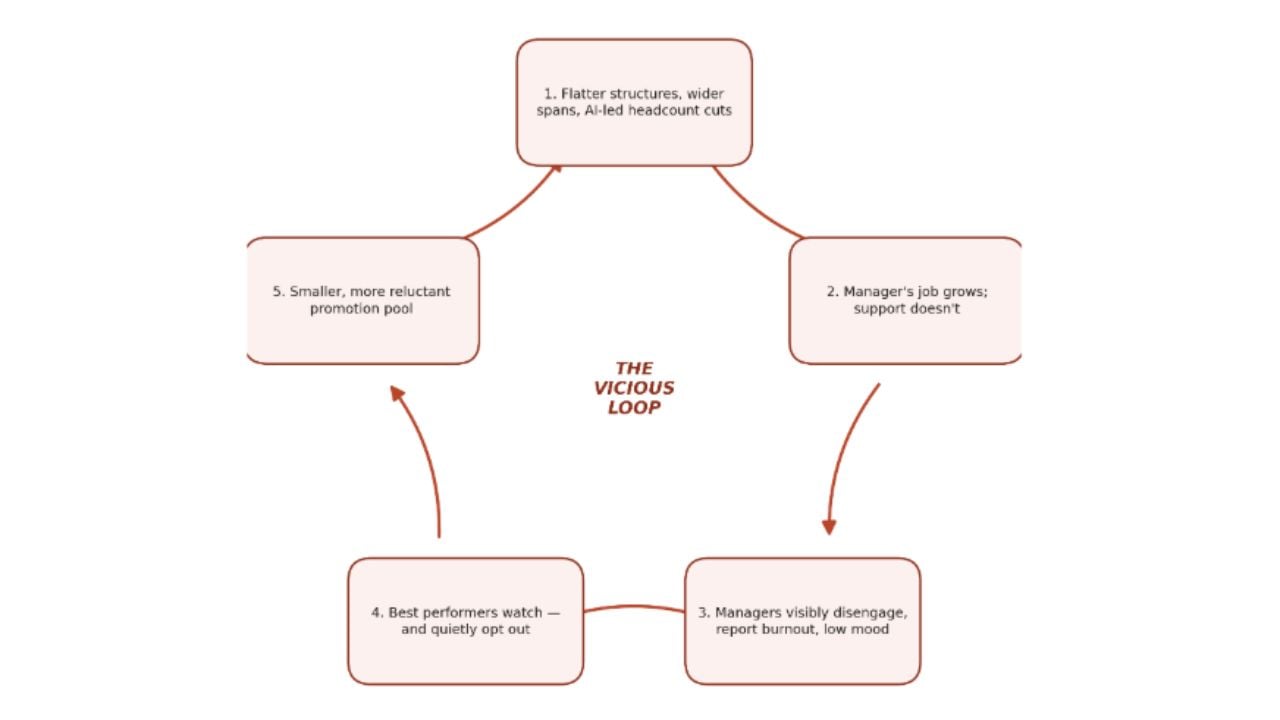
Flatter structures, wider spans of control and AI-led headcount reductions expand what a manager's job now requires, without a corresponding expansion in support, training or authority. Deloitte's 2025 Global Human Capital Trends research found that over a third of managers, 36 per cent, say they are insufficiently prepared for the people-management side of their role, and 40 per cent report a decline in their own mental health after becoming a manager. Average spans of control have risen to roughly twelve direct reports, a fifty per cent increase since 2013 — meaning the coaching and development work managers are meant to do is now being attempted across a wider group of people, with less time per person, by someone who was frequently never trained to do it in the first place.
The predictable result is visible strain: burnout, flatness, the manager who has stopped smiling. And this is the step most engagement conversations stop at, treating the manager's unhappiness as the end of the story rather than the middle of one.
It isn't the end. The people below that manager are watching, closely, because that manager's current life is also their own most likely future. And a growing body of research suggests they don't like what they see.
LinkedIn's 2025 data found only thirty per cent of individual contributors want to become people managers in the near term. Deloitte's Gen Z and Millennial Survey put the number wanting to reach a leadership position as their primary career goal at just six per cent. Robert Walters found 52 per cent of Gen Z professionals are actively avoiding management roles, and a Happily.ai study found 47 per cent of top performers would decline a promotion into management if offered one. A Hint App survey of nearly fourteen thousand workers across five countries found that 56 per cent have personally watched a colleague become visibly less happy after being promoted into management.
That is the loop closing. The organisation's most promotable people are opting out, in real time, based on direct observation of the very managers the organisation is failing to support. What remains is a smaller, more reluctant pool from which to promote — which means the next generation of managers is drawn from people who wanted the job less, were prepared for it no better, and inherit a role that has, if anything, grown harder in the interim. The loop does not need a villain. It needs only to be left alone.
Return, for a moment, to the manager who stopped smiling. The organisation reads that as one person's fatigue, addressable with a wellness session or a lighter quarter. The person two desks away reads it as market research — as the most reliable data they have on what their own future costs. Both readings are watching the same person. Only one of them understands what's actually being measured.
This is not fate — which is the uncomfortable part
Before turning to what might reverse this, it's worth sitting with one inconvenient fact: the average is not the ceiling. Gallup's own data shows that within what it calls best-practice organisations, manager engagement runs at 79 per cent — nearly four times the global average of 22. Those organisations are not exempt from AI disruption, flatter structures or cost pressure; they operate under the same conditions as everyone else. What they don't do is treat manager disengagement as weather.
That single number changes the register of this article, from diagnosis to indictment. A gap this wide between the average and the achievable means the decline documented above is substantially a set of choices — about span of control, about training budgets, about what gets rewarded — rather than an inevitable cost of doing business in 2026. Which is, depending on your seat in the organisation, either the most hopeful sentence in this piece or the most uncomfortable one.
Turning the loop
The reassuring part is that a loop this mechanical can, in principle, be run in the other direction — but only if the intervention addresses the mechanism, not the symptom. Four things, specifically, in rough order of leverage.
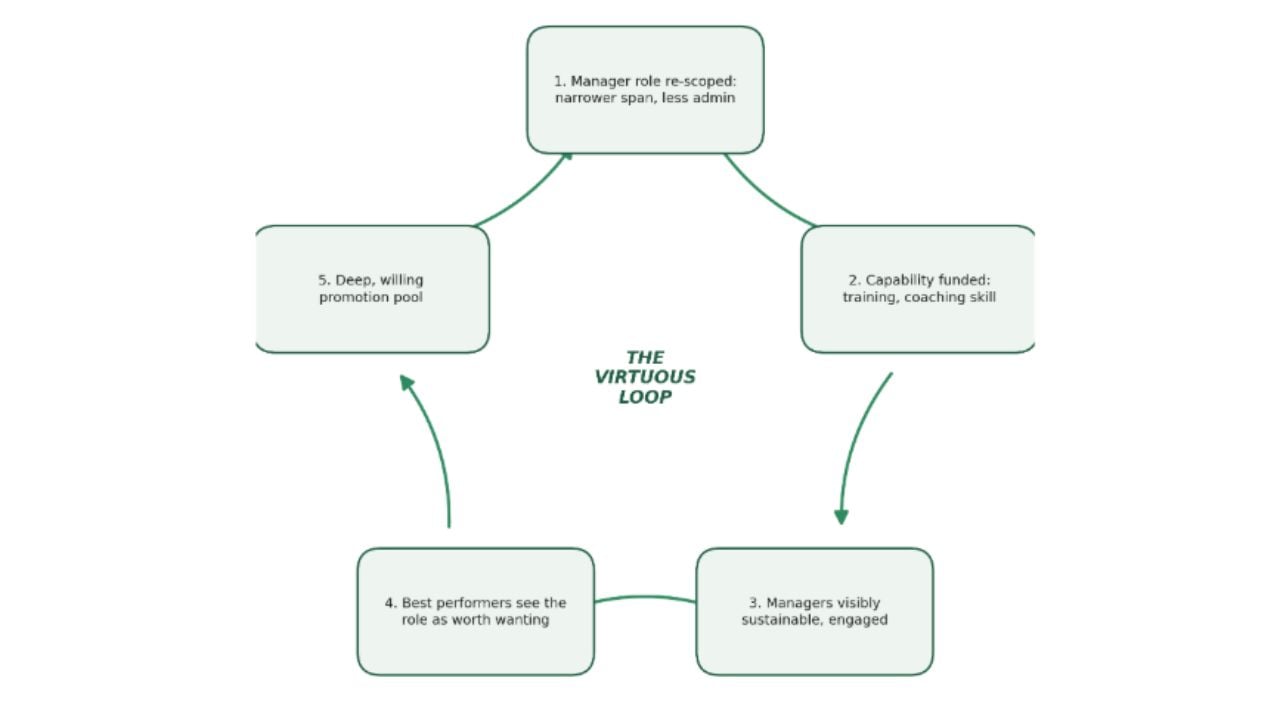
Shrink the job before trying to re-engage the person in it. Training a manager to coach twelve direct reports better does not fix a structural math problem; it asks one person to do the emotional and developmental work of what was, a decade ago, closer to two roles. Re-engagement efforts that do not first address scope and span are, in effect, asking managers to feel better about an unreasonable job rather than making the job reasonable. In practice this means auditing what a manager's week actually contains before redesigning what it should — stripping out the coordination and reporting work that a system or a more senior generalist could absorb, and protecting what remains for the coaching and judgment work only a manager can do.
Fund manager capability as though it sits on the same ledger as the technology budget — because it does. With only 44 per cent of managers globally having received formal management training, and over a third saying they feel unprepared, this is the most direct lever available on that 8.7-times AI-adoption gap. An organisation that invests in AI infrastructure while leaving its manager layer untrained is optimising the wrong side of the equation.
Build a second ladder that is genuinely equal, not a consolation prize. With anywhere from a third to half of top performers declining the move into people management, depending on the study, organisations need a senior technical or expert track that carries comparable status, pay and visibility — one that does not quietly signal “this is what we give people who couldn't handle the real promotion.” Without it, organisations either lose their best technical talent to competitors who offer that track, or force reluctant people into management, which feeds the loop rather than breaking it.
Fix the advertisement, not just the training manual. The Hint App finding — that a majority of workers have watched a colleague grow visibly less happy after promotion — points to something training programmes cannot solve on their own. The aspiration problem is a demonstration problem. Every current manager who looks depleted is, whether the organisation intends it or not, the most persuasive case study against taking the job. No onboarding module survives contact with a miserable person two desks away. The fix has to be visible in the manager the organisation already has, not only promised to the manager it hopes to develop.
The mirror the org chart doesn't want to look into
Every leadership team has, by now, had the AI conversation, the attrition conversation, the engagement-survey conversation. Fewer have had the conversation this data actually calls for: that the middle of the organisation — the layer meant to translate strategy into daily reality — has quietly stopped wanting the job it's in, and the layer below it has noticed and adjusted its ambitions accordingly.
The CHRO has known this for a while, in the language of engagement scores and exit interviews. What changes now is that the CFO has the same story in a different vocabulary — capital misallocated, adoption underperforming, a succession pipeline with fewer willing hands than headcount. When two functions that rarely read the same report start reaching for the same conclusion, the CEO does not get the option of treating it as somebody else's slide.
The question worth sitting with, then, is not whether your organisation has an engagement problem. Most do, somewhere. It is whether your own managers — the actual, specific people currently doing that job — look to the people below them like something worth becoming. If the honest answer is no, the pipeline problem you're planning for next year has already started.
Author

Loading...