







Organisational Culture
‘Culture is what you tolerate’: Designing employee experience beyond the culture statement






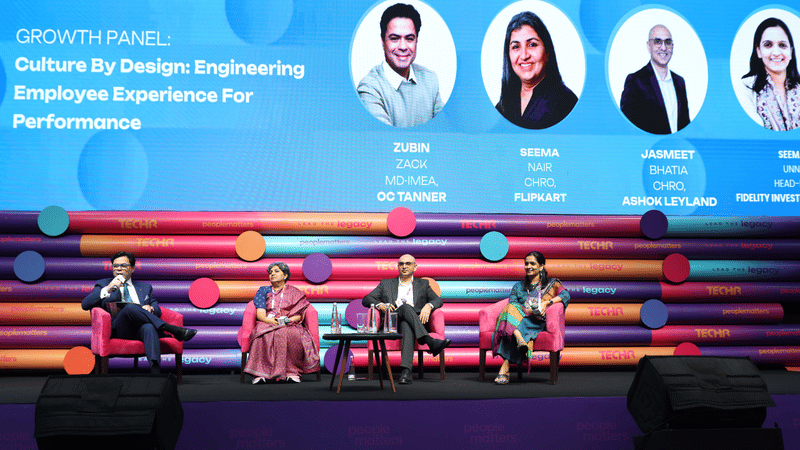
At TechHR India 2026, senior HR leaders explored how employee experience, talent decisions and leadership behaviour shape culture.
Culture is easy to talk about and harder to design. Organisations can define values, put them into frameworks and communicate them across the workforce. But what employees actually experience is shaped by what happens every day: how managers behave, how decisions are made, whether people feel trusted, and what leaders choose to reward or overlook.
This was the central thread running through the Growth Panel, “Culture By Design: Engineering Employee Experience For Performance” at People Matters TechHR India. The conversation brought together Seema Nair, CHRO, Flipkart; Jasmeet Bhatia, CHRO, Ashok Leyland; Seema Unni, Head HR, Fidelity Investments India; and Zubin Zack, Managing Director – IMEA, O.C. Tanner, to examine how organisations can move culture from a stated ambition to an employee experience that is visible in everyday work.
Culture is experienced, not displayed
Opening the discussion, Zubin Zack framed culture as something employees encounter rather than something organisations simply declare.
“Culture is not something you just put on paper or put up on the wall. You really see it, you live it,” he said, describing it as “the echoes you hear in the corridors of your workplace.” The choice for organisations, he argued, is whether to let culture emerge on its own or deliberately design it around the behaviours they want to reinforce.
That distinction sets up a practical question for leaders: if culture is being created through everyday behaviour anyway, what systems and decisions are shaping it?
For Jasmeet Bhatia, the answer begins with looking at the organisation through the employee's eyes.
“How does the employee speak about the organisation on a Sunday afternoon lunch with family and friends?” she asked.
At Ashok Leyland, that question has to account for very different employee realities. Factory employees, field teams, service-network employees and corporate professionals may experience the same organisation in very different ways. The challenge, therefore, is not to make every experience identical, but to establish a cultural foundation that holds across those differences.
One culture, different employee realities
Bhatia described a common connection that Ashok Leyland has worked to create across its workforce: an understanding of how individual work contributes to the end product and customer experience.
“Everyone, whether it's in the factory, in our field sales, in our surveys, in our corporate office, everyone understands that what we are doing is going to end up in a truck or a bus rolling off the line with good quality, what the customer needs,” she said.
From there, the organisation focuses on three common needs: psychological safety and wellbeing; connection to organisational purpose and growth; and empowerment.
The meaning of empowerment changes with the role. In a factory, it can mean being able to identify a quality or safety defect and stop the line. In sales, it can mean having the authority to make a pricing decision for a key customer.
The point is not uniformity. It is giving employees across different environments a consistent sense that their work matters, their concerns can be heard, and they have room to act.
Values have to influence decisions
At Flipkart, Seema Nair described a culture framework built around Audacity, Bias for Action, Customer Focus, Integrity and Inclusion. But the values are not treated as statements to be displayed.
“I’m yet to see this printed in any conference room,” Nair said. “But they permeate and radiate across the entire organisation.”
Their presence is instead tested through talent processes — from hiring and promotions to performance calibrations. The connection to business is deliberate: Flipkart's culture is closely tied to its focus on innovation, new categories and growth.
That makes talent decisions a critical test of culture. Nair pointed to the familiar case of a high performer who delivers strong results but does not demonstrate the expected behaviours.
“He or she is brilliant, brilliant results, but is not the best in terms of culture,” she said. If that behaviour is overlooked in hiring, performance or growth decisions, “we have basically tolerated poor culture.”
Culture, in this sense, is not only about what an organisation rewards. It is also about what it is prepared to tolerate.
Designing the employee journey
At Fidelity Investments India, Seema Unni approached the same challenge through the employee journey. The organisation uses a “moments that matter” framework that begins with candidate experience and continues through the employee lifecycle to alumni experience.
The approach starts before an employee joins. Fidelity engages prospective talent around financial education and careers, while its listening strategy covers candidates, employees and people who leave. Career mobility is another important part of the experience.
Unni's own career reflects that philosophy. “I've just done a ton of jobs in Fidelity,” she said, describing moves across HR, technology, business and risk. For younger employees, she noted, “They want freedom in the way they think about their career.”
The organisation has a dedicated associate-experience role that connects these different touchpoints and drives people experience across the business.
The underlying idea is simple: employee experience is not a collection of isolated HR programmes. It is the cumulative effect of the moments through which people encounter the organisation.
At scale, the fundamentals remain human
For Flipkart, designing those experiences becomes more complicated at scale. Nair described an organisation operating across roughly 6,400 locations, with warehouses, hubs, dark stores and fulfilment centres, and a workforce spanning white-collar, blue-collar, contract and gig workers, as well as candidates, consultants and interns.
Despite that complexity, she argued that some expectations are universal.
“Everybody wants dignity. Everybody wants respect.”
Nair also drew a distinction between culture and engagement, warning against reducing the latter to workplace events and perks. “Nobody joins an organisation because you're throwing a very nice Diwali party or Christmas party,” she said.
What matters more, she argued, are the fundamentals of the employment relationship: trust in managers, belief in leaders, opportunities to grow, fair performance evaluation and appropriate rewards.
That focus has also translated into an outcome for Flipkart: Nair said voluntary attrition, particularly among high performers, had fallen by more than half between last year and this year, which she attributed to sustained attention to the moments that matter to employees.
Managers turn culture into everyday behaviour
The manager emerged as one of the most important links between organisational intent and employee experience.
At Flipkart, a dedicated culture and engagement team connects moments across the employee lifecycle. The company also has around 4,000 people managers and tracks their capability through engagement tools, including the Manager Engagement Index. Nair said the organisation has taken concrete action where manager scores are very low.
At Fidelity, the emphasis is on changing how leaders themselves behave.
For Unni, leadership can be the biggest obstacle to cultural change. “The stumbling block really is the leader in terms of creating, adapting, changing culture as well,” she said.
Fidelity uses “coaching dojos”, inspired by martial arts, where leaders and managers practise coaching with diverse and cross-generational teams and receive live feedback on their conversations. The focus is on “coaching and not instructing talent.”
The approach reflects a broader shift: cultural change cannot be delegated entirely to HR. Leaders and managers are part of the experience employees are being asked to believe in.
Mental wellness needs systems, not slogans
The discussion also turned to mental wellness across a large, multigenerational workforce.
At Flipkart, employees can access external specialists and internal support networks, while mental wellness is incorporated into people-manager development. Nair said the organisation had set a goal of training all 4,000 people managers, with more than 78% having completed classroom training at the time of the session.
The company also offers unlimited wellness leave. Beyond a certain number of days, medical certificates or documents may be required, while information about what an employee is dealing with is kept confidential.
For the panel, these initiatives sit within a larger question of whether organisational systems and manager behaviours make it possible for employees to feel supported.
From Culture Statement to Culture in Practice
The discussion highlighted that culture is built through everyday employee experiences.
For Zubin, that meant asking whether organisations are intentionally designing the behaviours they want to see. For Jasmeet, it meant recognising that the same culture can be experienced differently while remaining anchored in common principles. For Seema Nair, it meant putting values to the test through talent decisions, accountability and the fundamentals of employee experience. For Seema Unni, it meant designing the employee journey and helping leaders change how they show up.
The practical priorities are clear: connect people to purpose, enable career mobility, give employees room to act, develop managers, listen continuously and hold leaders to the same standards as everyone else.
Ultimately, culture is revealed not by what an organisation says it values, but by what employees experience and what the organisation chooses to reward, reinforce and tolerate.
Author
Loading...