







Organisational Culture
TecHRIN 2025: Dr. Raju Mistry on building a culture that moves people forward



 ||
||Updated on


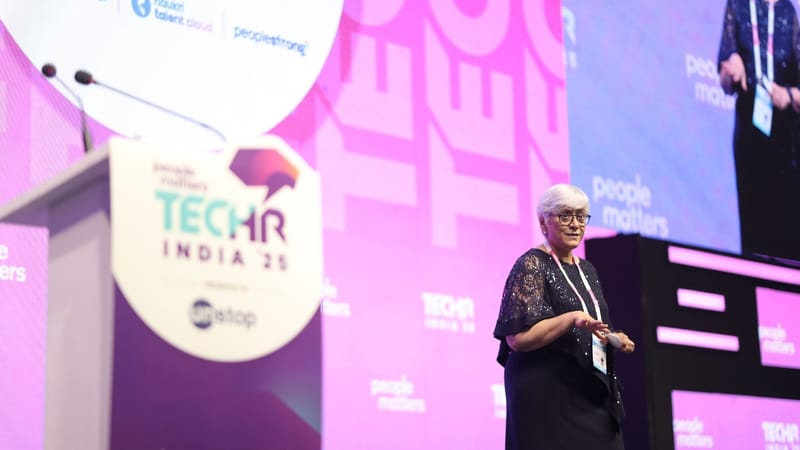
Sharing breakthroughs, Dr. Raju Mistry emphasised the urgent need for leaders to rethink leadership by aligning people, purpose, and performance.
Delivering a powerful keynote at People Matters TecHR India 2025, Dr. Raju Mistry emphasised the urgent need for leaders to rethink leadership by aligning people, purpose, and performance in response to evolving workforce expectations.
Dr. Raju shared her breakthrough insights on the mindset, skills, and strategies essential to fostering a workplace culture built on trust, inclusivity, and resilience, a timely call for leadership transformation in today’s dynamic world of work.
Culture eats strategy for breakfast, some even say lunch, dinner, and beyond. The point is, culture has taken center stage because of its ripple effect on everything that truly matters to a business.
That’s when people started paying attention to it. And that’s when HR saw a surge in hiring, because HR was handed the responsibility, the mantle, to be the custodian of culture. To lead cultural transformation.
We've all heard it: HR will bring in best practices. HR will fix the culture. That’s why sessions like these are organized, to equip you with frameworks, tools, and so-called ‘best practices’ so you can evolve culture in your organizations? Wrong!
Three common beliefs about culture (with real life experiences):
- The first belief: HR is the custodian of culture
- The second: HR leads and guides cultural transformation
- And the third: Adopting global best practices can help you build a better culture
These are the three beliefs we often hear, and I want to challenge them, starting with the first one: HR as the custodian of culture.
Picture this: you're in a boardroom meeting, and the topic of culture comes up — good culture, bad culture, toxic culture, harmonious culture… all of it. And what happens? Invariably, the eyes shift to the HR person in the room. And the unspoken expectation is: “You’re HR, so culture is your responsibility.”
But here’s the twist:
HR is not the sole custodian of culture. HR is one of the custodians.
Because when we talk about culture, good or bad, what we’re really referring to is people’s experience of that culture. But, can HR alone create or control every employee experience? Of course not.
There are too many variables: leaders, managers, teams, business dynamics, that shape these experiences.
How do breakthroughs happen?
When I was working with a large conglomerate, rolling out talent management processes for the first time. It was a big mandate, spanning multiple businesses and clusters. Part of this rollout included conducting assessment centers to gauge people’s potential.
We know business leaders have their own view of their team’s potential. And sometimes, the assessment center results don’t align with that view. That’s exactly why you do these assessments, to bring an objective lens.
One of the best pieces of advice I got at the time was: “When you sit down with the leaders to discuss these outcomes, don’t present it as HR’s point of view that overrides theirs. Position it as an additional perspective.”
Later, in the meeting with the business leader, I said, “Here’s the process: We’ve captured your view on the candidate. And here’s an alternate perspective, generated through multiple exercises. Your agreement on this is a choice, we just want this to be part of your consideration set when you make a decision.”
And guess what? A stunning 99.9% of the leaders aligned with the outcomes from the assessment centers.
If we have otherwise said, “This is HR’s final verdict.” What would have happened? Resistance. Misalignment, and maybe even conflict.
The point is, HR plays a critical role in shaping culture, but it can’t be the sole custodian. Culture is a shared responsibility.
This is what HR believed, and can do for favourable outcomes.
An approach of shared ownership not only aligns business leaders greatly with the outcomes, but ensures a smoother execution of all development plans and follow-through actions.
I reiterate, culture cannot be owned by HR alone. The buy-in and ownership of multiple stakeholders is essential.
HR leads and drives cultural transformation?
If we think through “transformation”, it sounds dramatic, painting a picture of radical change. The change you expect to see in one-year, two-year, or three-year programs. But, honestly, can we really transform something that’s embedded in a company’s DNA in just two or three years? The honest answer is, it's not that simple.
Culture is like a flowing river, evolving over time, and you can’t establish a dam and change its course overnight. You have to work with the flow, guide it gently, and nudge it in the right direction.
Therefore, we need to be careful with the ideas of instant “transformation”, because what evolves, stays. What’s forced, rarely does.
How real change happens?
About 25-30 years ago, computers weren’t common, and offices had those bulky desktops, and very few of them. In one of my previous companies, there was a union for the staff, where members of the corporate office could leave at 4:45 PM, but management at 5:45 PM.
In those days, computers were precious resources. In the corporate office, one computer was managed by an admin assistant, a union staffer. Same in the factory, that computer was strictly for salary processing. So, if you were a new joinee at a junior level, you were told: “Don’t touch that computer. All the data will get corrupted.” Naturally, you’d get intimidated, and simply follow the warning.
But here’s where that one-hour gap became my golden opportunity: when the staff left at 4:45 PM, I had an hour with that computer before I left at 5:45 PM. I started using that time to learn, to experiment, reverse coding, and playing with data.
Gradually, I became self-sufficient, and people noticed, “She doesn’t wait for someone else to do her work.” That’s how it all began, and others became less dependent too as they started exploring on their own.
A small action, quietly done, became a ripple. The company's admin noted that this enablement didn’t harm me, rather it made the process smoother for everyone.
That’s how real cultural shifts happen, not through flashy transformation programs, but through small, consistent actions that people experience and embrace over time. Culture is an accumulation of such stories.
Best practices are the holy grail of building culture?
We’ve all been searching for “best practices” that we can adopt. But my perspective is, best practices are often best left unpracticed.
Why? Because culture is not about copying what works elsewhere. It’s about what works here, in a unique context.
But, how many times has HR been given a hiring mandate that says, “Find someone who fits our culture”? We all do it. “Culture fit” is a common hiring criterion, but what happens when we only look for people who fit in? We end up with clones. People who think alike, behave alike, and agree with each other.
Where’s the diversity? Who’s challenging the status quo? Who’s bringing in fresh ideas?
Once in a sales organisation I worked for, they had built a team of “culture fits.”
People with common perspectives and mindset. But when the market dynamics changed, they struggled. There was no one to ask, “Why are we doing it this way?” That’s the danger of obsessing over “culture fit” and blindly chasing best practices.
Instead of best practices, what we need is next practices — ideas that are born from within, evolved through experimentation, and tailored to our context.
For example, in FMCG sales, we expect salespeople to be extroverts, the classic image of someone outgoing, loud, always chasing numbers.
Why? sales can't be done by introverted people.
But during a leadership development program, we ran an MBTI assessment for the entire sales team. And from top leadership all the way down, we found that most of them were high on introversion.
When we dug deeper, the top leader was an introvert and he hired only those who were introverts, who in turn, hired people just like them. Over time, about 90% of the entire leadership pipeline was made up of introverts. Extroverts never really fitted in.
It was an eye-opener, and a call to check whether we’re unconsciously building a team of clones. We need to bring in different personalities with different perspectives. Diversity isn’t just about demographics, it’s about perspectives that challenge the norm.
These are the kind of breakthrough realisations that make you pause, reflect, and tweak how you approach culture.
Topics
Author
Loading...