







Payroll Benefits Administration
"When you pay people right, you earn trust”: ADP Rahul Goyal on payroll's impact





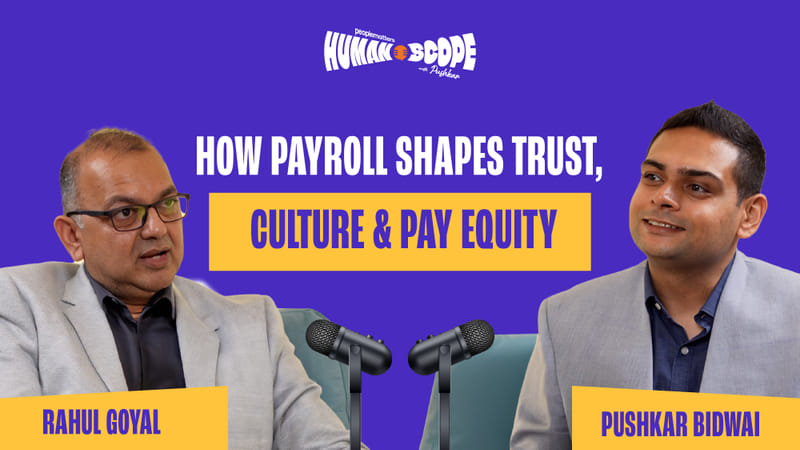
Rahul Goyal, MD for India & Southeast Asia at ADP, reveals how data, transparency, and compliance are turning payroll into an engine of business growth.
Modern civilisation sits on a bench of invisible systems that work codependently to light up the town with precision. Their strength lies in consistency, not visibility. When they perform as expected, they fade into the background. When they don’t, they command immediate attention. For all the latent applause, a reliability follows that processes the trust holding it all together. Payroll is a key aspect of the trust.
In a candid HumanScope conversation with People Matters CEO Pushkar, Rahul Goyal, a veteran leader with over a decade at ADP leading its operations across India and Southeast Asia, made a compelling case on the profound evolution of the payroll industry. While often dismissed as a "backroom" administrative task, Rahul argues that payroll is the "heart and soul of an organisation," serving as a critical touchpoint for trust, transparency, and employee wellness.
40 million paydays
Rahul has spent over a decade at ADP, as he joked, “a decade is not too long in ADP’s parlance.” What keeps him going, he said, is purpose.
Currently, ADP pays over 40 million people globally across 140 countries. In India alone, the formal workforce of 100 million represents a massive growth opportunity as companies move away from manual spreadsheets toward sophisticated, compliant outsourcing models.
During the pandemic, when uncertainty was the norm, payroll professionals quietly became essential workers. He recalls the "unsung heroes" during the pandemic who ensured that even in global crises, people received their hard-earned wages accurately and on time.
"It's like providing that electricity... Electricity in your homes, you don't feel, but the moment it goes off, hell breaks loose. And so is payroll."
The three phases of payroll evolution
According to Rahul, the industry has transitioned through three distinct phases:
The Spreadsheet Era: Basic software and Excel sheets where the only goal was to finish by month-end.
The HR Tech Era: A focus on employee experience. “Employee experience became important,” Rahul explained. “People wanted payslips, answers, transparency, why is my tax different this month?” Payslips became digital. Queries became visible.
The Expertise and Compliance Era: The pandemic marked this phase. “People realised that not only paying people is important,” Rahul said, “access to pay is important.”
Looking ahead, he sees payroll data driving strategic decisions, from pay equity to financial wellness. “Payroll information will increasingly shape how organisations think about fairness, inclusion, and wellbeing,” he said.
Gen Z influence: Pay literacy and personalisation
The younger generation is changing how organisations view the paycheck. Rahul notes that Gen Z sees pay as an "expression of their hard work" and demands higher levels of personalisation, such as gym allowances or professional development training. “They see pay as an expression of their hard work,” he said. “They want to understand take-home salary, savings, even how they can contribute to CSR.”
However, this has led to a "query surge." Most payroll queries come from employees with less than two years of experience who are confused by tax deductions. This has birthed the need for "Pay Literacy". “The majority of payroll queries come from employees who are less than two years old in the organisation,” Rahul shared. “And most of them ask why the tax deduction is higher this month than the previous one.”
“Financial wellness does not mean that you will get paid more,” he said. Instead, it begins with understanding what you are paid, how you are paid, and why. Tax literacy, payroll literacy, and long-term financial awareness form its core.
For a workforce increasingly dominated by younger employees, this lack of clarity creates anxiety. Financial wellness, then, becomes less about perks and more about education. Payroll, in that sense, becomes the first classroom adults enter.
Driving social change through data
One of the most transformative aspects of modern payroll is the use of data to address social inequities. Rahul highlights two primary use cases: Gender Pay Equity and Payroll Transparency.
1. Gender Pay Equity
By analysing payroll data, organisations can identify why women are often paid less frequently because high-paying roles like IT or sales are male-dominated and "recalibrate and calibrate all the time" to reach equilibrium.
2. Payroll Transparency
Rahul advocates for a shift away from asking candidates about their previous salary, a practice that often perpetuates low pay. Instead, he suggests a role-based approach. “Why should a new hire’s salary be based on what they earned in their last job?” he asked. “The right question is, what does this role pay?”
"We don't ask people, what's your salary, the previous job, we say, 'Hey, this job at ADP pays you this much.'... The messaging is very different. Hey, this is a fair pay organisation."
Strategy = Compliance
In the past, compliance was viewed as a burden or a cost. Today, especially for startups, it is a "growth strategy". Rahul praises the digitalisation of government portals in India (like PF and Income Tax), noting that "if you miss something... less than 48 hours, you receive a notice".
Why? “Compliance creates transparency and trust,” Rahul explained. “No one wants to join an organisation with doubts around statutory practices. With technology reducing administrative burden, some degree of customisation is possible.
“Pay is one area where creativity must have limits,” he said. “Compliance is non-negotiable.”
The seat at the table: Payroll 2.0
As the workforce becomes more complex, incorporating gig workers, contractors, and freelancers, the CHRO's role becomes one of "portfolio management". Rahul predicts that within the next three to five years, payroll data will be the primary driver for high-level business strategy. Looking ahead, he believes payroll will become a strategic subject in India. “The insights from pay data will be sharper,” he said. “CHROs and CFOs will make better decisions because they’ll truly understand workforce composition, cost structures, and productivity.”
"Payroll guys will have a seat at the table in the boardroom... CHROs would have to manage this entire spectrum as a portfolio... with an eye on optimisation but also which produces the maximum impact."
Ultimately, the goal is a more transparent, authentic relationship between employer and employee. By sharing both the "celebrations" and the "struggles" of business performance, leaders can build a culture where employees feel they truly own the journey. Because when you pay people right, you don’t just run a company, you earn trust.
Watch the full interview on Youtube here.
Topics
Author
Loading...