







Skilling
Democratisation of technology is a must to design the next curve of Bharat





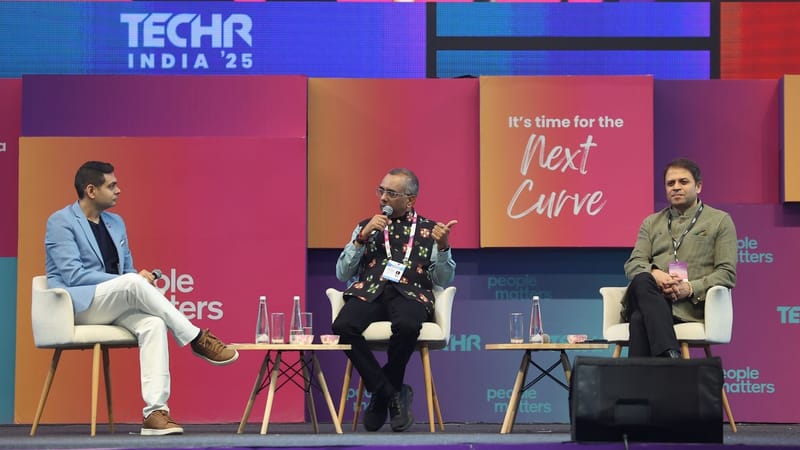
In a breakthrough conversation, Pankaj Bansal and Shankar Maruwada underscored the importance of democratising technology to drive inclusive, large impact.
In a breakthrough conversation during TechHR India 2025, Pankaj Bansal, Caret Capital, the Capacity Building Commission (CBC), Karmayogi Bharat, and Shankar Maruwada of EkStep Foundation, talked about the democratisation of technology.
For them, India’s digital public infrastructure has not only revolutionised governance and service delivery but has also become a global benchmark for scale, inclusivity, and innovation. From Aadhaar to UPI, India has built robust systems that serve the last mile with remarkable efficiency. Yet, as Bansal highlights, the real breakthrough lies beyond technology; it’s about vision, values, and a commitment to design for dignity and scale.
Drawing from India’s most ambitious digital initiatives, the session dove into the DNA of population-scale platforms. Referencing Nandan Nilekani’s insights, Maruwada noted that these systems began with a powerful idea—an inspiring destination that rallied policymakers, technologists, and administrators alike.
“Aadhaar and UPI didn’t just solve for identity or payments; they reimagined citizen empowerment through trust, simplicity, and human-centric design,” Maruwada added.
The Karmayogi Bharat initiative exemplifies this philosophy. With over 3 crore enrolments on the its platform, the programme is building competencies across 2.9 crore Indian civil servants. What sets it apart? A sovereign vision grounded in Indian values, democratised through open access and real-time learning.
“It’s about creating value and improving citizen services—not just digitising for the sake of it,” Bansal emphasised.
But transformation doesn’t come easy. Maruwada, an architect of India’s digital revolution, highlighted the psychological resistance to change: “People often push back when systems shift. The key is to continuously demonstrate value and positive impact.”
Bansal echoed this sentiment with an example from Karmayogi Bharat’s learning week, its Igot Karmayogi recorded over 30,000 transactions per second; a milestone that underscores the hunger for development and progress at the grassroots.
Looking ahead, the roadmap for public digital infrastructure is bold and ambitious. As Maruwada puts it, “India will be a digital society by 2035. It’s exciting, but picture abhi baaki hai.”
Sharing a similar sentiment, Bansal calls for the creation of the next generation of platforms, what he terms “the Blue Dot for Jobs”—to drive employment, skilling, and formalisation of the workforce. “It’s a continuation of the democratisation journey that started with financial access and now aims to unlock human potential at scale,” said Bansal.
In essence, this breakthrough conversation reframed the narrative around technology in India; from a tool of delivery to a platform for dignity, trust, and inclusive growth. As Bharat moves into its next curve, it's clear that designing for a billion dreams demands not just code, but courage, compassion, and collective will.
Topics
Author
Loading...