







Strategic HR
AI + Human touch: Striking the right balance in L&D transformation



 ||
||

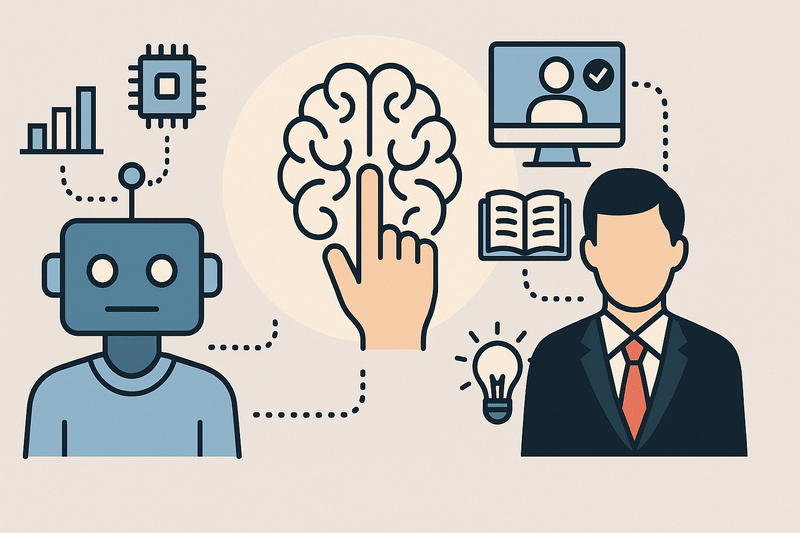
As AI accelerates the pace and precision of workplace learning, the irreplaceable value of human insight, mentorship and behavioural development is also becoming evident.
In boardrooms and break rooms alike, an irrefutable truth has emerged: artificial intelligence is transforming how we work and learn. Algorithms now recommend learning content, customise development pathways and surface skill gaps in real time. Forward-thinking organisations are reaping immense gains in efficiency and personalisation by leveraging AI-powered learning platforms that adapt to individual strengths, to analytics that quantify return on investment for every training rupee spent.
But as the workplace integrates AI in varied processes, a parallel truth is emerging: sustainable learning and lasting behaviour change require more than algorithms; they demand a uniquely human touch. While AI can rapidly scale knowledge transfer and curate vast content libraries, it cannot replicate the nuanced empathy, contextual judgement and social motivation that only people provide.
The future of capability development, as thought leaders now agree, is not a contest between man and machine. Rather, it is a conscious interplay of AI and human expertise working in tandem to deliver greater impact, better returns and higher growth.
AI algorithms + human connections: A powerhouse combination
While AI can radically personalise digital skilling content, experts believe peer interaction, collaborative learning and social interplay offer crucial value in workplace skilling. In other words, skills are most deeply embedded when learning is experiential, social and iterative. This sentiment is also reflected in Deloitte’s global State of AI in the Enterprise report, with 94% per cent of business leaders agreeing that AI is critical for success, but also admitting that striking the right balance in the tension between business and human outcomes is a key to unlocking human performance.
Similarly, one of the key strengths of AI in Learning & Development (L&D) is its ability to handle large volumes of data. AI tools can track learner performance, identify patterns and recommend personalised learning paths. For example, AI can flag when an employee is struggling with a specific concept and recommend additional resources or alternative learning formats. This data-driven approach allows learning teams to make informed decisions and adjust content in real-time, ensuring that no learner is left behind.
Adding this layer of analytics to embed behavioural and social learning, such as emotional intelligence, resilience, collaboration and ethical decision-making, can bolster the effectiveness of leadership development programmes and decision-making significantly. As this article in Harvard Business Review states, “Decisions are not merely exercises in data aggregation and algorithmic analysis... These are areas where humans have innate advantages over machines. Crucially, these involve implicit and often untrained human capabilities.”.
Hybrid learning ecosystems in practice: What do they look like?
A learning ecosystem driven by AI and humans can be designed on the following pillars:
Proactive skill development
AI platforms identify emerging skill gaps across the organisation based on market trends and internal performance data. L&D teams then leverage this insight to design targeted programs. For instance, if data shows a rising need for advanced data analytics skills, AI can quickly identify employees who would benefit from training and suggest relevant modules. Concurrently, human L&D professionals can then facilitate workshops, peer learning groups, or mentorship opportunities focused on applying these new skills in real-world projects.
Tekstac’s AI-driven video assessments and personalised evaluation tools, for instance, analyse technical responses and problem-solving approaches, enabling learners to refine their skills in a realistic, job-relevant manner through adaptive content recommendations.
Personalised pathways with human touchpoints
An AI-powered learning experience platform curates a unique learning path for an individual aiming for a leadership role. This path would include online modules, articles and assessments. Simultaneously, the learner gets opportunities for one-to-one coaching sessions with a seasoned leader in the organisation, participation in a facilitated behavioural leadership workshop and involvement in a cross-functional project where a human mentor provides guidance. Here, AI optimises delivery, and human interaction enriches comprehension and application.
Continuous performance enhancement
AI can provide real-time performance feedback within learning modules, highlighting areas for improvement. This data can then inform conversations between employees and their line managers or coaches. Instead of spending time on basic performance tracking, managers can use AI-generated insights to focus their coaching on specific areas requiring human-centric support, such as navigating team conflicts or enhancing communication skills.
Tekstac’s AI-enabled Practice Labs & Assessments can, for example, capture real-world proficiency by providing instant feedback on performance, identifying skill gaps and recommending targeted learning interventions. This can enable managers to map workforce skills against strategic priorities and recommend guided learning plans at scale to ensure a structured, data-driven progression path from foundational to advanced competencies.
Content evolution
While generative AI tools can rapidly draft training modules and assessments, human L&D teams provide the critical oversight to ensure accuracy, cultural relevance and ethical considerations. AI can analyse existing learning libraries to detect gaps or recommend updates, but human experts review, refine and imbue the content with the organisational context and storytelling that makes it truly resonant. This allows L&D teams to create high-quality, tailored content in days instead of weeks, keeping pace with ever-evolving business needs without compromising quality or human connection
.
AI is a powerful catalyst for learning and development - enhancing, not replacing, the human touch.
As AI advances, it is tempting to overfocus on automation and efficiency. But the evidence is unambiguous: organisations that focus exclusively on digital upskilling risk missing out on the very human qualities, like creativity, empathy and teamwork, that differentiate category leaders from the rest.
Instead, organisations can use AI to free up more time and space for human-centric learning. By automating routine tasks such as content curation and assessment marking, L&D teams can dedicate greater effort to higher-order work: facilitating reflective discussions, designing experiential workshops and nurturing mentoring relationships.
For L&D leaders, the imperative is clear. Harness the best of both worlds: invest in robust digital platforms, leverage analytics to tailor learning journeys, but anchor all efforts in the behavioural, experiential and social dimensions of true growth. This means providing not just content, but context; not just answers, but coaching; not just progress metrics, but pathways to personal and professional flourishing.
In the age of intelligent machines, it is the human touch and the ability to blend it skilfully with digital tools that will remain the ultimate competitive advantage. L&D and HR practitioners can benefit from remembering that while AI scales what is possible, it is humans who define what is meaningful.
Did you find this article helpful?
Get exclusive insights in the Next-Gen Learning Playbook: Supercharge ROI with AI & Analytics, published by Tekstac in partnership with People Matters.
Discover actionable hacks to elevate your L&D game and stay one step ahead.
Author

Loading...