







Strategic HR
AI Recruitment Is A Strategic Tool for Businesses, not just an HR function: A Business Leader's POV



 ||
||

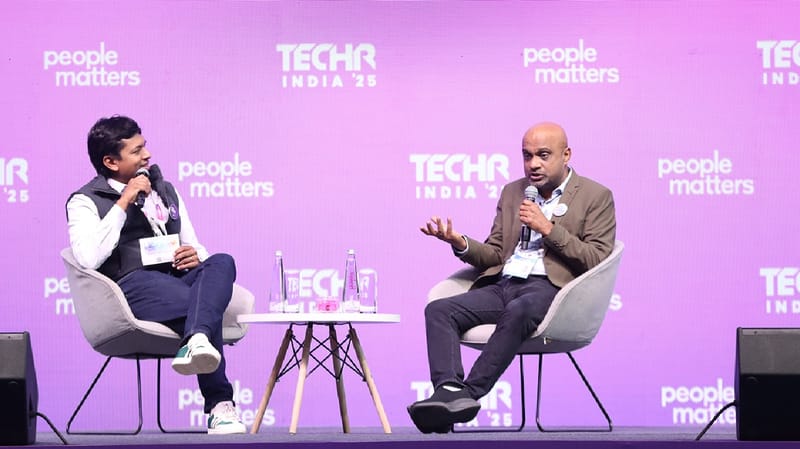
AI in recruitment is no longer just HR tech—it’s a business multiplier, driving agility, brand impact, and future-ready growth across organisations.
The Artificial Intelligence revolution has impacted every aspect of the organisational landscape, and recruitment too isn’t unaffected. In fact, as AI’s role goes, it is known to have aided the process, from crafting the pitch-perfect JD to scoring the right CV through data sorting, leaving the valuable work of culture and people to Human Resource managers. This has smoothened the recruitment process, making the work of HR professionals easier. But Srikant Naik, Chief Administrative Officer, Quest Global, goes on further to highlight the strategic role AI recruitment plays for businesses.
At People Matters TechHR India, Srikant, in conversation with Kiran Menon, Senior Director of Product, Phenom, observed how, beyond organisational roles in hiring, businesses can benefit from AI recruitment tools in terms of brand visibility and scaling. He noticed this shift from traditional to the current, marked by technological growth, and thus states that the knowledge of AI today is key to success. This success dynamic is not only true for organisations but also for individual growth. But it also comes with its apprehensions on the process of transition - from realistic deliverables to adoption of change-affirming mindsets in employees. In the fireside chat, he suggested a few doable approaches for enabling the best of the AI recruitment practices to accrue its strengths in terms of business strategy.
Recruitment as a Business Enabler
At Quest Global, which is an engineering services company with over 20,000 engineers across 20 countries, recruitment plays a pivotal role in enabling the business to solve some of the most complex and diversified engineering challenges in aerospace, energy, automotive, rail, and semiconductors.
“While we are in the services business, recruitment and bringing the best engineering talent across the globe becomes a very, very important element for us, and that's where these technologies come into the picture, which has a huge business impact,” says Srikant Naik.
In his 25 years at Quest Global, Srikant has seen a huge transformation, which has come forth in the adoption of technology. He goes on to share how hiring 20 years ago involved the tedious task of scouring the internet, doing a lot of secondary research, cold calling, and placing uncalculated bets.
The AI Advantage: From Weeks to Minutes
Srikant gave a simple but effective example of JD (Job Description) creation. Traditionally, perfecting a JD could take days, sometimes weeks, as managers debated scope, responsibilities, and skills. Today, AI tools can generate an 80–85% accurate draft JD in just 30 seconds, based on a single line input. With minimal human refinement, recruiters can move to market-ready postings in under five minutes.
The same compression of time also applies across the recruitment cycle:
Resume matching: AI can instantly scan hundreds of thousands of CVs, categorizing candidates as A-fit, B-fit, or C-fit.
Initial screening: For junior or niche roles, AI-led bots now conduct structured interviews, offering more reliable outcomes than manual screening.
Candidate engagement: Automated scheduling, reminders, and assessments reduce bottlenecks.
From Operators to Relationship Builders
With AI making the complex process easy and efficient, HR professionals can now focus on value-added tasks like building culture and helping with the productivity and proficiency of employees.
“I keep saying, HR is the new sales team of an organisation. Recruiters are not recruiters themselves, as the name suggests. They are the relationship managers representing your company.” - Srikant Naik
If 80% of transactional recruitment activities can be automated, what happens to recruiters? Far from being obsolete, they are now positioned to focus on the human side of hiring:
Selling the organisation’s mission and vision to candidates
Building long-term relationships with high-value talent
Negotiating and closing offers with empathy
This is a fundamental redefinition of the recruiter’s role: from operator to brand ambassador, from process executor to business partner.
Recruitment Technology as a Business Multiplier
Tools like CMS that can double down as what Kiran called “Candidate Management Systems”, sourcing platforms, and now AI-led solutions that have been seen as “HR tools” have expanded beyond hiring. It has become a strategic business lever that directly impacts the growth, agility, and competitiveness of organisations.
The real business transformation, however, lies not in recruitment alone but in its integration with other enterprise systems. At Quest Global, recruitment data is being connected with CRM, project management, talent management, and finance platforms.
“When all these tools are connected, you have fantastic visibility of the data at all levels, and then you can make smart decisions based on that data, and that's the next level multiplier effect of technology, what I call ‘campaigns to cash’. AI can play a huge role in all of these things. Your business becomes much more agile. You can make quick decisions.” - Srikant
The result is end-to-end visibility — from campaigns to cash. Leaders can see how hiring pipelines align with customer projects, how talent availability impacts revenue forecasts, and how workforce planning ties into financial performance. Recruitment thus evolves from a transactional HR process into a strategic intelligence system for the enterprise.
The Human Challenge: Change Management
In adopting new technology, the mindset shift is the most painful. Recruiters who once took pride in crafting the “perfect JD” or manually sourcing the “needle-in-a-haystack CV” may struggle when AI does this faster.
Without the willingness to embrace change, the best AI will yield no results. Successful adoption requires strong leadership push, cultural change, and continuous training, often over a 12–24 month horizon.
In fact, going forward, adapting to new tech, especially AI, will be key to a recruiter’s growth. A recruiter who is not using the technology will become obsolete. So it is very important that we adapt and influence associated KPIs to change.
Concept vs. Reality
In terms of implementation, whether a technology works or not, it can only be understood once rolled into action. In that case, it is up to the business perspective to make it work. It could take 12 to 24 months to make that change. And once you make that change, it's a huge impact, not only from the recruitment perspective.
Stating the example of concept cars and production cars, Srikant highlighted how AI recruitment platforms may promise futuristic features, but only a subset may translate into real-world value. Thus, organisations must prioritise phased implementation — testing, refining, and scaling features that deliver measurable impact.
The Road Ahead
AI in recruitment is not about reducing HR workload. It’s about enabling businesses to secure the right talent at the right speed, fueling agility and growth in highly competitive markets. As recruitment processes get smarter and more integrated, their impact moves well beyond HR dashboards - shaping how organisations deliver to customers, manage finances, and build future-ready workforces.
In short: AI in recruitment is not an HR upgrade. It’s a business transformation.
Author
Loading...