







Strategic HR
Breakthrough conversation with the leaders from PVR & Capgemini at PMTechHRIN





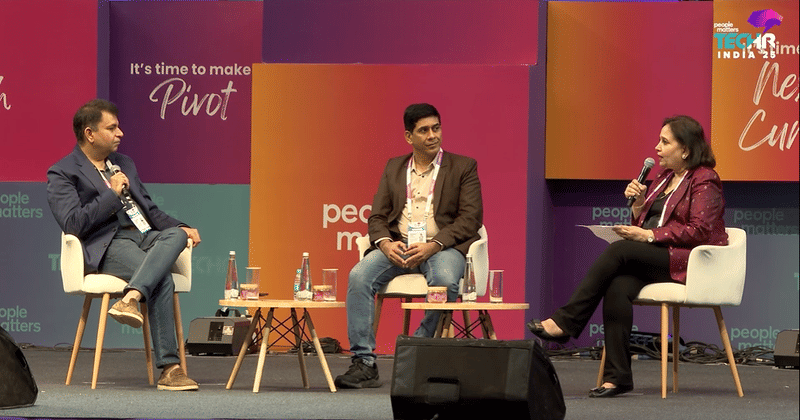
How can agility become central to an organisations' culture, work and talent talent strategies? Leaders who graced their presence at People Matters TechHRIN, discussed this matter further.
Agility is one of the most discussed concepts in the work landscape today. The organisations have realised the importance of engineering agility into their DNA, not as a buzzword, but as a core operating principle. But how can businesses uncover key solutions to redesign structures and decision-making processes ? How can companies enable and adapt to technologies that respond faster to change, pivot seamlessly, and seize new opportunities ahead of competitors?
To explore how businesses can move away from traditional and rigid hierarchies and towards adaptive teams that enable faster innovations and cross-functional collaboration, a breakthrough conversation was held at People Matters TechHR India 2025. Joined by PVR Cinema’s CEO Pramod Arora and CapGemini’s CTO Mukesh Jain, the conversation focussed on agility is a deliberate way of working that thrives on trust, empowerment, and cultural change.
From controlling employees to trusting them - at speed
Arora, who has led large-scale transformations across real estate and cinema chains, said agility starts with a leadership shift: replace control with trust. At PVR, that means treating each cinema manager like the CEO of their unit, empowered to make on-the-spot decisions without waiting for head-office sign-offs. “AI can assist,” he noted, “but emotional intelligence is what makes for sound, timely decisions.”
Jain traced agility’s evolution from “just moving faster” to building a feedback-driven operating system. He recalled a Microsoft experiment that tested multiple shades of blue for a search link; the winning variant shipped within two days—an example of how rapid, data-informed decisions can scale impact.
Both leaders agreed: give people closest to the customer freedom plus real-time data, and they’ll make better, faster calls than any centrally managed process can.
The psychology of ‘Letting Go’
Letting go is often the hardest part for the leaders, the panellists agreed in unison. Arora pointed to poor listening as a common blocker: leaders who assume they have all the answers stifle collaboration. A simple practice of replacing “but” with “and” would help the discussions be more additive rather than dismissive.
Jain admitted that he once struggled with delegation. Therefore, it was important for him to learn to step back. Ultimately, this learning was essential for his personal growth and for building teams that can operate independently.
It’s time to reduce fear and build confidence
Agility can trigger fear; for example - fear of failure, judgement, or being caught unprepared. Arora urged leaders to be patient with younger employees, giving them space to share half-formed ideas and supporting them through setbacks. Jain stressed that agility is not about haste: it’s about delivering value quickly, then iterating. An early career presentation mishap, he added, taught him to treat mistakes as fuel for learning, not reasons to retreat.
The panellists emphasised that rigid hierarchies and entrenched mindsets can hold organisations back. Therefore, they advocated the change from command-and-control to fluid networks that encourage cross-functional collaboration. In service-heavy environments where decision-making often sits too far from delivery teams, championing local decisions, even when that means challenging senior voices, is very important in any organisation.
Culture at the core of organisation
Agility, as the speakers argued, is cultural at its core. Arora defined it as empowerment, while Jain called it freedom. Arora gave an example of the time when he shifted PVR from the centralised decisions to distributed ownership, which helped uplift the organisation’s culture. Similarly, Jain talked about replacing rigid approval chains with notification-based workflows that keep leaders informed without becoming bottlenecks. In their conversation, both identified poor listening and power plays as cultural anti-patterns that stall progress. Arora also stressed on designing experience for the customer, noting that staff at newly acquired single-screen theatres were coached to create memorable visits.
What HR leaders can do now
As the session moved towards its conclusion, Arora urged the present HR community to hard-wire active listening across the organisation, with the help of forums, retrospectives, and mechanisms that surface frontline insight.
Jain’s insight was HR leaders must be encouraged to capture the data generated by everyday work and convert it into actionable decisions.
The panellists concluded that agility isn’t a one-off initiative or a toolkit to be “rolled out.” It’s a living culture built on trust, responsiveness, and the courage to act without perfect certainty. As Jain puts it, empowering others doesn’t make leaders redundant, it prepares them for the next opportunity.
Author
Loading...