







Strategic HR
Crafting workplace culture with purpose and design at TechHR India 2025





What happens when recognition becomes part of daily experiences and aligns with organisational values and business priorities?
Today, culture is not just a people agenda but a business success strategy. Sustaining it requires a thorough review process and an unwavering commitment to embed recognition into the workplace culture.
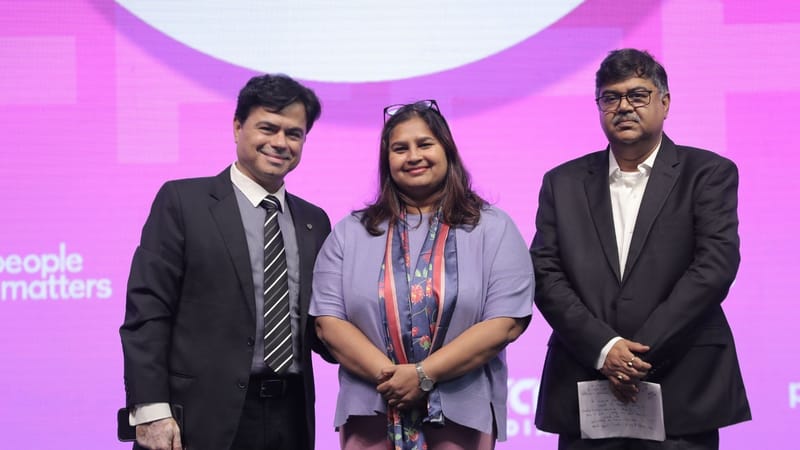
In an engaging fireside chat at TechHR India 2025, Zubin Zack, Managing Director, MEASA – O.C. Tanner Company, joined by Salil Lal, CHRO – Maruti Suzuki, and Kavita Kurup, Chief People Officer – Cyient, explored how thoughtfully designed recognition solutions can be a powerful catalyst for culture transformation.
The session emphasized that culture-building is not a one-off initiative but a continuous journey, one that directly influences employee engagement, performance excellence, and long-term retention. And what happens when recognition becomes part of daily experiences and aligns with organisational values and business priorities.
Here are the key takeaways from the session:
Culture redefined
Setting context on Maruti Suzuki’s definition of culture, Lal shared, “Maruti Suzuki is a 43-year-old organisation that began as a public sector enterprise, a large government-run company, and has since transitioned into a private entity. Over these decades, we’ve seen five different generations work with us. Today, as we speak, we have three generations actively working together. So, the spectrum of expectations, aspirations, and cultural values is quite broad.
Our challenge as well as opportunity is to preserve the legacy and foundational values that have built this company, while ensuring that we remain contemporary and future-ready. This is where culture becomes intentional. It’s no longer something that evolves passively. You have to shape it consciously, aligning it with the future of the organisation.
Kurup shared her perspective, “For me, culture is deeply tied to how we collaborate and innovate. I predominantly work with teams that are 25 years old, designing systems and processes that foster future-focused thinking while keeping us grounded in the present.
At Cyient, we’ve embedded culture into every facet of how we operate, whether it’s performance metrics, compensation, employee engagement, or even revenue models. We’ve created an “A.G.I.L.E” framework, where:
A stands for Accountability,
G for Growth (investment in innovation),
I for Innovation,
L for Leadership Development,
E for Execution.
Everything, from our goals, our strategies, our KPIs, aligns back to this framework. And I’ve seen this approach resonate not just within Cyient, but across global organisations.
Culture becomes the epicenter, the foundation around which business strategies are built. It allows us to take bold decisions that align with our purpose and values, even when they come at a short-term cost.
Beyond buzzwords
Lal emphasized, “For us, agility is not just a buzzword. When we talk about scaling from producing 2 million vehicles a year to 4 million by 2030, we’re essentially compressing the journey of the past 43 years into the next 6-7 years. That kind of ambition requires a fundamental shift in how we think about culture. It’s not just about the “what” producing more cars, it’s about the “how”.
Our workforce spans generations with differing aspirations. Some expect structured hierarchies but others seek flexibility like casual dressing or hybrid work models. Traditionally, our management style has been deeply influenced by Japanese practices, but there’s a growing need to integrate local nuances and future-facing strategies. Additionally, skill development and tech upskilling are constant needs.
But what’s equally critical is succession planning.
In an organisation of our scale and vintage, leadership pipelines need to be nurtured proactively at every level. When we talk about accountability in our A.G.I.L.E framework, it’s about setting clear milestones. For instance, if our goal is to reach a billion dollars in 6 years, what actions must we take today? This anchors every department’s objectives with measurable outcomes, ensuring we align present actions with future aspirations.
Kurup echoed, "Absolutely, and it’s not just about strategies on paper. Culture manifests in the micro-moments such as, day-to-day decisions, hallway conversations, how we respond to challenges. It’s not driven by mass emails or fancy presentations. It’s the collective rhythm of how we operate.
For example, we have AI-driven tools that provide nudges to our leadership, like virtual assistant pop ups serving as reminders on people-centric interventions. It’s a small but constant reinforcement of our cultural values, ensuring that we don’t lose sight of what matters amidst business pressures.”
How redefined culture shapes policies?
Lal shared, “We’re seeing shifts even in policies that were once unthinkable. Flexible work hours, hybrid work models, adapting factory operations for greater inclusivity. All these are now part of strategic discussions. They were never even considered 10 years ago. But today’s environment demands it.
The younger generation’s expectations are reshaping how we think about productivity and engagement. We have to build interventions that resonate with this shift, while still staying true to the core values that define us.”
Kurup added, “Culture, ultimately, is about staying grounded in your purpose while continuously adapting to the evolving landscape, be it technology, market dynamics, or employee expectations. It’s a living framework that needs constant nurturing.”
Topics
Author

Loading...