







Strategic HR
From taking bets on people to embracing AI: InMobi CHRO Shefali Rai’s approach to building a future-ready workforce



 ||
||

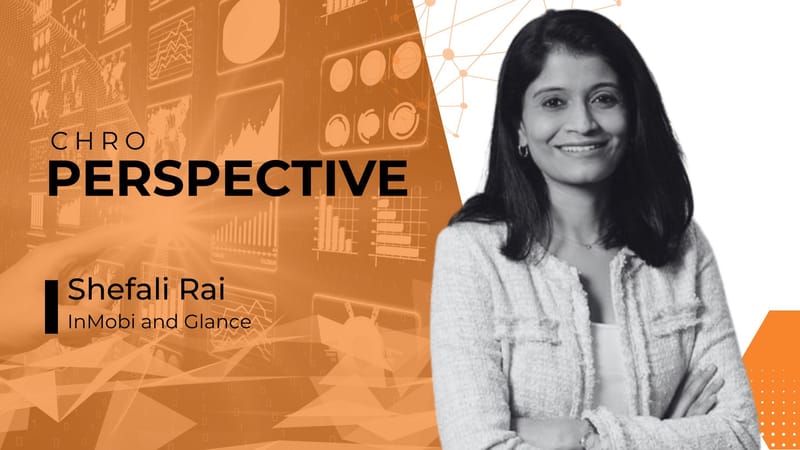
Shefali Rai, CHRO, InMobi and Glance, shares how the company is building an AI-native workforce by redesigning roles, developing AI-forward leaders and strengthening trust, psychological safety and future-ready capabilities.
As AI rapidly reshapes the AdTech and consumer internet landscape, the role of HR is evolving from managing talent and employee experience to actively shaping business transformation.
In this exclusive conversation on People Matters CHRO Perspective, Shefali Rai, CHRO, InMobi and Glance, shares how InMobi is preparing its workforce for an AI-native future — from redesigning roles and developing AI-forward leaders to building trust, psychological safety and future-ready capabilities.
She also reflects on the importance of taking bets on people, unlocking leadership potential and preserving InMobi’s entrepreneurial DNA as the company scales. For Shefali, the opportunity is not simply to adapt to AI, but to use it to remove mediocrity from work and create greater space for human potential, creativity and impact.
Edited excerpts:
You started out as an electrical engineer before spending nearly two decades shaping talent and culture, including 15 years at InMobi and Glance. Looking back, what was the pivotal moment that made you shift from engineering physical systems to shaping human systems?
Honestly, it was one of those decisions you make very early on, influenced by societal expectations and upbringing. I’d always been very observant about human behaviour, and that stayed with me.
Post-engineering, I got an opportunity for a talent acquisition role with InfoEdge’s Quadrangle. A couple of months in, candidates I’d helped place started calling to thank me. For many, it was their first job, and seeing that what I did could help people start their careers made me realise how much the outcome mattered to me.
What started off as luck started mattering. I also realised I was far more drawn to the science of human behaviour than machines, coding and everything that came with a purely technical job.
Then, after working with larger organisations like Yahoo and Symphony, I moved to InMobi, which was a conscious choice. Because I wanted to be somewhere I could shape and influence outcomes, and InMobi gave me that opportunity.
It’s been 15 life-changing years at InMobi. I found real value in influencing mindsets and shaping culture through the people-function. Having a seat at the table from the start gave me a very different sense of responsibility and marked my shift from a technical path to one centred on people and culture.
How does having an analytical, engineering brain change the way you construct a corporate culture?
I developed as a people leader because the environment allowed for questions, opinions to be shared, and for me to voice out my concerns.
It’s important because influence happens when there is trust. But trust is two-way. For me, it also happens when I know there is enough psychological safety in the environment to share openly what’s on my mind.
The solution-oriented mindset – saying, “I’m not fighting against you; I’m trying to arrive at a solution with you”, became a big part of making that equation mutually influential.
I also have to be willing to be influenced. I could be wrong about something, and I should be able to change my opinion if you convince me otherwise.
As you grow through different roles, situations become more complex, and you start developing the skill of judgement.
In people scenarios, nothing is black and white. You have to synthesise different angles and arrive at what is right, what the win-win is. Most scenarios are about creating that win-win for the organisation and the employee.
I think being observant of behaviour helped me develop that naturally. The ability to almost intuitively understand what the reaction might be came in very handy. It helps you balance a conversation, how do you influence without offending somebody? Those observations also feed into how you influence and judge the room.
For me, that’s what influence really comes down to, being able to influence the room, but also being open enough to be influenced yourself.
As work shifts towards human–AI agent collaboration, how are you redesigning roles at InMobi? And how do performance reviews and output metrics change when an employee’s primary collaborator is an AI agent?
There’s no silver bullet. Every organisation is finding a framework that fits its culture and DNA.
At InMobi, AI isn’t about replacing people. It’s about removing mediocrity from roles and freeing people from execution to do more. While some repetitive work can be automated, the bigger opportunity is to redesign roles and elevate human potential.
That makes leadership even more important. Leaders need to amplify their teams, create space for bigger thinking and identify game changers.
We’re also building an AI-native mindset, particularly in tech and product. It’s no longer about how well you code, but how intelligently you use AI to solve problems. Human judgement, original thinking and the ability to execute with AI matter more.
So the value is shifting from what you produce to what you create. Leadership accountability is shifting too, are you unlocking your team, taking bets on people and creating disproportionate impact? Being AI-forward is now a clear expectation of leadership.
How are you developing leaders to lead their functions/BUs when the business direction globally is scaling with AI?
The first is the individual unlock. We have an in-house coaching arm where coaches work one-on-one with leaders, going beyond leadership frameworks to understand the limiting beliefs or fears holding them back. It’s a holistic approach covering mindset, well-being and personal growth.
Then we have ILead, our flagship leadership programme focused on building future leaders, with tracks for early leaders, seasoned leaders and game changers who need different stretch experiences.
It’s built around four leadership attributes linked to our company values and follows a 3E framework: Experience through stretch opportunities, Exposure to diverse perspectives, and Education through external learning and leading universities.
The idea is simple: build leaders through real experiences, diverse perspectives and continuous learning.
As CHRO of a consumer internet company, how do you address employee anxiety when AI is seen as a threat to job security? How do you build psychological safety and trust when the skills needed for roles are changing so rapidly?
There was definitely discomfort, including among leaders, because nobody knew what was going to happen. What’s relevant today can become obsolete in a week, and that uncertainty is real.
For us, addressing anxiety isn’t about communication alone. It’s about being brutally honest: if you don’t embrace this change, you risk becoming irrelevant. You won’t become irrelevant because of AI, but because of people who are using AI.
The only skill this transformation demands is the ability to move. You may not have the right answer, but you have to move. Staying in freeze mode means choosing to stay behind.
I wouldn’t say there’s much resistance anymore. There’s awareness and acceptance that AI is here and will change how we work. For us, embracing it isn’t about being a technology company, it’s about staying relevant as a business.
And if we leverage AI well, we can do far greater things. AI is removing mediocrity and giving us the opportunity to amplify human potential. That’s boundless.
As deep-tech innovation scales, boards are moving from AI adoption to AI risk and data compliance. In InMobi’s boardroom, how do you help leaders look beyond efficiency and ROI to workforce impact, trust and data ethics?
When it comes to the board conversations, the focus is ultimately on business outcomes, metrics and numbers. But I think transparency is even more important when it comes to employees and the workforce.
At InMobi, we’re very transparent about how data is used, particularly because we operate a digital platform that handles large volumes of data. We have internal systems and teams to ensure AI compliance, ethical standards and the right access controls.
For us, there’s no masking or hiding. People should know what decisions are being made, why they’re being made, who has access and how data is being used. We also have the right legal and governance teams overseeing this.
That transparency is critical because dissonance comes when things are hidden. For us, the principle is simple: be transparent about how AI and data are being used and have the right systems in place to govern it.
How do you see the CHRO role evolving beyond traditional HR boundaries? What is the one legacy mindset HR leaders must unlearn to stay relevant in this shift?
Traditionally, the CHRO’s role was about building talent, strengthening culture and creating a world-class employee experience.
I think that’s evolving into more of a Chief Human Transformation Officer because people are at the core of this transformation, and they’re transforming too.
The CHRO is also becoming more of a business architect. Every function owns a core part of the business – finance owns capital, sales owns revenue, engineering builds technology. For the people and culture function, it’s about building the organisational capability to deliver on the company’s vision.
That’s why I see the CHRO becoming part of the business operating system, rather than just being a service provider.
When you look back at your legacy at InMobi and Glance, what is the one cultural or human impact you want to be remembered for, something that shows you helped build not just a successful company, but a lasting institution?
I’d like to be remembered for taking bets on people and helping them achieve what they once thought was impossible, while being part of building one of the most innovative companies India has ever seen.
I’m here because someone once took a bet on me. That belief changed my trajectory, and I want to pay that forward by creating the same opportunities for others.
This story is part of CHRO Perspective, a People Matters series featuring bold ideas and real-world insights from India’s top CHROs. Stay with us for more perspectives that power the future of work.

Loading...