







Strategic HR
From Personnel to Powerhouse: Baveja's front-row seat to the HR transformation


|
Updated on


HR now operates within the broader business context, ensuring every process influences outcomes, directly or indirectly, to drive organisational success.
In 1984, when a fresh-faced graduate from a top management institute entered the corporate world, the function we now know as Human Resources barely existed. It was a time of "Personnel and Administration," a domain often seen as a power-centric, traditional, and siloed part of the business. Fast forward four decades, and the landscape has undergone a complete transformation.
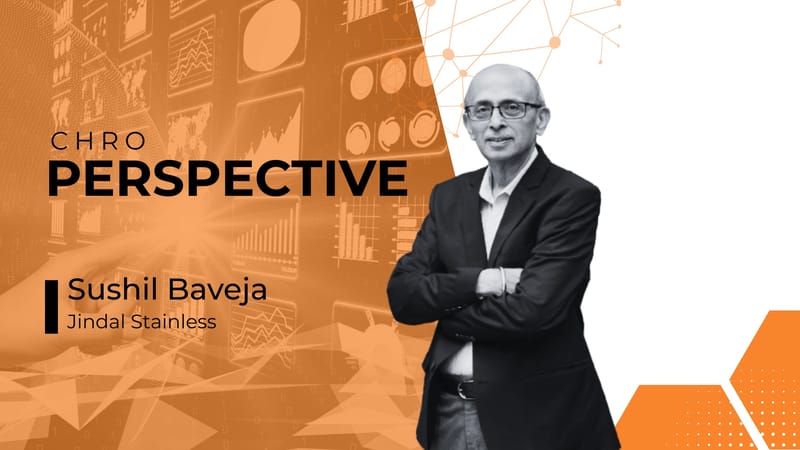
For Sushil Baveja, the Chief Human Resources Officer at Jindal Stainless, who has witnessed this evolution first-hand, the change is nothing short of a revolution. His career, spanning over 40 years across diverse companies, including Cadbury, Gillette, and now Jindal Stainless, offers a unique perspective on this profound shift. In this People Matters CHRO Perspective interview series, Baveja discusses his experiences that have shaped his leadership style, how manufacturing has become a top talent magnet, the qualities required to become leaders of tomorrow, and the evolving workplace trends in these uncertain times.
Read the edited excerpts below:
Read the edited excerpts below:
Q. With a career spanning four decades in HR, you have had a front-row seat to its transformation. What are the most significant shifts you have witnessed, and how did the function evolve from a 'personnel and administration' role to a strategic driver of business today?
The HR function has evolved into a full-fledged HR department that focuses on building culture, developing systems, and collaborating closely with the business to drive its agenda. In the past, HR was often siloed and worked on its own priorities. Today, we understand that we operate within the larger context of the business. Every process we run is designed to influence a business outcome, whether directly or indirectly. This is a crucial shift, moving HR from an insular function to a key strategic partner.
I've been fortunate to have worked for both traditional Indian family businesses and multinational corporations. What I have observed is that Indian family businesses have come a long way. They have invested heavily in creating work ecosystems and cultures that are as progressive and professional as any multinational. In fact, they are often more agile and quicker in their decision-making.
Today, an employee moving from a multinational to an Indian family business is unlikely to experience a major difference in the work culture. One of the most profound lessons I have learned is the outsized role a manager plays in an employee's career.
While an organisation's employee value proposition (EVP) may attract a candidate, it is the manager who drives 60-70 percent of that candidate's experience. My ability to influence stakeholders and my confidence today are primarily due to having had good managers early in my career. The manager is the true embodiment of the company's culture and values, making their role more critical than ever.
Q. Your career journey includes hands-on stints at the factory level, which you say were instrumental in shaping your leadership. How did those ground-level experiences build a foundation of confidence and business knowledge that you now leverage as a senior leader?
My early factory stints were instrumental in my development. It is where the real business takes place and where you find the largest employee strength. Gaining first-hand knowledge through hands-on experience—from maintaining manual attendance registers to appearing before conciliation officers—gave me a foundational confidence and ability to influence stakeholders that I still rely on today.
What has also shaped my leadership is my belief that learning should never stop, regardless of your level. Every person in the ecosystem is unique and has something to offer. I have consistently invested in my personal and professional development, whether through my own reading, attending programs like those at the Ross School of Business, or engaging in professional networking.
A key aspect of my leadership style is being an effective listener. In team meetings, I intentionally open the floor for others to speak first before I share my own thoughts. This ensures that their opinions aren't influenced by mine. It makes people feel valued, respected, and accepted, and the best ideas often come from listening to others.
Q. There's a perception that manufacturing isn't an attractive sector for new talent. What is your take on this?
While a divided school of thought exists, manufacturing remains the most attractive sector for talent today. It's the most stable industry, having grown steadily for years, unlike others, such as tech or BFSI, which have experienced cycles of ups and downs.
The most compelling aspect is the massive investment in technology that the industry is witnessing. Today's manufacturing processes are no longer traditional; they're driven by technology, offering the kind of contemporary experiences and a variety of opportunities that modern employees seek.
We have not faced significant challenges in attracting talent because we have focused on reinventing our value proposition to better align with people's aspirations.
However, as manufacturing continues to grow at a rapid pace, the demand for talent is also on the rise significantly. And talent, irrespective of sector, is always scarce because the person you want is often surrounded by 10 other individuals who also want the same talent.
Q. Can you tell us about the hiring trends you are seeing in the manufacturing industry and how Jindal Stainless ensures it retains top talent amidst a fierce talent war?
The trend of candidates accepting offers and then dropping out at the last minute because they have been retained with a counter offer is a real challenge, and it is something we all have to overcome. To "ring-fence" our critical talent, we must be innovative and provide a career path so compelling that people choose to stay.
The growth story in manufacturing is notable, and we are modernising our talent processes to match it. We have a sharp focus on ensuring our talent feels valued and believes the organisation is serious about their growth.
Q. In an era of rapid workplace transformation, how has your hiring strategy evolved to move beyond just filling roles and instead, proactively build a future-ready talent pipeline?
Our cadre hiring, which was once restricted, has now scaled up considerably, driven by our ambitious growth agenda, with a sharp focus on building a robust pipeline for tomorrow.
For instance, we never used to hire management trainees, but last year, we brought in a batch of 35. I am pleased to say we have retained 32 of them after 15-18 months. This increased intake of freshers and trainees, whether they are diploma engineers, graduate engineers, or chartered accountants, is crucial for our future.
To accommodate a workforce that now spans multiple generations, we have re-articulated our EVP to make it more relatable and compelling. Our EVP now centres around career opportunities, capability development, and the pride of being a part of a sector that directly contributes to nation-building. We also emphasise our focus on community, sustainability, and—uniquely—our room for risk-taking, which encourages an innovative work ecosystem.
Q. With a multi-generational workforce, how do you address the challenges of technology adoption, particularly among employees who are more accustomed to traditional, legacy processes?
This is a very interesting and real challenge. On one hand, the younger generation is drawn to technology and is digitally savvy. On the other hand, we have a segment of our workforce that is wedded to legacy processes, preferring to use pen and paper or Excel.
However, this is not a permanent resistance. I have seen this generation progressively become more open to technology, often influenced by their own children at home who are digital natives. We have pockets of employees who show great enthusiasm for learning new skills. It's a fascinating mix of mindsets.
To navigate this, we have had to be very deliberate in our approach.
We don't just push technology; we focus on showing the value it brings to each individual. This is how we are progressively bringing everyone along on our digital journey.
Q. With AI taking centre stage at companies across sectors and sizes, do you see new roles emerging at Jindal Stainless that were not there earlier? And how do you look at the impact of AI in a manufacturing setup like yours?
AI is a tremendous enabler, not a threat to jobs. What AI is doing is taking away the operational, day-to-day work, which in turn frees up our time to focus on the future and on more strategic deliverables.
This shift is also creating entirely new roles. For example, where we once had a single IT Head, we now have a CDIO (Chief Digital & Innovation Officer). This new role is entirely focused on AI, with a separate person dedicated to digital. This new organisational structure ensures that we are not just bringing in technology, but we are institutionalising its use to drive real business value.
Our approach to AI and technology adoption is centred on creating a "pull," not a "push." We have found that simply mandating the use of new tools only works to a point. To achieve true adoption, people need to understand "What's in it for me?"
Q. What, according to you, are the key qualities leaders of tomorrow in manufacturing will need to succeed, and how have these changed from previous generations?
The skills required for leadership today have undergone a profound shift. Where things once worked on mandates, today they work on persuasion. Therefore, the ability to influence outcomes and build strong stakeholder relationships is now far more significant.
The leaders of tomorrow must also be empathetic, open, and receptive. Having genuine, frequent conversations with your people is critical for building a deep connection.
Beyond these interpersonal skills, leaders must be committed to developing capabilities around them. This means ensuring your employees are continuously upskilled and reskilled, and are equipped with the latest knowledge. Finally, leaders must be digitally savvy. Technology is a powerful tool for making things better and simpler, and an openness to new tech is no longer optional.
Q. The manufacturing sector has historically been perceived as a male-dominated field. What is your perspective on gender diversity in the industry today, and what is Jindal Stainless doing to actively improve it?
While manufacturing has traditionally been a challenging sector for gender diversity, I believe that perception is rapidly changing. We are now seeing a significant increase in the influx of women employees. Where we once struggled to find female graduate engineers on campus, today we find quite a few.
We are seeing women not just in corporate roles, such as leadership positions, HR or finance, but also on the shop floor.
Last year, we nominated 40 women for a six-month-long leadership training program. We are also creating forums that focus on empowering our female employees to share their perspectives and feel heard. These initiatives are not just about meeting a metric; they are about building a more inclusive and dynamic workforce from the ground up.
Q. How do you envision the workplace and workforce evolving by 2030? And how is Jindal Stainless preparing for this shift?
Today's young professionals, many of whom are aspiring entrepreneurs, don't necessarily envision a traditional career that lasts until age 60. They are looking for an entrepreneurial space within the organisation, a place where they can operate with a high degree of freedom, empowerment, and trust.
To address this, our policies are becoming increasingly fluid and are continually revisited to remain relevant. We are also emphasising the idea that AI and digital tools are here to simplify work and create new opportunities, not to replace jobs.
This mindset will define the workplace of 2030. We believe that by providing this kind of environment, we can attract and retain this generation, ultimately driving our organisation's growth.
This story is part of CHRO Perspective. A People Matters series featuring bold ideas and real-world insights from India’s top CHROs. Stay with us for more perspectives that power the future of work.
Author

Loading...