







Talent Analytics
Classified echoes of 1997: The click that launched Naukri.com





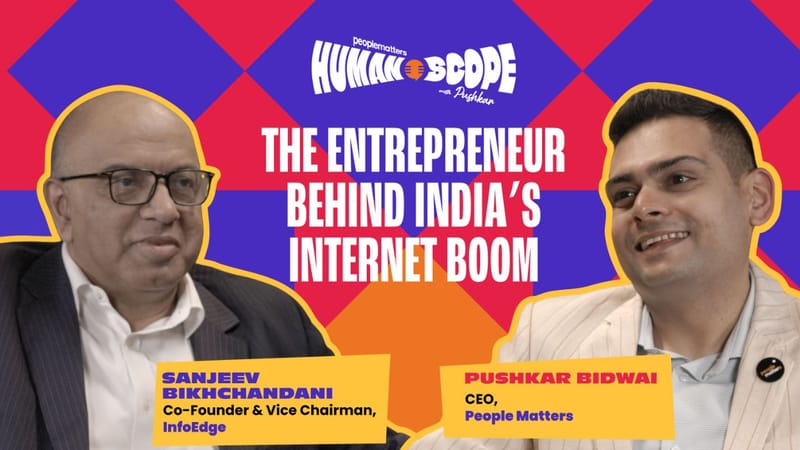
In an exclusive episode of Humanscope, Sanjeev Bikhchandani reflects on building Naukri.com, redefining job searches in India, and shaping the future of work.
In every song, the past finds its voice in the present. And a song once sung in 1997, when Sanjeev Bikhchandani stitched together job ads from twenty-nine newspapers and called it Naukri.com, still echoes in how we think about opportunity, ambition, and building companies that last.
In an exclusive episode of the People Matters Humanscope podcast, Sanjeev Bikhchandani, the man who rewrote how India looks for work, sat down with People Matters CEO Pushkar Bidwai to map the journey from the fragile beginnings of India’s internet economy to building a brand synonymous with opportunity and now, backing the next wave of entrepreneurs shaping the future of work.
From grit to growth
As the conversation began about how it started, how did Naukri.com come to life? Sanjeev recalled it was less glamour and more grit. “We didn’t even have an internet connection when we launched because it was expensive and I was broke,” he laughed.
The spark for Naukri.com came not from Silicon Valley but from the humble halls of a Delhi office, where colleagues would flip through Business India classifieds even when they weren’t job hunting. Sanjeev Bikhchandani didn’t set out to build a billion-dollar company. He just wanted to solve a problem no one else had noticed. Back then, jobs were found in the thick classifieds section of Sunday newspapers; today, they are discovered through clicks and algorithms.
Echoes of an epiphany
How do you scale a company without chasing hype? Sanjeev’s answer: focus on execution, not epiphany. Unlike today’s startups chasing valuations, Naukri wasn’t built on a vision statement. It was built on a sales target. “If 1,000 companies pay 500 rupees a month, we’re fine. Companies that have sales targets break even. Companies that have visions make a loss. Vision came later.” Despite having no connections at launch, he saw what others missed: jobs are a high-interest category of information. That insight, backed by a simple promise of “1,000 jobs at all times”, became the foundation for Naukri.com.
The making of a moat
Companies stay and float, but Naukri.com stayed anchored. Pushkar leaned in with the question – what truly makes a company last? Sanjeev’s answer was clear: stay close to the user. In the early days, there was no capital, no tech, and no investors. What kept Naukri alive was relevance. “It was never about chasing glamour. “It was about being useful,” he said. That usefulness, he added, became their moat.
What’s in a name? Everything
What makes a brand stay iconic? Sometimes, it’s the choice no one else dares to make. As Sanjeev recalled, when the obvious names like JobsIndia and EmploymentIndia were taken, he chose Naukri, a simple Hindi word his peers dismissed as “downmarket”. However, he found it to be more relatable and energetic than others. “People told me this is a downmarket word… but I thought it had zing,” he opened up while sharing. Time would prove him right. Not only did Naukri survive, but it also became a shorthand for opportunity itself and entered a generation's professional lexicon.
Who are we solving for?
The conversation then turned to what today’s leaders can learn from those early days of India’s internet economy. Over the past twenty-five years, Sanjeev pointed out, four forces have continually reshaped how we work: technology, social media, generational change, and now artificial intelligence. “Every time a new technology comes in, people tend to overestimate its short-term impact and underestimate its long-term impact,” Sanjeev observed. Today's AI is no different. Instead of worrying about being replaced, businesses should consider how AI may improve human decision-making, expedite tedious tasks, and uncover previously undiscovered insights.
Sanjeev also pointed out that new generations of job seekers bring new behaviours. Millennials and Gen Z are digital natives. They expect instant access, transparency, and mobility. “We follow our customers. We figure out what they’re saying, what they’re doing… they tell us what to do.” Markets evolve more slowly than hype cycles suggest. His advice for the AI age? Start small, prove value, and scale only when you know it works.
Where the conversation lands
Sanjeev now devotes as much time to coaching founders as he used to to cold-contacting potential customers. Through Info Edge’s investments, he now backs the next generation of companies, helping entrepreneurs avoid the mistakes he made and build with the same resilience that kept Naukri alive through booms and busts. “When you’ve seen the journey once, you know the potholes,” he says.
From bootstrapping Naukri.com in the 1990s to pioneering India’s online recruitment revolution, Sanjeev shares the untold story behind the country’s first job portal. He reflects on scaling a portfolio of successful ventures, co-founding Ashoka University, and the enduring mindset that defines long-term entrepreneurship in India’s evolving tech ecosystem. Watch the full episode on People Matters’ YouTube channel.

Loading...