







Wellbeing
Why the future of Indian manufacturing depends on responsible growth and people-first strategies





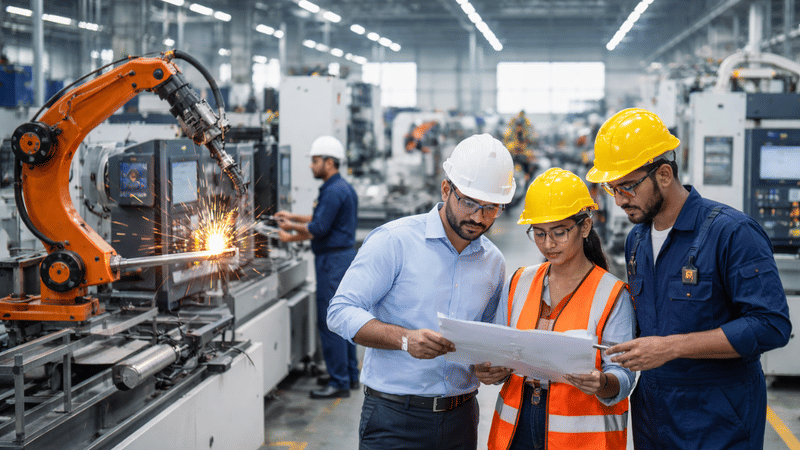
As India accelerates toward Industry 4.0 and global economic leadership, manufacturing must balance technological advancement with workforce wellbeing, inclusion and community-led development.
Earlier this year, the World Economic Forum (WEF) released a report, The Future of Jobs in Industry 4.0, which talks about how the paradigm of work will change in the coming years.
While the report emphasises that the change will be brought in by the advent of modern technologies like Artificial Intelligence (AI), Machine Learning (ML) and automation, it also puts forward a key message. It unequivocally emphasises the need to put people at the centre of the Fourth Industrial Revolution. This, it said, is crucial because workforce enablement and new forms of multi-stakeholder collaboration would be the key for future growth in manufacturing.
This theory of WEF has its genesis in the thinking of Klaus Schwab, Founder and former Executive Chairman of WEF, who was a strong advocate of the theory that while technology will take centre stage in future work environments, it should be used to create a more inclusive, human-centred ecosystem in manufacturing. Schwab was of the firm belief that while technology should be an enabler, the workforce should be given priority with the objective of benefiting the society as a whole.
Fortunately, this thinking has found positive vibes among the change makers in India, and the government has taken this up as a primary objective for building India’s own Industry 4.0. Increasingly, Indian manufacturing is adopting a people-first strategy and thinking through efforts to improve workplace culture, diversity, and employee well-being. This is being complemented by government initiatives on skill development and social security, which is not only getting our younger generation future-ready but is also adding legitimacy to this approach.
The result: a noticeable development in the community, improvement in the lives of employees, job and financial security, and a more inclusive work environment. Most importantly, government policy is also encouraging greater participation of women in manufacturing, with some companies showing significant increase in female representation, and industry is responding by introducing initiatives like flexible shifts and safe transport.
It is important for the industry to realise that it is the industry’s responsibility to create a work environment that ensures employee and social well-being through community-linked skilling ecosystems, ethical and locally grounded supply chains, inclusion and diversity as development drivers.
The industry has to remember that to create a conducive workplace ecosystem of tomorrow, it has to invest in the skilling, upskilling, reskilling and training of its workforce and mentor them to be ready for future needs. And this has to go hand in hand with community and social development to provide quality life to the workforce through a carefully calibrated work-life balance approach.
An important element of the people-first strategy in modern times is the mental well-being of workers, as stress levels have increased manifold because of the increasing demands of the industry. Mental health and well-being, feel-good add-ons so far, are becoming essential pillars of a company’s work culture and environment. This is because eight in ten employees are reporting heightened stress and burnout, mandating well-being to be embedded into a company’s work environment through robust mental health support, flexible work models, equitable career progression, and green and ethical upskilling opportunities.
With the International Monetary Fund (IMF) projecting the Indian economy to grow at 6.6 per cent in 2025-26 in its latest World Economic Outlook report, and India projected to become the world's third-largest economy by 2030, the manufacturing sector, particularly core industries like cement, are seen at the forefront of national development. So, the industry has to acknowledge that the future of manufacturing is dependent on responsible growth and fostering people-first ecosystems.
Many in the industry, including the cement industry, are following a people-centric approach that is rooted in trust, transparency, and support for individual and team growth, which is essential to building a vibrant and resourceful workplace. This focus is formalised as a core value: caring for people.
In today’s world, maintaining a safe and healthy work environment is paramount. The proactive commitment to workplace safety is an imperative that cannot be overlooked.
Continuous efforts to nurture talent and enhance skillsets through employee training and development programmes are getting embedded into HR practices as well as a company’s overall work culture. In many companies, the entire employee lifecycle, from onboarding to learning and performance reviews, is being digitised to monitor not only their progress and productivity but also their mental well-being, health and social needs.
Companies are also giving a lot of importance to human rights practices, including following ethical labour practices and providing training on human rights issues. The focus on employee diversity ensures an inclusive workplace where diversity is valued and embraced.
But we have to remember that the industry’s responsibility does not stop at the shop floor or the factory level. Prosperity and development of the community is also a responsibility that is ingrained in the Indian philosophy of inclusive growth. As such, it is important to ensure that, along with the employee, community well-being should also be part of the industry’s focus area, because responsible manufacturing inherently involves extending value creation to the surrounding communities.
Accordingly, community development and welfare is increasingly becoming an integral part of corporate strategy rather than just a CSR activity to show. Through community initiatives, the Indian corporate sector is making a statement about its commitment to build social and relationship capital, to reiterate that economic development has to go together with the well-being and development of the people.
We have to remember that in the next decade and beyond, the industry has to prioritise an ethical, inclusive, and sustainable operational framework. And this can be done only by placing our people and community at the core of our value creation model. Only then can we ensure a more equitable and sustainable future for the entire nation.
Loading...