







AI & Emerging Tech
AI-Ready, Human-Led: Creating continuous learners in Indian enterprises





Today, if a machine can write a clean line of code, draft a flawless corporate email, or compile an analytics report at the push of a button, the definition of human capability must be elevated.
The hum of the modern Indian workplace is changing. It is no longer just the sound of clattering keyboards, overlapping conversations in open-plan offices, or the steady chime of virtual meeting invites. Instead, it is the quiet, tectonic shift of an entirely new relationship forming at the desk, the partnership between human intuition and machine intelligence.
We have officially moved past the era of viewing Artificial Intelligence as a mere novelty or a glorified productivity tool sitting quietly in the corner of our screens. Today, AI has walked right into the boardroom. It has pulled up a chair as an active collaborator: an entity capable of parsing complex analytics in seconds, automating execution, and subtly reshaping how decisions are engineered across every corporate function.
But as these co-pilots weave themselves into the fabric of daily operations, they leave enterprise leaders facing an existential mosaic of questions: Which human skills will withstand this digital tide? How do we strike a flawless equilibrium between machine precision and human empathy? And, perhaps most crucially, how do we ensure our teams evolve just as rapidly as the software rewriting our business models?
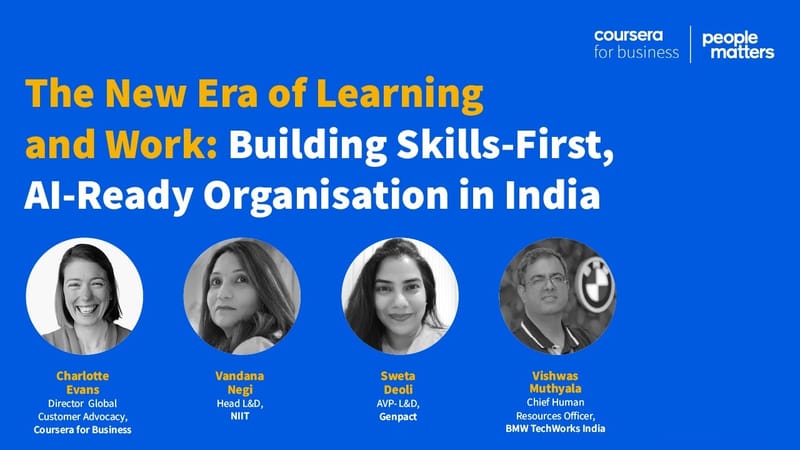
To decode this massive transformation, People Matters, in partnership with Coursera for Business, recently brought together a distinguished panel of industry pioneers for a deep-dive discussion titled, "The New Era of Learning and Work: Building Skills-First, AI-Ready Organisations in India." What emerged from the conversation was not a sterile technical blueprint, but a deeply human narrative about adaptability, cultural evolution, and the death of the traditional corporate job title.
Beyond Code and Cars: The power of context
When looking at the sheer scale of technological disruption, it is tempting to seek out standard, one-size-fits-all corporate training regimes. However, as Vishwas Muthyala, Chief Human Resources Officer at BMW TechWorks India, pointed out, the reality on the ground defies simple formulas. Operating at the cutting edge of automotive software and digital product engineering, Muthyala’s team deals with AI use cases that sound like science fiction—running predictive simulations on aerodynamic design changes or assessing the full life-cycle carbon footprint of a vehicle before a single piece of metal is moulded.
Yet, for Muthyala, preparing a workforce for this level of sophistication starts with fundamentally deconstructing the organisation into distinct user archetypes: from the everyday general AI user to specialised integrators, builders, and architects. More importantly, he argues, the most critical skills in an AI-dominated world are, paradoxically, non-technical.
The leader explained that the skills they are talking about for many of their employees right now are less AI-related and much more context-related. He noted that while AI can easily provide an output or a recommendation, humans must apply their own judgment and discretion to determine the best way to use it. In fact, he emphasised that there are countless instances where the human-in-the-loop must and will override what the AI suggests.
In this new paradigm, the half-life of technical knowledge is shrinking by the day. Therefore, the ultimate corporate asset is no longer a fixed repository of expertise, but pure, unadulterated learning agility.
Moving from answer providers to experience managers
This sentiment of human supremacy over machine output was echoed strongly by Vandana Negi, Head of L&D at NIIT. Reflecting on how recruitment and talent management used to function, Negi noted that organisations historically hired almost exclusively for technical compliance and linear role execution. Today, if a machine can write a clean line of code, draft a flawless corporate email, or compile an analytics report at the push of a button, the definition of human capability must be elevated.
The spotlight has swung firmly toward uniquely human traits: ethical judgment, creativity, complex negotiation, and emotional intelligence. Vandana illustrated this shift through the evolution of customer service and talent acquisition. While chatbots can answer routine queries instantly, humans are essential to managing emotional escalations, resolving conflicts, and cultivating deep organisational trust.
Negi observed that the modern corporate role is no longer about being a mere answer provider, but about becoming a true manager of the customer experience. She explained that the goal now is to build a culture where organisations hire and develop people who can learn, adapt, and judge what is right. In her view, AI can comfortably serve as the co-pilot for execution, but human talent remains solely responsible for direction, decisions, relationships, and purpose.
The collapse of the job title
Perhaps one of the most radical structural shifts discussed by the panel was the transition from rigid, job-based structures to dynamic, skill-first talent ecosystems. For decades, the corporate world has been obsessed with the safety of the job title. You are a 'Data Analyst' or a 'Software Engineer Level II,' and your duties are strictly bound by those semantic walls.
According to Sweta Deoli AVP- L&D, Genpact, rigid architecture is fast becoming a relic of the past. Genpact began its journey toward a skill-first talent model over half a decade ago, anchoring its strategy on a sophisticated internal AI-powered skill intelligence platform.
Instead of frantically searching for an external candidate with a specific, perfect title for a new client engagement, Genpact’s platform looks beneath the surface. It continuously enriches internal employee profiles based on real-time work, learning history, and project experiences.
Deoli shared enthusiastically that with a skill-based approach, they are looking well beyond traditional titles. For instance, their internal platform might identify a data analyst who has a strong grasp of Python analytics, stakeholder management, and Generative AI. While that individual may not currently hold the formal title of 'AI Solution Consultant,' the platform recognises the functional overlap and recommends targeted learning paths. This allows the company to proactively develop internal talent and fill critical roles much faster.
To keep pace with shrinking technology lifecycles, Genpact has gamified and democratised this tracking through an internal app called My AI Readiness. It allows employees to see exactly where they stand on the AI proficiency spectrum—transforming professional growth from a top-down mandate into a self-driven journey of personal ownership. Crucially, Deoli emphasises that reskilling never happens in a vacuum; it is always tied directly to an operational delivery team and a tangible business problem.
The Indian upskilling explosion
The numbers backing this shift in Indian corporate behaviour are nothing short of staggering. Charlotte Evans, Director of Global Customer Advocacy at Coursera for Business, brought a global analytical lens to the discussion, revealing that India is currently pacing far ahead of many global counterparts in its hunger for AI literacy.
Evans revealed that Generative AI skilling has absolutely skyrocketed across the country. Coursera's data show that enrollments in GenAI courses in India surged from 1 enrollment per minute in 2024 to 3 per minute in 2025. That represents a collective 4.2 million hours of GenAI learning—the equivalent of 480 years of continuous upskilling.
Yet, Evans warns that simply throwing a "kitchen sink" of content at employees under the guise of a corporate benefit is an outdated approach that leads to digital fatigue. Today’s learners crave hyper-personalised, prescriptive learning paths that meet them precisely where they are.
Furthermore, the most forward-thinking global companies are moving away from forcing employees to leave their workspace to learn. Instead, they are embedding micro-learning injections directly into the tools people use all day, such as Copilot, Claude, or ChatGPT. The goal is to build a "padded playground"—a safe, sandbox environment where professionals can experiment, prompt, and even fail without breaking proprietary corporate systems.
It is not an L&D problem; it is a business delivery problem
As the discussion drew to a close, Muthyala threw down a provocative gauntlet for HR and business leaders alike: stop viewing AI readiness as an HR or L&D problem.
He stated candidly that he does not see this as a learning problem, but rather a delivery problem for the organisation to solve. He argued that the hands-on application of AI is far more critical than any formal qualifications or certifications around it. Because models are evolving faster than any curriculum can be built, and capabilities are shifting quicker than any job description can be written, the challenge is simply ensuring people are ready to run with changes as they come.
The panel universally agreed that the ultimate validation of any learning culture is its psychological safety. If an organisation truly wants to lead India’s tech-driven future, it must celebrate the art of "failing fast." It must replace theoretical training with live hackathons, ground-level corporate problem-solving, and cross-functional communities of practice led by passionate internal AI evangelists.
Blueprint for the Future: Top takeaways for professionals and enterprises
For organisations and working professionals looking to future-proof their trajectories in this brave new world, the panel synthesised three core actions.
First, professionals must partner with AI rather than compete against it. This means letting go of the fear of being replaced and instead viewing intelligent systems as analytical partners that can absorb repetitive task loads, freeing up human time for experience management and strategic direction.
Second, enterprises need to reverse-engineer the problem. Leaders should resist the temptation to compile a laundry list of AI tools just to look current. Instead, they must start with the specific operational bottleneck or business problem and then identify the precise machine capability needed to solve it.
Finally, there must be a cultural shift toward an agility mindset. Both employers and employees need to accept that skills now come with an expiration date. The future belongs to those who actively embrace continuous, lifelong learning and are willing to systematically unlearn and relearn as technologies evolve.
Topics
Author
Loading...