







AI & Emerging Tech
Vaishnaw warns of global turbulence ahead from tech disruptions, debt levels in rich nations





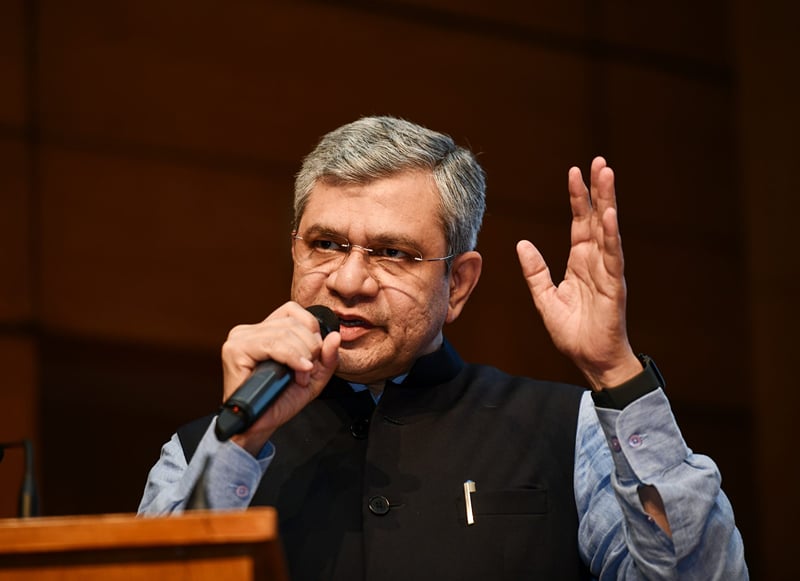
The minister flags AI’s impact on jobs and services alongside debt risks in advanced economies, as India prepares for greater global uncertainty.
Warning of heightened global turbulence in the coming years from tech disruptions, artificial intelligence and financial risks, Union Minister Ashwini Vaishnaw on Wednesday said India is strengthening its economic and technological resilience to shield its growth from external shocks.
Speaking at the Bloomberg New Economy Forum 2026, Vaishnaw -- who is Minister for Electronics and IT, Information and Broadcasting and Railways -- said global technology supply chains would continue to span multiple countries and geographies, but companies and governments would need to repeatedly evaluate their partners and ensure that dependence on a particular country or company did not compromise resilience.
Technology will remain a highly globalised field, he emphasised, adding that global value chains will be multi-border, multi-country, and multi-geography, reflecting the nature of the industry itself.
"... Strategic dependencies, which are the countries you can trust, which are the places where you believe that your production, your design, your dependency on a particular country or a company does not make you lose your resilience...Those are the decisions which will have to be taken again and again, continuously," Vaishnaw said.
This would mean constantly evaluating partners, making sure that the partners and the producers are on the same page, and have a similar mindset.
The minister warned that global uncertainty could intensify in the coming years, driven by rapid technological change and financial risks, including high debt levels in developed economies. He said the eventual unwinding of these debt levels could add to economic disruption.
"In my understanding of the way the world is moving today, the turbulence is going to be much more than what it was in the past decades, and the turbulence will come both from technology as well as from the way the financial world is moving, the whole debt levels in the rich countries that is going to unfold today or tomorrow, maybe in 3-5 years," Vaishnaw said.
When that unravels, it is going to bring in much bigger turbulence, the minister said, and added "by that time, AI would have brought in many other disruptions in the employment sector, in the way people, especially the services industries, work, and the debt levels getting unravelled".
He warned that the combination of these factors could make the coming years extremely challenging.
"The biggest issue that we all have to be prepared for is the turbulence, which is coming in the next few years," the minister said.
Vaishnaw further said that trust was becoming as important as cost in technology supply chains, particularly as cybersecurity risks increased and concentration in some semiconductor segments grew.
Cisco Chairman and CEO Chuck Robbins backed India's approach, saying the country had the scale, engineering capabilities and technological expertise to develop critical capabilities while partnering with trusted companies for other requirements.
"India has been an incredible trusted partner for lots of American companies, in particular, and global companies...it really does create an environment where we are comfortable investing, and I think that is super important...," Robbins said.
During the discussion, Vaishnaw said India was identifying the parts of the technology value chain where it needed domestic manufacturing, design and end-to-end product development capabilities, while remaining integrated with global supply chains.
"We want to be deeply embedded in this global value chain and be able to add value to those parts of the value chain where we play the best role," he said.
Citing India's semiconductor design capabilities, Vaishnaw said chips at advanced nodes of two and three nanometres for major companies, including Qualcomm, Nvidia and AMD, were being designed in India. The next stage would involve expanding into fabrication, assembly, testing, marking and packaging (ATMP), and complete product development.
Robbins said the pace of technological change made it difficult for any country to "do it all", that is build every component of the technology stack from scratch, as capabilities could become outdated by the time they were developed.
"The world needs more capacity in this space too, so the world would welcome a friend like India who has that capacity," Robbins said.
Robbins said India had been a trusted partner for American and global companies, creating confidence for them to invest in the country.
He said India's scale gave it an advantage over many other countries seeking greater control over critical technologies, while its engineering and technology capabilities supported the development of domestic capacity.
Vaishnaw said trust was becoming as important as cost in technology supply chains, particularly as cybersecurity risks increased and concentration in some semiconductor segments grew.
He cited the concentration of production in legacy semiconductor nodes of 28 to 90 nanometres, saying even a small chip shortage could disrupt the production of expensive equipment.
India was following a gradual approach to building manufacturing capabilities, moving from finished products to modules, components, materials and capital equipment, he said.
The minister identified materials, including chemicals, gases and substrate materials used in semiconductor manufacturing, as a major area of dependence. Building these capabilities would require sustained investment and ecosystem development, he said, noting that countries with established materials ecosystems had taken 20 to 25 years to develop them.
Vaishnaw said India also needed to increase research and development spending and focus on applied research in areas where the country could build strategic capabilities.
He cited the development of India's indigenous end-to-end 4G telecom stack, which can be upgraded to 5G, as an example of what could be achieved.
Developed in three-and-a-half years, the stack is deployed on more than 100,000 towers, he said, adding that India had emerged as a sixth contender in the global stage previously dominated by players from Europe, South Korea and other geographies.
Robbins said Cisco had developed a portfolio of sovereign critical infrastructure solutions and would bring them to India over the coming months.
Robbins also endorsed India's approach of building capabilities in strategically important areas while partnering with trusted companies elsewhere, saying countries needed to balance their ambitions with the speed at which technology was evolving.
Vaishnaw said India was planning across short-term goals of three to five years, medium-term goals of five to 15 years and long-term goals of 20 to 25 years to reduce vulnerabilities arising from changing geopolitical relationships.
"There are times when friends will become foes. So it's very important to build, find out, figure out what's the most important thing which can make your production, make your economy vulnerable to somebody else's policies.
So we think in that way and identify those things and start working on that," the minister said.
India's public debt-to-GDP ratio had declined from 61 per cent to 55 per cent over the past five years, he said, adding that the country was seeking resilience across financial, economic and technological fronts.
The minister said global factors posed a risk to India's economy and its sustained growth, making it important to prepare for external shocks.
"We are at a cusp today where around USD 4 trillion and growing six to 8 per cent consistently with 95 per cent confidence interval... So that kind of growth can be disrupted by global factors more than our internal factors. So we are very carefully not only making sure that internally we keep becoming stronger, but also how do we make ourselves immune to the global turbulence that's definitely going to happen in the coming years," Vaishnaw said.
Topics
Author
Loading...