







AI & Emerging Tech
When AI knows more, what matters most?






In a world of complexity and AI, there is growing discussion on building a skill-first organization. The deeper question is which skills still matter most when technology can bring higher efficiency and productivity.
By: Rubi Khan
The biggest consequence of AI is not fewer jobs; it is a fundamental reshaping of skills. Organizations are focusing on shaping their skill framework. In a world of complexity and AI, there is growing discussion on building a skill-first organization. The deeper question is which skills still matter most when technology can bring higher efficiency and productivity.
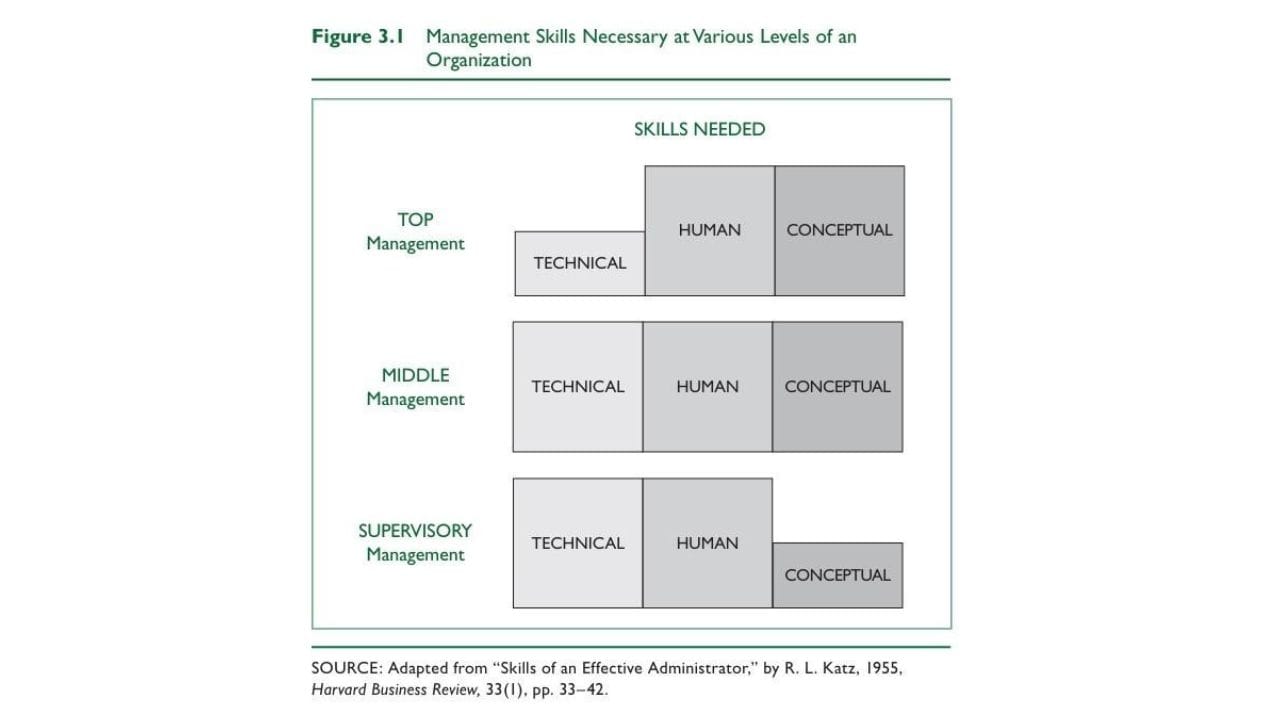
Technology has constantly pushed us to deskill, reskill, and upskill. According to Katz, there are three skill areas: technical, human, and conceptual. The model suggests that leaders at the top, middle, and supervisory levels need all three skills, each at varying levels of proficiency, to achieve outcomes. It explains that the mix of the three skill types is fundamental at each level.
Technical skills
Technical Skills are the understanding and ability to perform functional work effectively. They are the fundamental skills required to do a job. They involve knowing the core technicalities of the product and technology and using tools and resources. They are about the basics of being right. The model clearly highlights that technical skills are important at the supervisory level. The weightage and significance of technical know-how and people skills at the supervisory level is highest, followed by conceptual skills.
Human Skills
Human skills are the ability to work with people. They are required to build strong interpersonal relationships. In the model, human skills are critical across all levels of leadership. As one climbs the leadership ladder, interactions with the team and various stakeholders become important. Technical skills are assumed to be strong, given that an individual has moved from a supervisory role to a middle-level role; interpersonal skills for building and strengthening relationships become more important. Human skills help build trust, resolve conflict, give effective feedback, and build high-functioning teams.
Conceptual Skills
Conceptual skills are the ability to work with ideas. They can articulate the organization's vision, launch new product lines, and increase profitability. A leader with high conceptual skills can easily work with concepts and assumptions. Conceptual skills are most important at the leadership level because leaders are expected to solve problems, connect the dots, and work with ideas.
Technology reconstructs work; AI redesigns skills. Therefore, the definitions of technical, human, and conceptual skills have changed to support this shift. The coexistence of technology will lead to deskilling, upskilling, and reskilling across levels.
As per research, deskilling is defined as the deterioration of knowledge and skills due to a lack of use or practice. According to Arther and Dey (2020), prolonged use of AI systems by workers can cause their skills to deteriorate. Redundant skills are being replaced by AI, such as customer service, financial data analysis, and preliminary interviews. Hence, the skills applied earlier will be lost as employees no longer perform those tasks. At the same time, AI will improve existing processes and systems, leading to boosted operational efficiencies. Replacing redundant work with AI enables people to learn new skills and upskill to take on more complex tasks. This will lead not only to redesigning work but also to redesigning skills.
The new skill equation in the age of AI
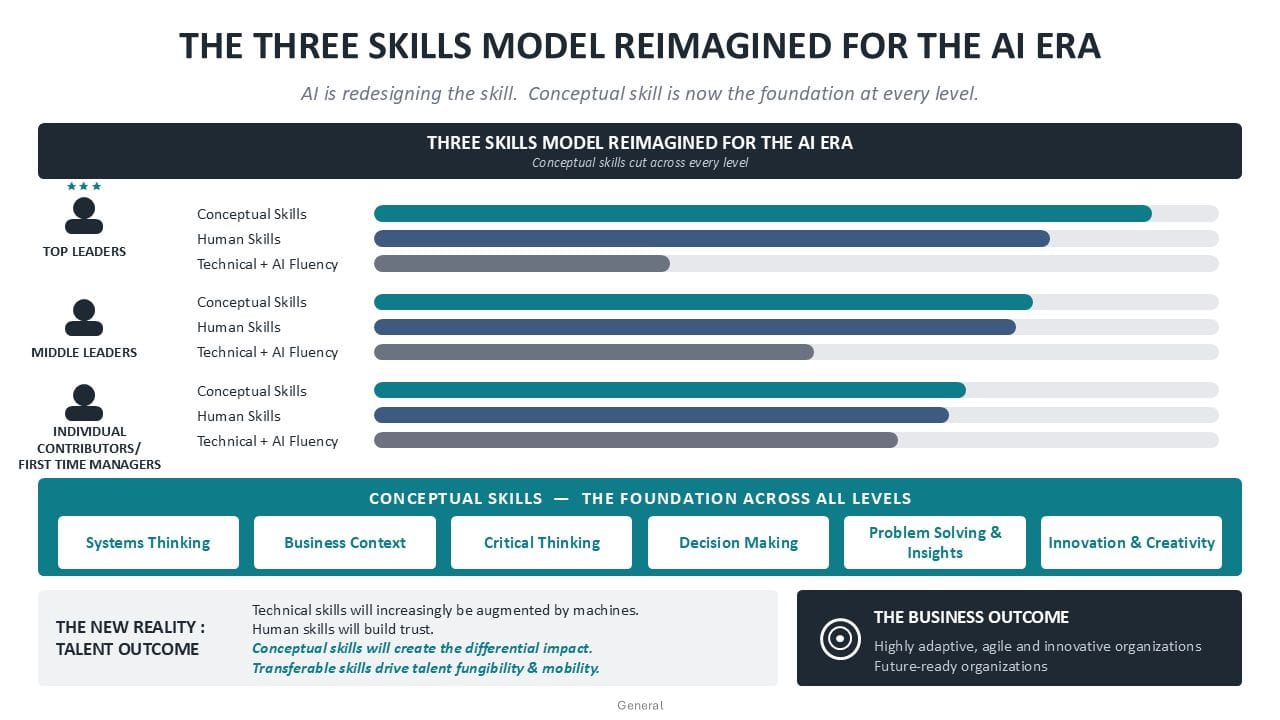
One skill that will become critical at all levels is conceptual skill. Its importance will increase, and people will be expected to have a moderate-to-high level of these skills, depending on the role and organization. At higher levels, the expectation will be stronger, since conceptual skill becomes central to strategic thinking and decision-making. Accordingly, this skill will shape performance spanning levels. This reinforces the argument that conceptual skill will sit at the center of the new skill equation.
Technical skills
Technical skills are the core abilities required to perform tasks more proficiently. Simple and redundant skills will no longer be essential. Therefore, it will be necessary to understand the industry, its context, and the business complex. For a GET, it will be important to understand the need for new technologies and their contribution toward enterprise goals. Technical skills will place a strong focus on working with technology and using it to solve problems.
They would need a deep understanding of technology to augment productivity. Using AI and digital tools effectively, while understanding the business and validating outputs, will become important. The expectation will be digital fluency, ease with technology, and automation. It will not be only about execution but execution with technology.
Human skills
Human skills are becoming increasingly important as organizations flatten. As AI replaces junior roles, it may lead to a shorter span of control, so human skills will not be limited to middle managers but will also extend to team collaboration and participation. Amid technological advances, human skills will become more critical than ever, as people will be expected to work with cross-functional teams.
Hence, empathy, collaboration, networking, and stakeholder management, along with people manager skills, will be imperative. AI may help curate feedback for the team; the individual should be able to contextualize it for the team member and the situation at hand. As organizations flatten and the need to align with cross-functional teams grows, human skills will become increasingly important from the beginning. The weightage of human skills will increase.
Conceptual skills
Conceptual skills will be all-pervasive from the beginning. A recent study published in science found that AI can boost output by up to 40% on text-based tasks, but novices who accept the machine's suggestions uncritically perform worse than those who reason through the problem themselves. Therefore, it is pertinent to demonstrate the ability to think about a solution in the context of the organization.
AI can augment work output but cannot think in the context of the organization. An individual will be expected to examine the problem, connect the dots, and consider solutions within the organization's context.
As leaders, the expectation is to demonstrate systems thinking. Pause, look at the problem, and seek solutions. Thinking will become important to grow in the hierarchy. Conceptual skills are the ability to think strategically and strike the right balance between today and tomorrow. Perform for outcomes now and constantly transform to deliver in the future.
Over time, the need for transferable skills will increase. It may not matter which industry or organization; an individual's ability to learn and apply transferable skills within the organization will become of utmost importance. Individuals will be able to apply human and conceptual skills, including empathy, stakeholder management, trust-building, adaptability, strategic thinking, and critical problem-solving. In this context, the quality of thinking and human discernment will be indispensable.
For ages, organizations differentiated people by what they knew. In the AI era, they will differentiate people by how they think. Technology and AI will increase business efficiency and productivity. Human skills will build credibility.
It is the conceptual skills- the ability to create meaning from complexity, insights from a plethora of information- that will define the new skill equation across organizational levels. The future belongs not to those who know the most, but to those who think the best.
Loading...