







Economy Policy
PM Modi urges inclusive global growth, unveils new connectivity and skills initiatives at G7






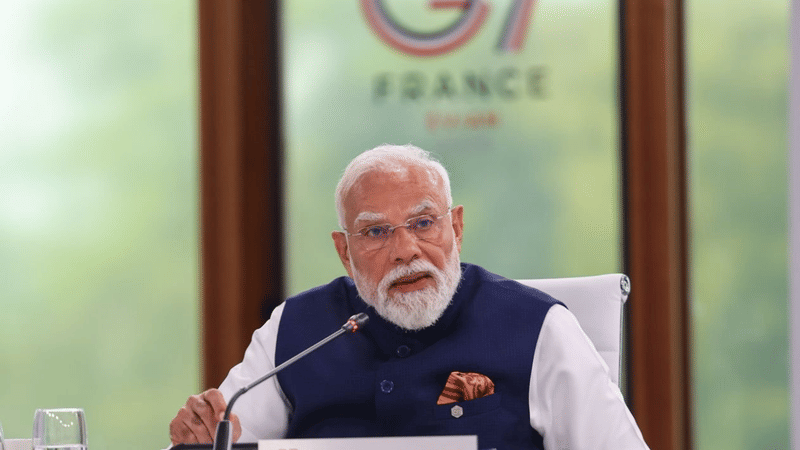
PM Modi proposed a Global Skills Partnership to connect skilled talent with ageing economies, reinforcing India’s ambition to become a global talent hub.
Prime Minister Narendra Modi used the G7 Outreach Session on “Reviving a Balanced, Shared and Sustainable Economic Growth for All” to project India as a key driver of inclusive global development, urging world leaders to focus on who benefits from economic growth rather than merely measuring progress through GDP and trade figures.
Addressing leaders at the summit, PM Modi argued that economic growth must be judged by its inclusiveness and long-term impact, especially at a time when the global economy faces geopolitical tensions, supply chain disruptions, and growing uncertainty.
“The real question is - Who benefits from this growth? Who is included in it? And what direction is it taking?” PM Modi said, framing India’s development journey as an example of how large-scale economic progress can be combined with social inclusion.
India’s growth story as a global model
The Prime Minister highlighted India's economic transformation over the past decade, saying the country’s development has been guided by the principle of “Sabka Saath, Sabka Vikas, Sabka Vishwas, Sabka Prayas” (Together with All, Development for All, Trust of All, Efforts by All).
Positioning India’s rise as a global opportunity rather than a national achievement alone, PM Modi noted that when India progresses, “one-sixth of humanity progresses with it.” He described India’s growth story as one rooted in democratic empowerment, inclusion, and scale.
IMEC at the centre of India's connectivity vision
A significant portion of Modi’s address focused on the India–Middle East–Europe Economic Corridor (IMEC), the ambitious infrastructure and connectivity initiative first announced during India’s G20 Presidency.
Calling IMEC a “historic” project, Modi said the corridor would strengthen supply chains, boost trade, and generate investment and employment opportunities across Asia, the Middle East, and Europe.
At a time when global powers are competing to shape infrastructure investment and trade routes, Modi emphasized that future connectivity projects should be based on local ownership, transparent financing, and long-term sustainability.
Warning on impact of west asia crisis
The Prime Minister also highlighted the economic consequences of ongoing instability in West Asia, warning that disruptions to fuel, fertilizer, and food supply chains continue to weigh heavily on developing economies.
He argued that the burden of such crises should not fall disproportionately on poorer nations and called on international financial institutions to create mechanisms that help developing countries absorb external shocks and maintain economic resilience.
IMPACT partnership initiatives
Seeking to move beyond existing frameworks, Modi proposed the creation of the International Mobilisation Partnership for Accelerating Connectivity and Trade (IMPACT).
Under the proposed initiative, G7 capital, Indian talent, and the participation of developing nations would be combined to build new trade and connectivity corridors across Africa, Latin America, and Pacific Island countries.
According to PM Modi, the initiative could help connect trade, technology, energy, and investment opportunities while accelerating economic integration across developing regions.
If pursued, the framework would represent another attempt by India to bridge the gap between developed and developing economies and strengthen South-South and North-South cooperation simultaneously.
Global skills partnership
Recognising demographic shifts across the world, Modi also proposed a Global Skills Partnership to address workforce imbalances.
He noted that many advanced economies are grappling with ageing populations, while countries such as India possess large pools of young, skilled talent. A structured framework for skill mapping and trusted mobility, he argued, could help both sides benefit from this demographic complementarity.
In a broader message on global economic cooperation, PM Modi stressed that India remains committed to integration rather than fragmentation. Pointing to the series of trade agreements India has signed in recent years with several G7 countries and partners, he argued that economic partnerships remain critical to global prosperity.
“India’s commitment to shared global prosperity is not confined to words alone; it is also reflected in our actions,” he said.
Topics
Author
Loading...