







Leadership
“Legacy cannot scale on individuals alone”: Haldiram’s Ashok Tyagi on building systems for growth at TechHR India 2026





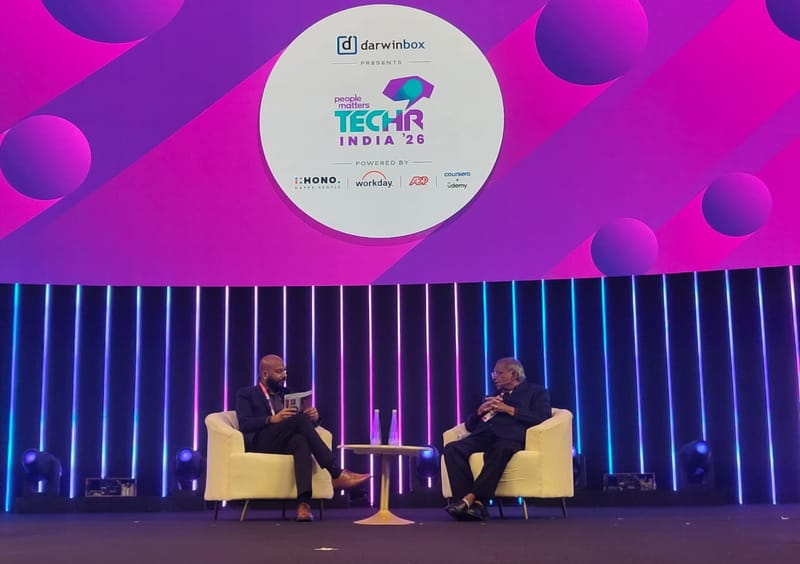
At TechHR India 2026, Haldiram Snacks Executive Director Dr Ashok Tyagi unpacked how accountability, automation, professionalisation and patient change management helped turn legacy into an engine for growth.
A heritage business faces a peculiar challenge when it begins to scale. The practices, relationships and instincts that built the organisation can be its greatest strength, but some can also become constraints when complexity multiplies.
For Haldiram Snacks, the answer was not to discard its roots in pursuit of a more “corporate” identity. It was to build systems strong enough to carry those roots into a much larger business.
Speaking at People Matters TechHR India 2026 during the session, ‘Voice Of Change: From Heritage To High Growth, The Haldiram Legacy In Motion’, Dr Ashok Tyagi, Executive Director, Haldiram Snacks, offered a candid account of what that transformation demanded: clearer accountability, phased professionalisation, automation, data-led decisions and, perhaps most importantly, the patience to bring people along.
The conversation, moderated by Varun Jain, Senior Editor – India & APAC, People Matters, surfaced a lesson relevant well beyond family businesses: transformation becomes sustainable when new systems earn the trust required to replace old ways of working.
The first transformation was accountability, not technology
Tyagi came to Haldiram in 2006 after a career that began at Wimpy International and included more than a decade across leadership roles at Uncle Chipps. Moving from professionally structured environments into a heritage, promoter-driven organisation required a different approach.
He recalled spending significant time understanding Haldiram’s culture and aligning with its leadership before trying to change it.
One of the earliest challenges was organisational bypassing. In a traditional set-up where employees had long-standing relationships with promoters, formal reporting lines could easily be circumvented. For professional management to work, Tyagi argued, responsibility and authority had to sit together.
His mandate, therefore, was straightforward: give professionals the room to operate, but hold them fully accountable for results.
That meant strengthening SOPs, KPIs, KRAs and reporting mechanisms while ensuring that management reinforced rather than circumvented the new structure.
“When there is bypassing, accountability suffers,” was the essence of Tyagi’s argument. A professional cannot be held responsible for an outcome if decisions can continually move around the role.
For leaders attempting transformation today, the implication is significant. Changing an organisation chart achieves little if the informal routes through which decisions are actually made remain untouched.
Don’t professionalise faster than the business can absorb
Tyagi also challenged a familiar assumption about professionalisation: that a family-run company must immediately recreate the full hierarchy of a large multinational.
Haldiram took a more measured route.
Rather than beginning with an expensive senior leadership structure across every function, Tyagi said the company first strengthened manager-level capability across areas such as production, HR, quality and operations.
The sequence mattered. Sales and marketing received early attention because, as Tyagi put it, growth would generate the resources needed to fund the next stage of transformation.
“My concern was: where will the revenue come from?” he recalled.
It is a deceptively simple question with a larger management lesson. Transformation has to create enough business value to sustain itself. Adding structures, technology and senior talent without demonstrating returns can quickly weaken management confidence in the change itself.
As the business grew, Haldiram could progressively invest in deeper professional capability and more sophisticated organisational structures.
Professionalisation, in Tyagi’s account, was not a one-time switch from ‘family-run’ to ‘corporate’. It was an organisational capability built in stages.
Automation was about scale before it was about savings
Technology entered the story for an equally practical reason: consistency.
“If you don't have consistency in quality, you can't become a global brand,” Tyagi told the audience.
For a food business, scale magnifies the stakes. Product consistency, food safety, hygiene and process control become increasingly difficult to leave dependent on individual skill or manual intervention.
Automation offered Haldiram a way to standardise these variables while simultaneously improving productivity and reducing operating costs. Tyagi said the investments could take several years to deliver their financial return, but cost reduction was only one part of the equation.
The more strategic return was the ability to reproduce quality and safety consistently at far greater scale.
This distinction matters in today's conversations about automation and AI. The most valuable case for technology may not begin with replacing labour; it can begin with making growth possible without compromising the standards on which the business was built.
That was also the message given to employees as automation expanded.
“We were looking at the future, not at replacing you,” Tyagi explained, describing how workers were counselled about the larger volumes and growth the company was preparing to handle.
You cannot automate resistance away
New technology, however, did not automatically create new behaviour.
Tyagi recalled resistance when digital systems such as distributor management and sales-force automation were introduced. Teams accustomed to offline processes did not immediately embrace real-time reporting and greater visibility.
Haldiram responded through a combination of training, repeated communication, pilots and time-bound adoption before bringing incentives and consequences into the process.
The important element was the transition period.
Employees were told what was changing, why it mattered and when the new process would become mandatory. Tyagi also spoke of directly engaging workers, managers and karigars to explain the benefits and address their questions.
“In any change, there will be resistance,” he said. “You need to know how to address it. If you keep working on it, that resistance gradually comes down.”
It moves the discussion beyond the fashionable language of “change readiness”. People rarely resist transformation as an abstract idea; they resist what it changes about their routines, influence, skills or sense of security.
Data made growth visible
Alongside automation came another shift: making decisions increasingly measurable.
Tyagi described bringing external market measurement into sales and marketing so the company could track category growth, market share and distribution, while making performance expectations clearer for sales teams.
Targets could then connect individual performance with what was actually happening in the market.
This was an important step in moving from intuition-led growth to evidence-led execution. For a business with decades of accumulated instinct, data did not have to replace experience. It gave leaders another way to test whether their strategy was working.
A heritage company still has to compete for tomorrow’s talent
The transformation also changed the talent proposition.
Tyagi acknowledged the challenge a family business can face when competing for younger professionals against large corporate employers. Haldiram’s response, he said, has been to show candidates not simply the strength of its brand, but its growth trajectory, philosophy, evolving systems and the opportunities available inside the organisation.
Over time, the company has also modernised employee policies and benefits as its talent needs have changed.
For employers carrying a powerful legacy, that distinction is crucial. Heritage may make people recognise a company; it does not automatically make the next generation want to build a career there.
Young talent has to see where the organisation is going and what role they can play in taking it there.
The leadership lesson: understand before you transform
Perhaps Tyagi’s most interesting observation was also his simplest. He resisted dividing workplaces into “good” multinational organisations and “bad” promoter-led ones, or vice versa. Their ways of working are different, he argued, and professionals entering them need to understand those differences before expecting the organisation to change around them.
He described the promoter as an “internal customer”: understand what the owner needs, establish alignment and then demonstrate the value of the change being proposed.
That is what makes the Haldiram story particularly relevant to the idea of leading legacy.
A legacy does not remain alive because leaders protect every process inherited from the past. Nor does growth require erasing everything that came before.
The harder leadership task is knowing what must be preserved, what must be professionalised and what must be rebuilt so the organisation can carry its heritage into its next phase of growth.
And, as Tyagi’s two decades at Haldiram suggest, that work is less about one dramatic transformation than about building trust, systems and capability - one layer at a time.
Topics
Author
Loading...