







Leadership
‘Robots may replace managers, never leaders’: Tiny Dhillon at TechHR India 2026





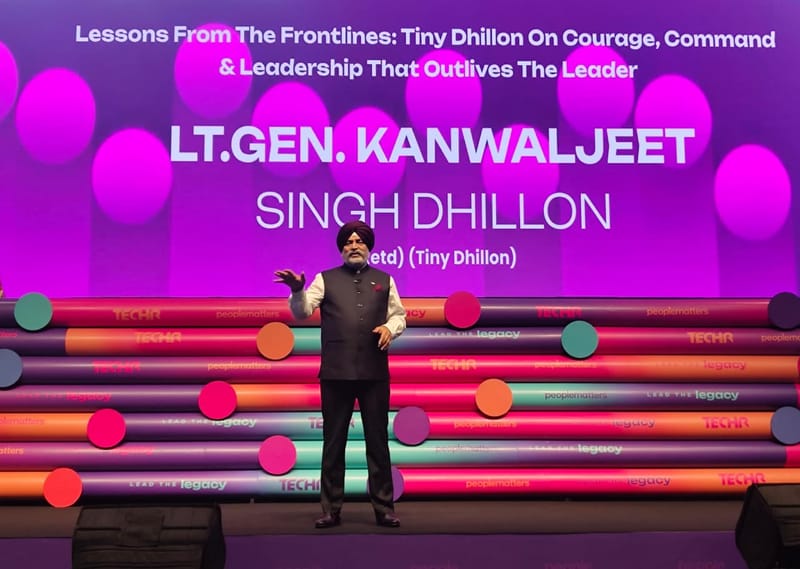
From an everyday lesson in ownership to stories forged under extraordinary pressure, Lt Gen K.J.S. 'Tiny' Dhillon showed why enduring leadership rests on trust, responsibility and the behaviours people carry forward.
One of the most compelling leadership lessons from Lt Gen Kanwal Jeet Singh 'Tiny' Dhillon at People Matters TechHR India 2026 began far away from the battlefield.
In fact, it picked up almost perfectly from the session that had just preceded his.
Amazon had been on stage moments earlier. As Dhillon stepped up, he reached for an experience involving the company—not as criticism, he was quick to make clear, but as a story about what ownership really looks like.
After retiring from the Indian Army, Dhillon had ordered a television from Amazon. The product arrived, but its installation remained unresolved despite days of emails, calls and follow-ups. Eventually, frustrated, he posted about the experience online.
Then came a call from Ratul Kapur, a former Lieutenant Colonel who had served with Dhillon in Kashmir and had subsequently joined Amazon. Dhillon asked why Kapur was getting involved when fixing installations had nothing to do with his role.
His answer became the lesson.
“When I was in the Army, the Army taught me to take ownership of the organisation I was working for,” Dhillon recalled him saying. Now that he worked at Amazon, he felt the same responsibility towards that organisation. The issue was resolved soon afterwards.
The uniform had changed. The workplace had changed. The instinct to take ownership had not.
It was an unexpectedly fitting beginning to ‘Lessons From The Frontlines: Tiny Dhillon On Courage, Command & Leadership That Outlives The Leader’—a session that moved from everyday work to some of the most consequential moments of Dhillon’s military career, yet kept returning to one central idea: leadership lasts when values become behaviours people carry forward on their own.
Leaders lead people; managers manage projects
Dhillon drew a sharp distinction between managing work and leading the human beings doing it.
“Leaders lead men and women towards the accomplishment of a mission. Managers manage projects,” he said.
His example could have come from almost any modern workplace.
A virtual meeting is about to begin. A few participants have joined while others are still arriving. A leader uses that minute to ask a colleague how her mother is doing after being in hospital. A manager uses it to ask for an update on the pending task.
Both care about the work. But one remembers the human being behind it.
Then came one of his sharpest lines for an audience immersed in conversations about AI and the changing world of work:
“Robots may replace managers. Robots will never replace leaders.”
At a technology conference, it was a useful provocation. AI can monitor activity, analyse performance, track projects and increasingly coordinate tasks. Dhillon's argument was that leadership begins where those capabilities stop: with empathy, trust, judgement and the ability to make people believe in a shared mission.
Courage is not having every answer- it is taking responsibility
For Dhillon, leadership under pressure begins with clarity of purpose.
“Selection of aim, maintenance of aim and completion of aim,” was how he described it.
He took the audience back to 2019, when he was commanding the Srinagar-based XV Corps during the period surrounding the abrogation of Article 370.
Recounting a meeting with Union Home Minister Amit Shah in the weeks beforehand, Dhillon spoke about being confronted with a fundamental question: who would take responsibility for managing what followed?
He could have asked for more time, consulted upwards or returned to his team before responding.
Instead, he recalled saying: “Sir, we will do it. I take the responsibility.”
But what followed was arguably more revealing than the declaration itself.
“I didn't do anything. My team performed. My leadership held my hand,” Dhillon told the audience.
It exposed an important distinction in how he understands command. Taking responsibility does not mean believing the leader must possess every answer. It means having enough confidence in the mission, the team and the leadership around you to stand behind the collective ability to deliver.
For business leaders navigating transformation with incomplete information, that idea feels especially relevant. Leadership is not certainty. Sometimes, it is the willingness to own a decision before the outcome is certain.
Culture is strongest when nobody needs to enforce it
The conversation became even more powerful when Dhillon moved from command to culture.
The Indian Army, he explained, lives by certain honour codes. They are more than rules, SOPs or disciplinary requirements. Their power comes from the fact that soldiers follow them because they have become part of how the institution thinks and acts.
One of those codes is uncompromising: “The Indian Army does not leave anyone behind. Not even our dead.”
Dhillon recalled an episode from the Kargil War involving a young soldier whose patrol came under fire. Wounded himself, he found himself alongside the body of his Subedar. Rather than return alone, Dhillon recounted, the soldier carried and dragged his fallen senior for days until he could bring him back.
When asked why he had endangered himself, the soldier’s explanation captured the real power of culture: he believed that if something happened to him, his comrades would never leave him behind either.
That is where a battlefield story acquires a lesson for organisations without requiring the two environments to be equated.
Culture becomes real when people trust that the values they are asked to uphold will also be upheld for them.
Most companies have values written somewhere. Far fewer have built such confidence in those values that people instinctively act on them when following the code is difficult or inconvenient.
People protect cultures they believe will protect them.
Great leaders see capability where others see limitation
Dhillon also challenged the tendency to evaluate people primarily through their deficits.
Using a judo parable about a young boy with one arm, he described how a coach turned what appeared to be an obvious limitation into a competitive advantage by deeply understanding both the athlete and the technique.
The lesson was simple: a leader must understand people's strengths and weaknesses well enough to know how and where they can perform at their best.
It is particularly relevant at a moment when organisations are rapidly rewriting roles around AI and skills. Talent cannot simply be about finding people who perfectly match an existing mould. Leadership is also about recognising distinctive capability and creating the conditions in which it can become valuable.
Never turn a failed event into a failed person
Then came perhaps the line with the greatest relevance for anyone who leads people.
“Failure is never a person. Failure is an event.”
Dhillon credited actor Anupam Kher with giving him the thought, before illustrating it with the room around him.
The microphone could stop working. The screen could fail. Something about the event could go wrong. But that would not suddenly mean the person organising it had become a failure.
That distinction sounds simple. In workplaces, it is anything but.
Organisations routinely talk about experimentation, learning and innovation. Yet people quickly stop taking risks when one failed outcome begins to define how their competence is perceived.
A person can own a failure without being defined by it.
That is an important leadership responsibility too. Resilience is not built simply by telling employees to bounce back. Leaders create it when people know that a difficult outcome will be examined, learned from and corrected without automatically becoming a permanent judgement on their potential.
“Failures will happen,” Dhillon reminded the audience. “Failures are part of a success story.”
What remains after the leader leaves?
Towards the end, Dhillon offered a deeply personal reflection on his nearly four decades in uniform.
“The Army is not a job. The Army is love. And in love, there are no challenges; there are stories.”
For workplaces, the lesson is not that employees should be expected to love their companies with the intensity of military service. The environments and stakes are fundamentally different.
What translates is the power of meaning.
When people understand why their work matters, trust the people beside them and see leaders taking the same responsibility they expect from others, something changes. Ownership becomes less dependent on instruction. Values need less policing. Teams become more willing to act when the leader is absent.
The former Army officer who stepped outside his formal remit at Amazon was, in a way, the session's beginning and its conclusion.
His commanding officer was no longer commanding him. His organisation was different. His mission was different.
But something his earlier institution had taught him about responsibility had stayed.
And perhaps that is leadership that truly outlives the leader: not how many people follow you when you are in command, but what they continue to stand for when you are no longer in the room.
Topics
Author
Loading...