







Organisational Culture
Heavy AI users are also the most collaborative, global Gensler survey finds







Employees now spend 55% of their workweek in the office, outpacing remote work, and many say they would prefer even more on-site time when workplaces better support focus, collaboration, and well-being.
Conventional wisdom suggests AI makes work more solitary, but new research from the Gensler Research Institute flips that assumption.
The report titled, '2026 Global Workplace Survey', covering over 16,400 office workers across 16 countries, finds that employees who use AI most are also the most collaborative and engaged with their teams.
It identifies 30% of respondents as “AI Power Users,” defined as individuals who regularly integrate AI into both their professional and personal lives.
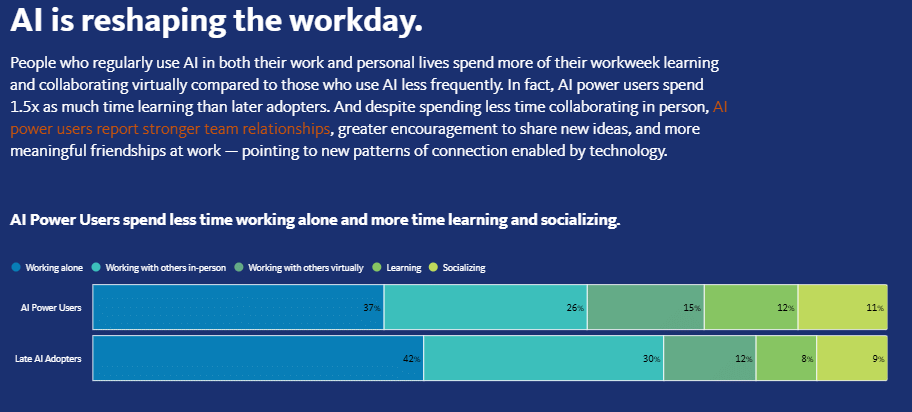
These workers report spending less time working alone, more time learning, and stronger team connections than peers who use AI less frequently.
The findings reveal that AI is reshaping the workday in ways that amplify human interaction rather than replace it. AI Power Users spend 37% of their workweek alone, compared to 42% for late adopters, and dedicate more time to learning (12% vs. 8%) and socialising (11% vs. 9%).
The survey also reinforces the enduring importance of the office. Despite remote work trends, employees spend 55% of their week in the office, with 18% at home and 26% in alternative locations such as coworking spaces or client sites. Workers expressed a desire to spend even more time on-site when the environment supports focus, collaboration, and well-being.
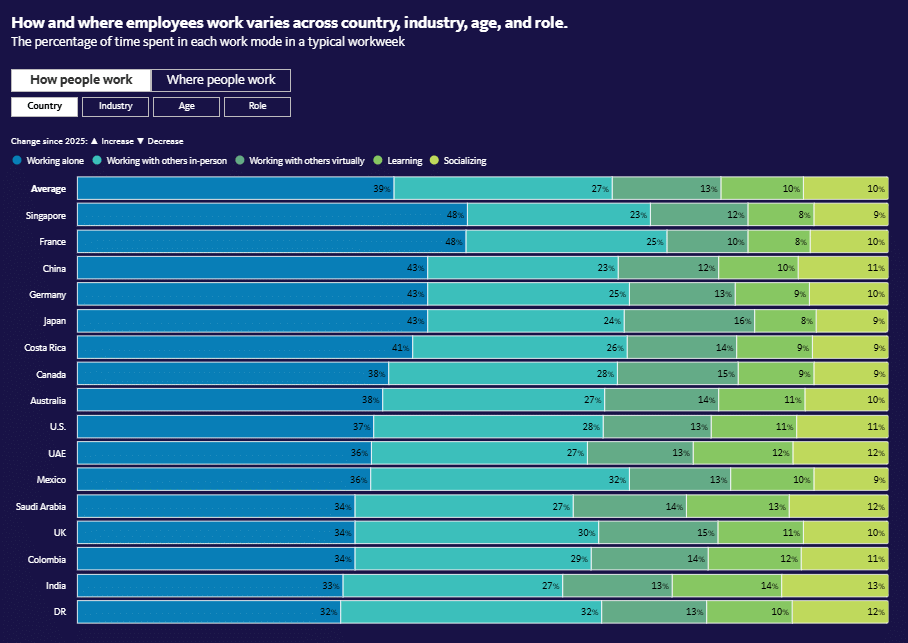
Yet workplaces still lag behind expectations. Two-thirds of employees report improvising solutions to gaps in workspace performance, from ergonomics to noise control, highlighting the persistent disconnect between how work is done and how offices are designed. High-performing environments, the survey notes, significantly enhance engagement, productivity, and retention.
As AI reshapes workflows, Gensler’s research underscores that technology and physical space must evolve together. Organisations that invest in environments fostering focus, learning, and connection are likely to unlock the full potential of both their people and their AI investments.
“We often assume that more technology means less connection,” said Janet Pogue McLaurin, Global Director of Workplace Research at Gensler. “But our data tells a different story. Employees most embedded in AI workflows are also the ones most engaged in learning and have better team relationships. That signals a new and important role for the workplace.”
Author
Loading...