







Payroll Benefits Administration
People Matters launches TRWC 2026, puts the future of pay, benefits and wellbeing on the agenda





Built around four strategic pillars and multiple learning tracks, TRWC 2026 is bringing CHROs, CFOs and Total Rewards leaders together to reshape how organisations connect pay, performance, choice, trust and employee wellbeing.
The most pressing Total Rewards question today is not how much more organisations should spend. It is what every investment in pay, benefits and wellbeing should achieve.
Employees increasingly expect visibility into pay decisions, benefits that reflect their life stage, flexibility in how they receive value and credible support for their physical, mental and financial wellbeing. Organisations, meanwhile, must retain critical talent, manage workforce costs, protect internal equity and respond to growing governance scrutiny.
These pressures are turning Total Rewards into a business-performance question.
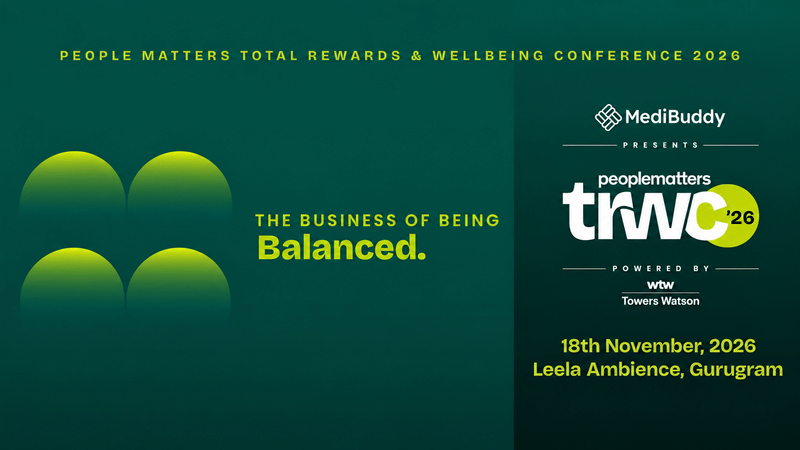
People Matters is bringing the Total Rewards & Wellbeing Conference 2026 to The Leela Ambience, Gurugram, on 18 November 2026. This year’s theme, “Orchestrating Performance in a Choice-Driven Workforce,” puts the focus on how organisations can make pay, performance, benefits and wellbeing work as one coherent system.
TRWC 2026 is moving the conversation beyond whether compensation is competitive. It is asking whether the overall rewards system accelerates performance, sustains workforce energy and earns employee trust.
The new rewards equation: Performance, fairness and choice

Total Rewards strategies have traditionally been built around market parity, consistency and cost control. These fundamentals remain important, but organisations are now confronting a more complex set of trade-offs.
How can businesses retain scarce talent without continuously increasing fixed costs? How much personalisation can they offer without fragmenting equity? Where can AI improve rewards decisions, and where must human judgement remain decisive? Can organisations pursue higher performance without steadily exhausting the people responsible for delivering it?
TRWC 2026 is bringing these tensions into the open. Rather than treating compensation, benefits, recognition and wellbeing as separate programmes, the conference is examining how decisions across these areas influence performance, fairness, trust and long-term workforce capacity.
Four strategic levers shaping Total Rewards
The conference is built around four interconnected pillars, each addressing a critical part of the emerging rewards equation.
Orchestrating Impact: Make pay a clearer performance signal
Performance-linked pay is moving beyond standard increments, broad bonus pools and short-term targets. Organisations are increasingly considering skills, role criticality, market scarcity and enterprise value when determining how contribution should be recognised.
The challenge is to create stronger performance differentiation without encouraging narrow behaviour, excessive complexity or inconsistent manager decisions.
This pillar is examining how goal-setting, feedback, differentiated pay and recognition can operate as one performance loop, giving employees a clearer understanding of what the organisation values and rewards.
Orchestrating Choice: Personalise without fragmenting fairness
A uniform benefits package cannot reflect every employee’s reality. Early-career professionals, parents, caregivers and employees approaching retirement often value very different forms of support.
At the same time, unchecked personalisation can increase costs, complicate administration and create new perceptions of inequity.
TRWC 2026 is exploring the idea of intentional optionality: offering employees meaningful choices through flexible and modular benefits while maintaining clear guardrails around cost, access and fairness. The objective is not unlimited choice, but better-designed choice.
Orchestrating Trust: Turn transparency into credibility
Employees are paying closer attention to how pay is decided, how opportunities are distributed and whether organisational claims of fairness are supported by evidence.
The question for leaders is not simply how much information to disclose. It is how to create pay architectures and communication practices that employees can understand and trust.
This pillar is bringing greater attention to structured pay communication, fairness analytics, governance and the challenge of maintaining consistency across roles, businesses and talent markets. Trust becomes a performance lever when employees understand expectations, believe decisions are fair and see a credible connection between contribution and outcomes.
Orchestrating Energy: Protect performance from human depletion
High performance cannot remain sustainable when it repeatedly consumes more human energy than an organisation restores.
TRWC 2026 is positioning wellbeing as part of performance infrastructure. The conversation is covering preventive healthcare, insurance, financial security, mental resilience, recovery, workload and manager behaviour, and how these factors influence productivity, retention and workforce capacity.
The focus is shifting from the number of wellbeing programmes offered to the measurable value those programmes create for employees and the business.
The Convergence: Put economic and human realities in the same room
The conference opens with The Convergence, bringing the rewards and wellbeing agendas together before leaders enter dedicated learning tracks.
“The Big Picture: Orchestrating Performance in a Choice-Driven Workforce” is setting the strategic context, examining how organisations can balance performance intensity with fairness, optionality with discipline and innovation with regulatory clarity.
An Economist Perspective on Economic Intelligence for People Decisions is bringing inflation, interest rates, economic growth, currency movements and healthcare costs into the Total Rewards conversation. It is helping CHROs, CFOs and Total Rewards leaders distinguish temporary volatility from structural shifts and make better-informed decisions about pay, benefits and people costs.
“The Human Energy Equation” is then connecting health, rewards and performance. The session is examining how preventive healthcare, personalised support and everyday employee experiences can strengthen resilience and help people perform sustainably.
The Vitality Room: Make wellbeing valuable, not merely available

The dedicated Wellbeing Track, the Vitality Room, is focusing on whether employees can genuinely experience the value of organisational investment in health and benefits.
“One Workforce, Many Lives” is examining how organisations can create choice across parenthood, caregiving, health, learning and retirement without compromising fairness.
“Beyond the Claim” is taking a closer look at Group Health Insurance and the wider benefits portfolio. The discussion is addressing how employers can improve access, utilisation, preventive care and employee experience while managing medical inflation and long-term costs.
The track is also exploring the financial wellbeing gap, recognising that earning an income does not automatically create confidence around debt, emergency savings, insurance or retirement.
“The Energy Balance Sheet” is asking leaders to examine whether business results are being achieved through repeatable human capacity or continuous depletion. Another discussion, “The Long Horizon,” is bringing retirement planning, benefits portability, phased career transitions and longer working lives into the Total Rewards agenda.
The Value Room: Redesign rewards for work that is changing
The Rewards Track, the Value Room, is examining how AI, skills and shifting career expectations are changing the mechanics of pay and performance.
“The Rewards Engine: Where AI Earns Its Place, and Where It Does Not” is moving the discussion beyond technology demonstrations. Leaders are examining where AI is creating credible value in salary benchmarking, pay-equity analysis, incentive modelling, benefits personalisation and employee communication, and where bias, privacy, explainability and human judgement require firm boundaries.
“The Performance Loop” is bringing goals, feedback, differentiated pay and recognition into one system so that employees receive a consistent performance signal.
“Paying for Work That Is Still Being Invented” is addressing a fast-emerging challenge: how organisations should value new skills, human-agent collaboration and roles whose business impact is still evolving.
The track is also exploring what makes people choose and stay when employers offer comparable pay, how organisations can manage different rewards expectations across traditional businesses and Global Capability Centres, and why technology, manufacturing, BFSI, healthcare and consumer businesses require different rewards responses to the same economic conditions.
The Craft Track: Convert complex questions into workable designs

TRWC 2026 is also bringing a dedicated Craft Track of masterclasses and workshops for leaders working through specific rewards challenges.
One masterclass is examining how organisations can design executive incentives that balance investor confidence, governance requirements and leadership retention. The discussion is covering proxy-adviser engagement, long-term incentive structures, performance metrics, vesting conditions, malus and clawback provisions.
A second masterclass, “The AI Career Pipeline,” is addressing what happens when entry-level tasks are automated and organisational layers become leaner. It is exploring how junior and mid-level roles must be redesigned to preserve capability building, career progression and future leadership pipelines.
The certification workshop on “The Tailored EVP” is helping leaders segment their workforce by career preferences and working styles, and build differentiated employee value propositions without weakening the organisation’s common promise.
One group, many realities: Where the conversations converge
The tracks come together for “One Group, Many Realities: The Conglomerate Rewards Challenge.”
Diversified enterprises need a common rewards philosophy, but their businesses often operate across different margins, growth cycles and talent markets. The closing conversation is examining what should remain consistent across the enterprise and where individual businesses need autonomy.
That tension captures the central purpose of TRWC 2026: creating coherence without rigid uniformity, choice without uncontrolled complexity, and stronger performance without compromising fairness or human capacity.
The next rewards playbook is not about adding more programmes. It is about orchestrating the existing system more intelligently, and ensuring that pay, performance, benefits, wellbeing and trust reinforce one another.
Explore the TRWC 2026 agenda and join the room on 18 November 2026 at The Leela Ambience, Gurugram.
Topics
Author
Loading...