







Skilling
Redefining ROI in a Skills-First Era: Measuring Competence, Capability and Business Impact





Decoding the evolving skilling paradigm and how organisations are designing new ways of measuring learning effectiveness.
As organisations accelerate AI-driven transformation, the measure of learning impact is changing. Course completions, learning hours and participation rates say little about whether employees can actually apply new skills, adapt to changing roles and deliver stronger business outcomes. The question for leaders is shifting from “Are people learning?” to “Are we building the capabilities the business needs?”
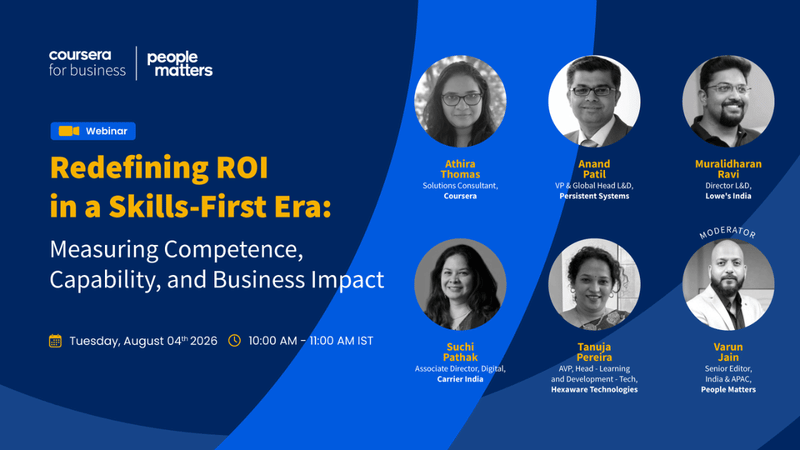
Yet despite significant investments in skills frameworks, assessments and workforce intelligence, many organisations still struggle to turn capability data into action. In a People Matters webinar, in partnership with Coursera, Anand Patil, Persistent Systems; Suchi Pathak, Carrier India; Tanuja Pereira, Hexaware Technologies and Athira Thomas, Coursera, explored how organisations can identify critical skills, build them at scale and connect learning more directly to performance and business priorities. The discussion was moderated by Varun Jain, Senior Editor, India & APAC, People Matters. This article captures the key insights from the conversation.
Accelerating time-to-proficiency through hybrid learning
As roles evolve faster, organisations need employees to become productive in critical roles sooner. At Carrier, Suchi says, workforce development draws on the 70-20-10 model: 70% through hands-on experience, 20% through targeted development and 10% through formal learning and career frameworks.
Technology is helping make that journey more targeted. AI-powered platforms and skill assessments can combine self-paced learning, manager inputs and on-the-job performance to provide a fuller picture of employee progress. More importantly, they can connect learning directly with the work employees are expected to deliver.
“The learnings are about supporting deliverables, executions and problem statements. Learning cannot happen in closed rooms; it has to go hand-in-hand with business and digital transformation strategies,” Suchi said.
From competence to capability: Defining the skills that matter
As technology rapidly reshapes roles, knowing which skills employees possess is only the starting point. Organisations also need to understand whether people can apply those skills effectively in real-world situations.
That distinction between competence and capability is becoming increasingly important. Competence reflects what an employee knows; capability reflects what they can deliver.
At Persistent Systems, Anand explains that structured proficiency levels and technical assessments help connect expertise with outcomes such as incremental billing and cost optimisation. While isolating learning’s contribution to business performance is difficult, clearer competency frameworks make the relationship easier to demonstrate.
“Incremental billing and cost optimisation are critical parameters. While it is not easy to measure business impact because multiple factors govern performance, defining clear competency levels allows us to connect expertise directly to client value,” Anand noted.
Strong skill inventories and role-based learning pathways can also improve internal mobility. When organisations can identify employees ready for critical projects, they reduce reliance on external hiring, shorten deployment timelines and create a clearer business case for learning investments.
Embedding continuous learning into the flow of work
Learning loses impact when employees experience it as something separate from their day-to-day work. Increasingly, organisations are therefore moving beyond standalone learning portals and bringing development closer to the workflow through AI assistants, communities and personalised learning experiences.
Tanuja says the approach also needs to reflect how different employee groups prefer to learn. Younger employees may gravitate towards self-directed learning, peer communities and gamified experiences; mid-career professionals may value more structured development pathways; and senior leaders often need short, highly curated insights linked to immediate business challenges.
At Hexaware, integrating learning tools directly into platforms such as Microsoft Teams has helped make development easier to access without pulling employees away from their work.
“People know what they want. When we move away from traditional portals towards agentic AI and cohort-based physical communities, we see a massive uptick because learning is integrated directly into their professional reality,” Tanuja said.
Making business leaders partners in learning impact
Proving the value of learning requires more than better measurement. It requires a different relationship between L&D and the business.
Muralidharan argues that learning teams cannot operate in isolation, designing programmes first and trying to demonstrate impact later. Business leaders need to help define the capability need, agree on what success looks like and assess whether behaviour or performance changes afterwards.
At Lowe’s, this means combining business KPIs with post-learning feedback and qualitative evidence to build a more complete picture of impact. It also requires candid conversations about shared accountability.
Rethinking ROI for the future of work
Learning ROI cannot always be reduced to a simple cause-and-effect equation. Employee performance is shaped by several factors — from manager support and opportunities to apply new skills to individual motivation and business context.
The stronger approach is therefore to combine quantitative evidence with qualitative insight. Metrics can show movement in proficiency, productivity, mobility or business performance; stories and behavioural evidence can reveal whether employees are actually handling more complex situations differently.
Learning has to include both quantitative and qualitative metrics because it is difficult to measure. We cannot show the true behavioural change of handling complex situations without bringing in data storytelling alongside scale,” Athira summed up.
For organisations navigating AI-led transformation, the goal is ultimately not to prove that learning happened. It is to show that the workforce became more capable because of it.
Author
Loading...