The race to adopt artificial intelligence is accelerating across industries. Yet many organisations continue to struggle with a fundamental question: how do they translate AI investments into measurable business value?
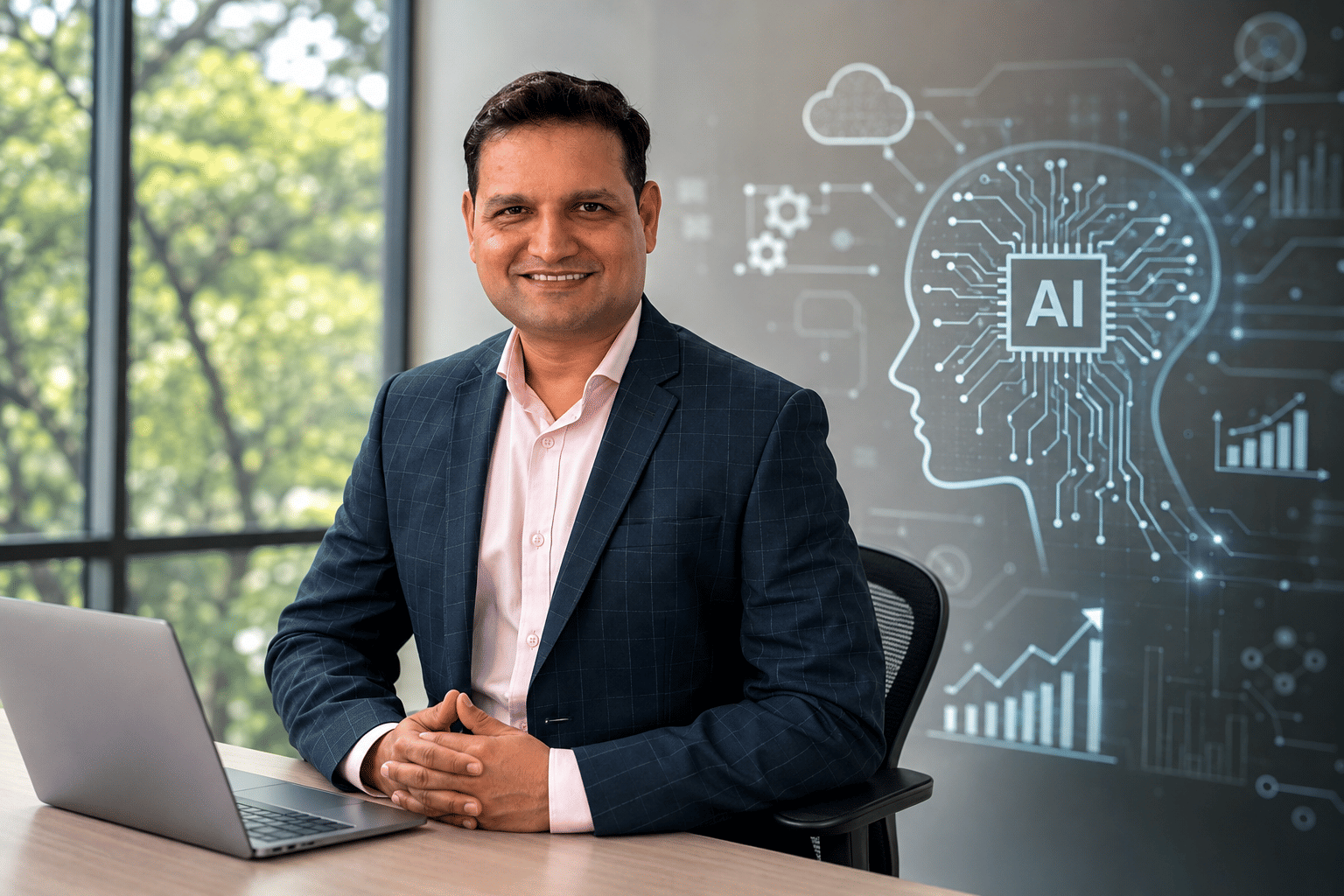
For Bhavesh Goswami, Founder and CEO of CloudThat, the challenge is not the technology itself. It is the absence of clear objectives, disciplined cost controls, meaningful success metrics and workforce adoption strategies.
Drawing parallels with the transition from traditional infrastructure to cloud computing, Goswami believes AI is following a familiar path. Organisations are enthusiastic about experimentation, but many are still learning how to govern, measure and operationalise the technology at scale. The result is rising expenditure, uncertain returns and pilots that fail to move beyond experimentation.
At the same time, he sees AI becoming a defining competitive differentiator. Companies that embed it into their operating models could gain a substantial productivity advantage. Those that fail to adapt risk falling behind.
Why enterprises are struggling to prove AI returns
According to Goswami, every major technology shift forces organisations to rethink how they operate.
"When any model fundamentally changes, it takes time for the entire environment (all the processes and systems) to adapt."
He points to the transition from on-premise infrastructure to cloud computing as an example.
"In the old model, hardware and running costs were largely fixed. You knew exactly how much infrastructure you had, and your costs were predictable."
Cloud computing introduced flexibility but also created new challenges around cost management and accountability.
"Cloud computing turned that model on its head. You could go from 100 servers to 1,000 or more during peak demand, which meant your budgeting and costing models had to evolve entirely."
He believes AI is creating a similar disruption.
"In the AI world, a developer can write inefficient code and just spin up 1,000 servers to make it look fast. So, we had to rethink how we measure developer performance."
The issue becomes more complicated when organisations adopt AI tools at scale without clear controls.
"Everyone is still figuring it out."
According to Goswami, enterprises should begin with expected business outcomes and build governance frameworks around them.
"One thing companies can do is work backwards. Start from the ROI you're anticipating and put control parameters in place to make sure costs don't spiral."
He adds: "Training people to use the right tool for the right job is just as important as the technology itself."
Adoption metrics are not transformation metrics
A recurring problem in enterprise AI programmes is the tendency to measure activity rather than outcomes.
"This one's difficult. Organisations will have to put in real, intentional effort to come up with the right metrics."
Goswami says it is easy to count users, subscriptions or API calls. Measuring actual business impact is far harder.
"It's easy to track surface-level activity: how many employees are using Copilot, how many have an OpenAI enterprise subscription, how many API calls are being made."
"But what are they actually doing with it? What productivity gains are they getting? That's where it gets hard."
He uses customer service as an example.
"If you had a chat-based support function where humans were previously responding to every query, and you've now introduced AI to handle the first few interactions, you need to measure the full picture."
For him, success should be evaluated through business outcomes rather than technology adoption rates.
"What's the reduction in chats per agent? Are your standard operational metrics improving? And critically, is customer satisfaction holding steady or going up?"
The workforce challenge behind AI transformation
While technology often dominates AI discussions, Goswami believes human behaviour remains one of the biggest obstacles to scaling adoption.
"There's an interesting human truth at play here: the thought of learning something new is exciting, but the actual process of learning is often painful."
He says organisations frequently overestimate the willingness of employees to continuously learn new skills.
"Initial enthusiasm for AI learning tends to be high. But that enthusiasm fades quickly once it has to translate into actual courses, assessments, attendance requirements, and evaluations."
According to him, two issues repeatedly undermine enterprise AI programmes:
- Poor employee upskilling
- Lack of clearly defined objectives
"The second major gap is not having clear objectives from the outset."
As AI investments increase, leadership teams inevitably demand evidence of value.
"When AI adoption begins and costs start rising, leadership will inevitably ask: What are we actually getting out of this?"
"If there's no clear objective defined and no tracking in place, it becomes very hard to justify the investment."
He warns that AI initiatives become vulnerable during leadership transitions when measurable outcomes are absent.
"If there's any leadership change during that period, AI initiatives become the easiest thing to cut. The spend is visible, but the value isn't."
Why many AI pilots never scale
Many organisations successfully complete proof-of-concept projects but fail to move beyond experimentation.
For Goswami, the root cause often lies in planning failures rather than technological limitations. "It comes back to the same issue: not defining objectives before you begin."
He says organisations frequently abandon programmes when early friction emerges.
"Rather than having the confidence to stay the course, they pull the plug."
Instead, leadership teams should establish acceptable trade-offs before deployment.
"We expect some complaints during the transition period, and that's okay."
"We're comfortable with a certain level of human escalations, as long as overall satisfaction stays steady or improves."
The second challenge is financial. "The second common reason pilots don't scale is budget miscalculation."
He explains: "A POC with 10 developers might go really well, but if you haven't properly extrapolated what the cost looks like at 1,000 developers, you're in for a shock when the actual implementation cost lands."
His advice is straightforward. "You need to understand the full-scale cost model before you fall in love with the results of your pilot."
Creating pull instead of pushing adoption
Beyond training, Goswami believes organisations need to create internal motivation for AI adoption.
"AI transformation is going to be a hard push unless you build in a pull model as well."
Drawing from enterprise training programmes delivered by CloudThat, he says many employees remain unconvinced about AI's relevance to their roles.
"They need a reason to believe it matters for their specific role."
According to him, generic awareness campaigns are rarely effective. "Role-specific relevance does."
He advocates making adoption visible inside organisations. "Benchmark adoption rates across teams, make the data visible, and celebrate the people who are doing well."
He also emphasises recognition. "Recognise employees who complete assessments or hit adoption milestones."
"When people see their peers achieving something, they naturally want it too."
Without this approach, organisations risk fighting resistance continuously. "That pull is essential."
Define value before deployment
When asked how organisations should evaluate AI investments, Goswami repeatedly returns to one principle: establish success criteria before implementation.
"The key is that these indicators need to be defined before implementation, not after." He says the metrics will differ depending on the business objective.
Potential measures include:
- Cost reduction
- Customer satisfaction
- Faster response times
- Brand engagement
- Conversion rates
- Operational efficiency
"What matters is that you decide upfront which metrics you're optimising for and then build your measurement framework around those."
His conclusion is clear. "Define the metrics first, implement second."
The competitive divide is only beginning
Looking ahead, Goswami believes AI could create a competitive gap similar to the one created by computers decades ago.
"At worst, the productivity gains from AI will make non-adopters completely non-competitive." He points to historical examples where businesses failed to adapt to technology shifts.
"When computers became mainstream, any accounting firm that kept doing things by hand eventually became unviable."
"Not because they were doing something wrong, but because the efficiency gap became so large that they simply couldn't compete." He sees AI as a comparable inflection point.
"AI has the potential to be a similar inflection point."
"If you don't get on board, the operational gap between you and your competitors could become so significant that survival itself becomes difficult."
Even organisations that remain viable without AI may face long-term disadvantages. "They might survive, but they'll be less efficient, less profitable, and grow more slowly than their peers."
For Goswami, the organisations most likely to succeed will be those that move beyond experimentation and treat AI as a core business capability rather than a standalone technology initiative.
"The companies that come out ahead will be those that treat AI not as a technology experiment, but as a fundamental shift in how they operate, and invest accordingly."