For years, the conversation around women at work has centred on representation, skilling and policies. Organisations have invested in diversity targets, leadership programmes and governance frameworks, yet the question of why women continue to fall out of the leadership pipeline remains.
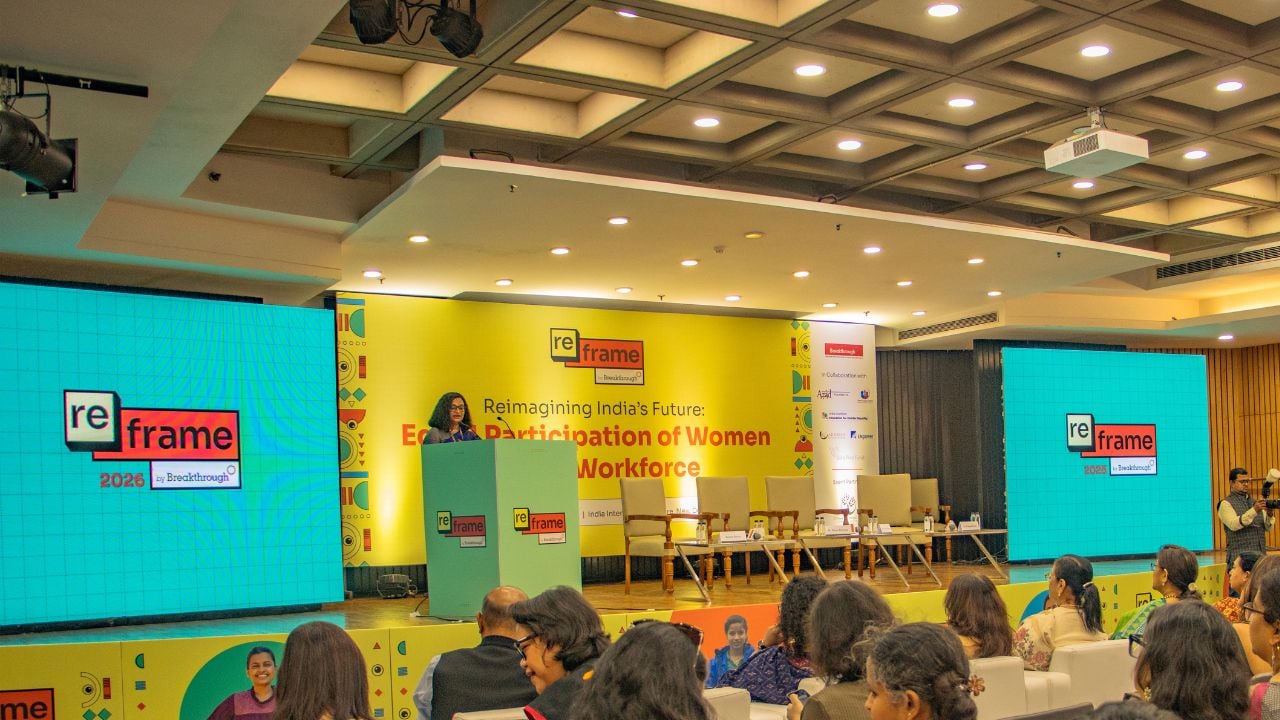
The challenge, as conversations atReframe 2026, Breakthrough’s flagship annual summit, brought into focus, is not simply about preparing women for work. It is about examining the systems that determine whether they can access opportunities, exercise agency and build careers on their own terms.
Bringing together perspectives from government, business, philanthropy and civil society, the summit explored the structural barriers that shape women’s economic participation—and the collective action needed to address them.
The message was clear: an equal world for women cannot be built through policy intent alone. It requires a shift in how institutions, workplaces and communities create opportunity.
The leadership pipeline is a systems challenge
One of the central questions for organisations is why women continue to be underrepresented in leadership despite years of investment in gender diversity.
The answer begins much earlier than the C-suite.
Dr. Renu Swarup, Hon’ble Former Secretary, Department of Biotechnology, Government of India, emphasised the importance of building a strong base of women talent, rather than focusing only on increasing representation at the top.
Leadership development, she noted, must go hand in hand with confidence, capability and access to opportunities. Women need to be groomed for leadership, but they also need the space to voice their views, take on challenging assignments and be evaluated on their potential—not gendered assumptions.
This raises an important question for HR leaders: are organisations building a leadership pipeline, or simply trying to fill one?
The distinction matters. If women are excluded from certain roles because of assumptions around safety, availability or suitability, the pipeline narrows long before leadership decisions are made.
For organisations, creating a level playing field means ensuring that opportunity is not restricted by gender—and that women are supported to progress through every stage of their careers.
Workforce participation is not a skilling problem alone
While skilling remains an important part of enabling women’s economic participation, the conversations at Reframe 2026 highlighted why it cannot be the sole answer.
Nayana Chowdhury, Chief Executive Officer, Breakthrough, brought attention to a critical distinction: the barriers that enable women to enter the workforce are not necessarily the same as those that determine whether they stay and thrive.
Family support and the sharing of care work can influence whether a woman is able to join the workforce. Once she enters, however, equal treatment, fair pay, supportive managers and opportunities for career growth become critical to her continued participation.
This is where the conversation shifts from employability to the employee experience.
Organisations may invest in bringing women into the workforce, but without examining the conditions that shape their careers, the leadership pipeline will continue to narrow.
For HR, the opportunity is to look beyond entry-level representation and understand what happens after women join. Are they receiving meaningful assignments? Are they being considered for advancement? Do they feel empowered to speak up and take risks?
These are not peripheral questions. They are central to building a workforce where women can progress.
From intent to implementation
The summit also brought attention to the role of institutions in translating gender equity from an aspiration into action.
Vandana Chavan, Former Member of Parliament, Rajya Sabha, Former Mayor, Pune and Founder, Pune Climate Warriors, shared perspectives from her work in creating opportunities for women through grassroots initiatives.
Her experiences highlighted how locally relevant models can create meaningful pathways for women’s economic participation when supported by the right institutional ecosystem.
But successful models also need sustained resources, collaboration and implementation support to scale.
This has implications for businesses. Supporting women’s empowerment cannot be reduced to funding a programme or fulfilling a CSR mandate. Organisations also possess expertise that can help strengthen women’s economic opportunities.
The Smile initiative, for instance, illustrated how practical support around marketing, branding and business skills can help women navigate economic participation with greater confidence.
For HR leaders, this opens up a broader role for employee engagement—one where employees can contribute their knowledge and capabilities to communities beyond the workplace.
The opportunity is to move from contribution to participation, and from isolated initiatives to sustained engagement.
Building an ecosystem of change
A recurring theme across the conversations was that women’s workforce participation is too complex an issue for one organisation or sector to solve alone.
Government institutions, businesses, civil society organisations and skilling partners each bring different capabilities to the table. The challenge is to connect them.
Chowdhury emphasised the importance of collaboration between organisations working across different parts of the problem. Skilling organisations may build professional capabilities, while development organisations can support the social and interpersonal skills required to navigate workplaces and family expectations.
This also calls for a shift in how organisations think about workforce readiness.
Technical skills matter, but so do the ability to negotiate, communicate and navigate workplace relationships. These capabilities often determine whether women can translate aspirations into sustained participation.
For businesses, collaboration therefore becomes more than a social impact opportunity. It is a way to strengthen the broader ecosystem that supports women’s economic participation.
The role of HR: From policy owners to ecosystem enablers
The conversations at Reframe 2026 offered HR leaders a clear takeaway: gender equity must move beyond policy ownership and representation metrics.
It must become part of how organisations design work, develop talent and build leadership.
That means creating pathways for women to progress, ensuring equitable access to opportunities and challenging assumptions that restrict their participation.
It also means recognising that inclusion cannot be delivered by HR alone. Managers, senior leaders and employees all play a role in shaping the experience of women at work.
Chowdhury’s emphasis on activating bystanders offers a useful lens here. Creating change does not always require a formal programme. It can begin with individuals challenging bias, supporting women’s aspirations and creating space for more equitable participation.
The larger opportunity is to make gender equity a shared responsibility—one that extends from organisational leadership to everyday workplace behaviour.
Reframing the conversation
Reframe 2026 brought together a set of insights that point towards a broader shift in how women’s workforce participation must be understood.
The conversation is no longer only about how to bring more women into the workforce. It is about building the conditions that allow them to stay, grow and lead.
For organisations, this means moving beyond the question of whether the right policies exist, and asking whether those policies are translating into meaningful opportunity.
It means investing in the pipeline early, examining the systems that shape career progression, and collaborating across sectors to address the barriers that women face.
Most importantly, it means recognising that the aspirations of women and girls are not the problem. The larger question is whether the systems around them are equipped to support those aspirations.
An equal world will not be built by intent alone. It will be built when institutions, workplaces and communities take responsibility for turning that intent into opportunity.
And that is the shift Reframe 2026 calls for: from policy to practice, from participation to progression, and from individual effort to collective action.