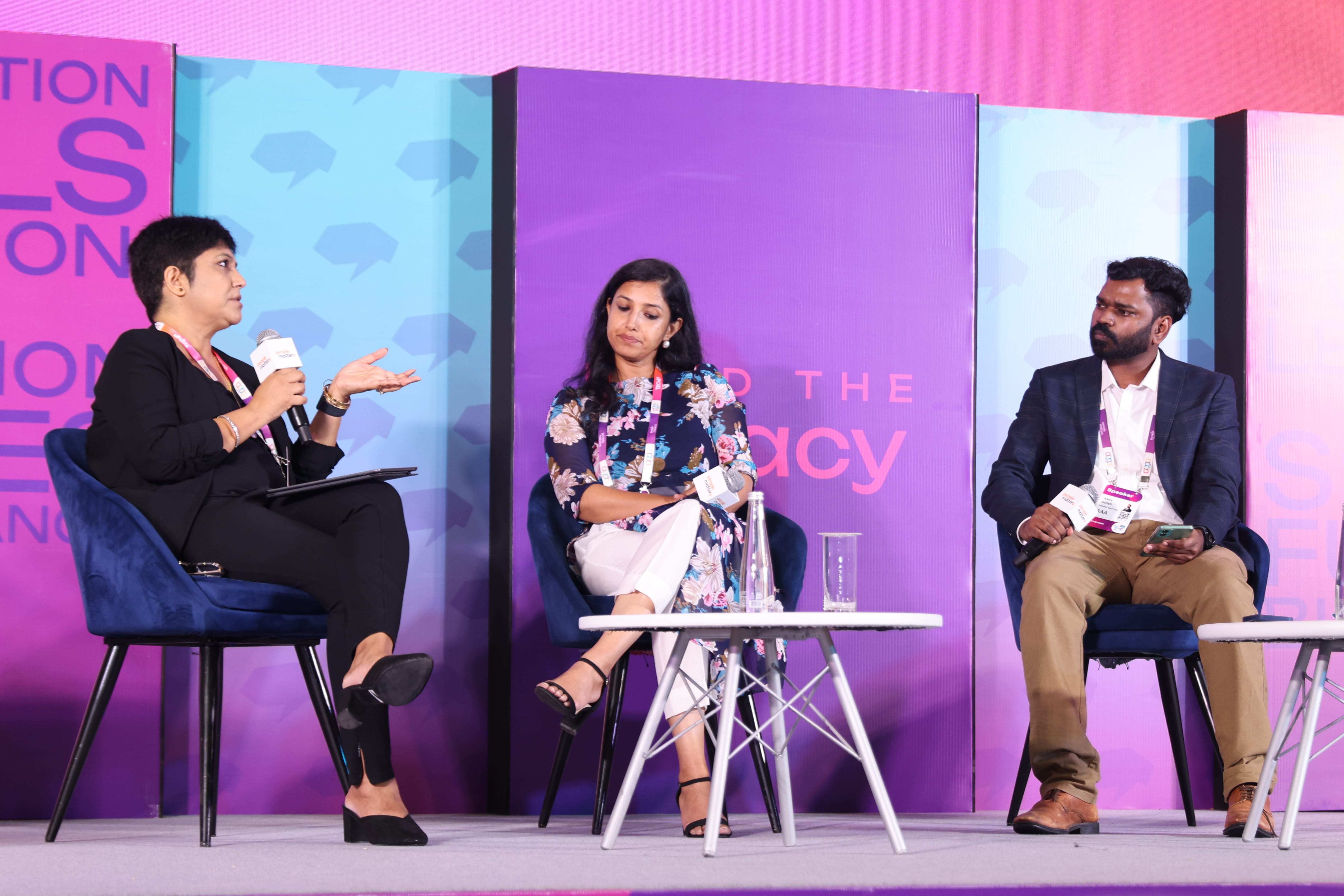
Diversity, equity and inclusion (DEI) started off as a well intentioned effort from HR. Now it is evolving into a journey that many progressive organisations are embarking upon. Businesses have started taking into consideration the importance of diversity and a balanced workforce that can help them in their outcomes. People Matters hosted Meenakshi Corenelius, Head of HR, JLL India and Swetha Joseph, Director, Diversity, Equity and Inclusion practice, Aon, for a panel discussion at TechHR India to discuss how DEI experiments are getting scaled at organisations.
Evolution of DEI
DEI programs have seen much change since they were introduced as a well intentioned HR effort. They are now moving from tracking representation to tracking outcomes. These outcomes could be around growth, progressions and cultural shifts for diverse talent groups. Swetha Joseph, Director, Diversity, Equity and Inclusion practice, Aon, notes, “There is a renewed focus on making DEI a part of the business agenda, not just something that sits with HR, but making it a part of business strategy.”
Organisations are also moving ahead. There has been an increase in the number of female participation in the workforce, every gender now has an equal right to work from any place. However conversations also need to shift. Organisations have to move away from compliance based actions for DEI and understand the problems at a deeper level. Meenakshi Cornelius, Head of HR at JLL india says, “Organisations need to ask whether a person is feeling included when they are at work, are persons with disabilities getting accommodated at the workplace and feel welcomed and wanted?”
Challenges to DEI Programs
The top challenge for any DEI effort is to look beyond a compliance checkbox and start thinking about how it can play a larger role in business strategy. Additionally, most DEI efforts are narrowly focused at gender and do not consider the broad lens of all under represented groups at the workplace. Swetha Joseph, Director, Diversity, Equity and Inclusion Practice, Aon, says, “Broadening the lens of diversity and looking at intersectionality across different groups where challenges encountered are different for different people, could be an area for companies to focus on.”
Driving Accountability from Leadership
Organisations are presently following a quota based approach for their DEI goals. While this may work for early efforts, it is not solving the problem at the core. In any organisation, the DEI efforts start showing improvement when the CEO takes the ownership, but it has to cascade at lower levels as well. Tying it to the business outcomes and defining the goal itself- whether it is representation, progression or culture creation- top leadership can drive the outcomes when they get involved actively. There is considerable cost of inaction, as a well-balanced workforce enables better client satisfaction and employee experience for the organisation. Meenakshi Cornelius, Head of HR at JLL India says, “Organisations need to start making statements and take actions that push down the message strongly. They have to take actions that they genuinely believe in.”
Behavioural Aspects for Leadership
Leaders need to lead by actions, and walk the talk. While they could begin small by sponsoring DEI programs and taking up mentorship engagements, the broader change occurs when leaders create a value system that targets bias and promotes meritocracy. This can be reflected in their hiring practices, talent management practices and ensure that a balanced workforce is accepted by all. It is the prerogative of the leaders to be the role model and imbibe and showcase the values of the organisation in order to make successful DEI interventions.
Role of Technology
While technology works as a great enabler for levelling the field for everyone through accessibility, there are concerns that have to be addressed. In AI based use cases in hiring and talent management, a key challenge is to reduce the bias in decision making. This is solved by setting proper criteria for the algorithm and data inputs for the algorithm to train itself. Additionally, the people working on these algorithms should also have a good representation so as to make sure every nuance is considered while designing the system. Swetha Joseph, Director at Diversity, Equity and Inclusion practice, Aon, says, “We need to ask ourselves how we are training AI. Are the biases in our society getting into these systems and are there enough underrepresented groups shaping these systems?”
Path Forward
Swetha Joseph, Director at Diversity, Equity and Inclusion practice, Aon, says, “Organisations have to lead with aspirations and break benchmarks. We have to make DEI part of the business strategy, it has to be a part of day to day culture. “ Organisations have to understand that business outcomes are dictated by the effectiveness of the workforce. Having a good balance in the workforce enables them to amplify their capabilities, spot any blind spots and promote a superior employee and client experience. Meenakshi Cornelius, Head of HR at JLL India, concludes, “If all of us start making a difference to someone’s life at the workplace everyday, it's a big thing. It brings in inclusion, it brings in equity and brings winning teams together.”